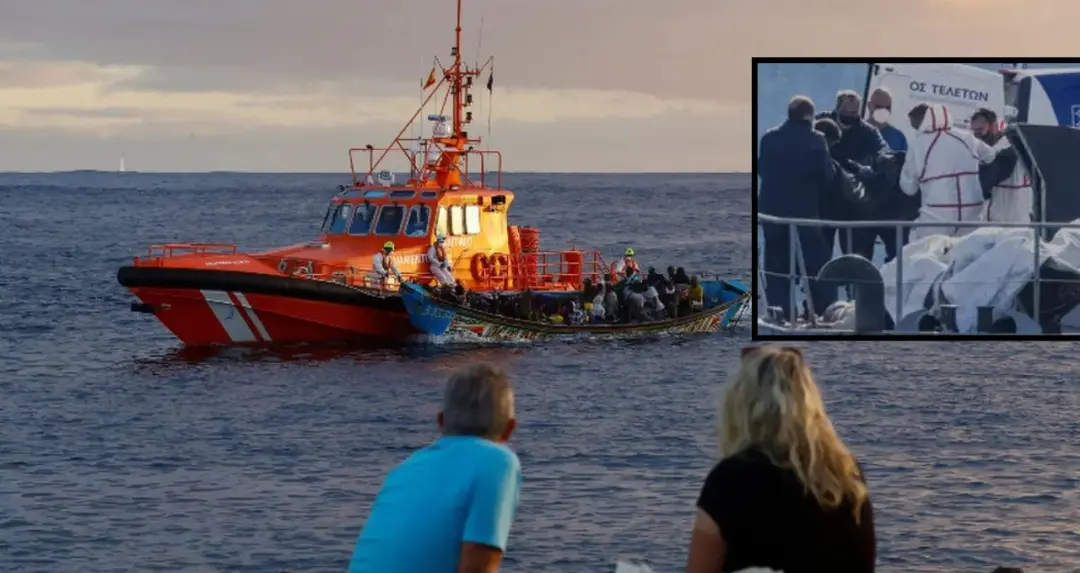
1,488 migrants were rescued in Spain's Canary Islands on Saturday. These people had crossed the Atlantic Ocean in 14 boats. The arrival of so many people in one day is the biggest figure after 2020. These also include women and children.
Madrid: Spain's Canary Islands recorded a record number of migrants on Saturday, November 14, 2026. Spain's maritime rescue service brought 1,488 people who arrived by sea from West African countries safely to shore. All of them were in 14 different boats. This is the biggest case of so many migrants being rescued within a day in the last six years. Due to the sudden arrival of a large number of people, the pressure on relief and health services on small islands has also increased.
Six years old record broken, 1488 migrants arrived in one day
A total of 1,488 migrants were rescued in 14 boats around the Canary Islands on Saturday, Spanish news agency EFE quoted the maritime rescue service as saying. This figure is higher than the previous record made in November 2020.
Earlier on 7 November 2020, 1,461 migrants were rescued in a single day near the Canary Islands. Now after almost six years this record has been broken.
There has been an increase in the number of boats coming from West Africa since October. Migrants continue to arrive in November also.
A large number of those who arrived on Saturday were migrants who had left by sea from West African countries like Senegal, Gambia and Guinea.
Many people traveled for several days in small boats. These boats had more passengers than required, which increased the risk of sea travel.
There were 240 people in a boat, including children
One of the boats rescued on Saturday was carrying 240 people. These included 12 women and 36 children.
According to officials, most of the people aboard this boat came from West African countries. The rescue team brought them safely from the sea to El Hierro Island.
El Hierro is among the smaller islands of the Canary Islands group. The population here is about 11 thousand. In such a situation, it is natural for hundreds of people to arrive in a single day to increase the pressure on local systems.
During the rescue operation, after bringing the people ashore, their health needs were assessed.
Some migrants needed medical assistance. The local administration and relief agencies made necessary arrangements for them.
Most boats reached El Hierro
Of the 14 boats rescued on Saturday, 12 reached the island of El Hierro, according to Spain's maritime rescue service.
Apart from this, one boat was delivered to Gran Canaria and the other to the island of Teneriffe.
According to local reports, about 1,235 migrants arrived in El Hierro on Saturday. The rest were evacuated to other parts of the Canary Islands.
La Restinga port in El Hierro is where migrant boats arrive and disembark safely.
In recent times, boats have been continuously arriving here. This is putting additional pressure on ports, temporary shelter centers and health services.
Spanish minister will visit El Hierro on Sunday
The Spanish government is also monitoring the situation after the arrival of migrants in large numbers.
Spain's Regional Policy Minister Angel Victor Torres is scheduled to visit El Hierro for Sunday, November 15.
During this, he will talk with local officials regarding the increasing arrival of migrants and necessary facilities.
The biggest challenge before the government is to arrange temporary stay, medical aid and further administrative process for the people rescued from the sea.
Due to limited resources on small islands, it may be difficult to accommodate large numbers of migrants for long periods of time.
Why is the route from West Africa to Canary Islands dangerous?
Migrants from West Africa have to cross the Atlantic Ocean to reach Spain's Canary Islands. This journey is not easy. During a journey lasting several days at sea, people have to face problems like bad weather, high waves and boat damage. For this reason this route is considered extremely dangerous for migrants.
Every year, large numbers of people leave the coastal areas of Senegal, Gambia and Mauritania in boats in the hope of reaching Europe. There are many such boats in which there is less seating space, but the number of passengers is more.
Many times even the items required for long sea journeys are not available in the boats. The problem increases when drinking water and food items run out. If the engine stops in the middle of the sea or the boat loses its way, it can take a long time to get help.
The International Organization for Migration i.e. IOM has also been expressing concern about the accidents happening on this sea route. According to the organization, many migrants have lost their lives in this part of the Atlantic Ocean, while many remain unaccounted for.
Why do migrants start increasing in the Canary Islands after October?
The number of boats sailing to the Canary Islands varies during different months of the year. Around October, weather and wind conditions change in some maritime areas of West Africa. At such times some people try to cross the sea.
However, just because the weather has become slightly favorable does not mean that the sea route has become safe. The weather may deteriorate suddenly in the Atlantic Ocean. Such a situation can prove to be very dangerous for those traveling in small boats.
In recent times the movement of migrants towards the Canary Islands has intensified. In many countries of West Africa, limited employment opportunities and economic problems motivate people to move to other countries. Some people want to go to Europe for a better life for their family.
At the same time, many people leave their homes due to the situation in their country. However, the reason for leaving the country may be different for every person. Therefore, it would not be correct to consider all migrants as going to Europe only in search of jobs.
Record arrivals in one day, but what do the figures for the year tell?
News of the arrival of a large number of migrants in the Canary Islands came to light on Saturday. A six-year-old record was broken with nearly 1,500 people coming in a single day. However, if we look at the data from January to October, the picture appears different.
According to Spanish government data, 13,327 migrants arrived in the Canary Islands by sea between January 1 and October 31, 2026. Last year, in the same ten months, 14,099 people came here.