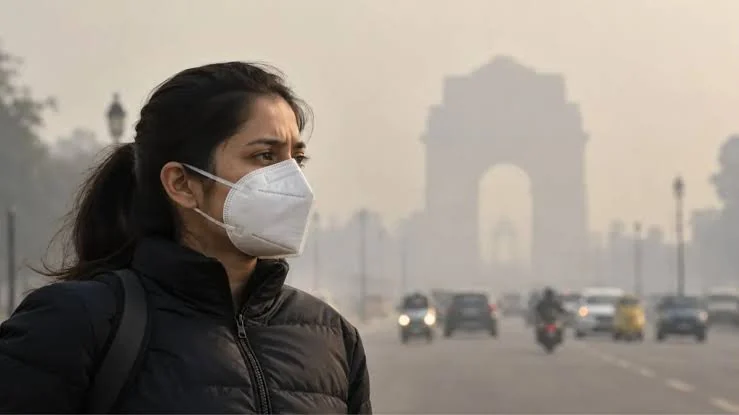
To avoid pollution, people use N-95 masks while going out of the house, but there are some very tiny particles present in the air, which are not easy to protect against. These particles are smaller than PM2.5 and can reach deep parts of the lungs through breathing. These are known as PM1. Due to the extremely small size of PM1 particles, regular monitoring of them is also challenging. A private sensor in Delhi has recorded levels of these particles as high as 100 micrograms per cubic metre, raising concerns over air pollution.
PM1 means extremely small particles of one micrometer or smaller in size, which are not possible to see with normal eyes. Due to their small size, they can reach deep parts of the lungs through breathing. According to data from global private sensor network PurpleAir, PM1 levels were recorded at 100 micrograms per cubic meter at 3:28 pm on November 14 at Malcha Marg. At the same time, its 10-minute average was 89.2 micrograms per cubic meter. In October this year, manual testing of PM1 has also been started in Atal Lab of IITM. However, data from this monitoring is not yet available on the Decision Support System (DSS).
The country's first PM1 monitoring station was installed in Delhi 8 years ago.
The initiative to monitor PM1 pollution was started in the country about eight years ago. On 21 July 2018, SAFAR's air quality monitoring station was started near Town Hall, Chandni Chowk, Delhi. Developed by IITM Pune, this was the first station in the country where along with PM1, mercury, black carbon and UV index were also monitored in real time. Earlier in the year 2016, the Central Pollution Control Board (CPCB) had also planned to start monitoring of PM1 in big cities. However, despite this, till date the government data related to PM1 is limited and a comprehensive network of its regular monitoring has not been developed.
Follow the LALLURAM.COM MP channel on WhatsApp