
AI agents are becoming increasingly capable of interacting with software, but many businesses depend on older portals that lack modern APIs. Technicians must log in, navigate menus, update records and complete repetitive actions manually.
Shield Technology Partners believes OpenAI's GPT-6 Astra can help remove that bottleneck through its Forge platform, allowing AI agents to perform supported browser-based tasks while technicians focus on more complicated problems.
OpenAI highlighted the implementation in a customer story published on November 13, 2026. Shield reports that GPT-6 Astra executes computer-use tasks 35–40% faster on average than the older models it previously used.
However, Shield’s separate October 30 evaluation of difficult IT support tickets presents a more complicated picture of AI automation. The speed improvement and ticket pass rate measure different workloads and should not be treated as directly comparable performance results.
How GPT-6 Astra Helps Shield Automate Legacy IT Systems
Shield developed Forge as an AI operating system for managed IT service providers, commonly known as MSPs. These companies manage technology infrastructure, troubleshoot employee issues, handle software access and maintain systems for other businesses. Their technicians frequently work across multiple portals that manage support tickets, devices, software licences and customer information.
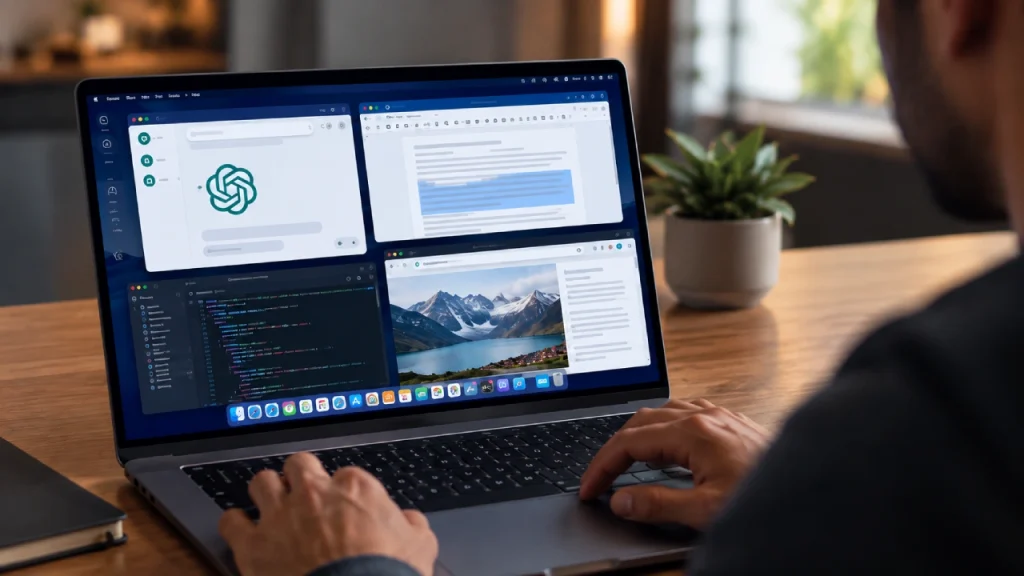
Within Forge, the AI Engineer assigns supported work to a computer-use agent, with GPT-6 Astra handling interface navigation. The model reads what appears on the screen, clicks buttons, enters information and moves through supported browser workflows. Shield says this capability helps agents work across systems that previously required human intervention because they lacked API access.
The distinction matters because computer-use automation does not require every older business application to be rebuilt or connected through a modern API. Instead, an agent can interact with supported interfaces much like a technician would. However, the ability to navigate a portal does not automatically mean an agent understands every customer requirement or operational rule associated with a task.
Shield Reports 35–40% Faster Computer-Use Workflows
According to Shield Head of Technology Mayank Jain, GPT-6 Astra performs computer-use tasks 35–40% faster on average than the older models the company had tested. Shield also reports fewer failures and timeouts, along with less time spent writing detailed instructions or guiding agents through tasks.
These figures concern computer-use execution, not the success rate of the separate 52-ticket benchmark. Shield says its browser workflows are already live, generating thousands of runs each month across its IT service providers.
Technicians retain control over what agents can do by determining which actions can be performed independently and which require review or approval.
Phone calls, on-site work and remote-desktop tasks continue to involve human technicians. Shield is still testing more complex desktop automation. This suggests the current deployment is focused on supported browser-based work rather than replacing technicians across the entire IT support process.
The 52-Ticket Benchmark Reveals AI’s Reliability Gap
Shield’s October 30 benchmark provides a useful counterpoint to its OpenAI customer story. The company evaluated 57 model configurations against 52 challenging IT support tickets that its Forge AI Engineer had previously handled incorrectly. GPT-6 Astra with extra-high reasoning achieved the highest pass rate, completing 32 of the 52 tickets successfully. That translates to 61.5%, leaving 20 tasks unsuccessful.
However, Astra’s lead was narrow. Its extra-high reasoning configuration completed only one more ticket than GPT-6 Astra at high reasoning and Claude Opus 5.5 at maximum reasoning. Both competing configurations passed 31 of the 52 tickets, recording a 59.6% success rate.
| Pass rate | Passed / Failed | Cost per ticket | Average time | |
| GPT-6 Astra (xhigh) | 61.5% | 32 / 20 | $7.60 | 19.9 min |
| GPT-6 Astra (high) | 59.6% | 31 / 21 | $7.10 | 16.9 min |
| Claude Opus 5.5 (max) | 59.6% | 31 / 21 | $8.30 | 22.4 min |
The results show that Astra’s extra-high reasoning configuration ranked first, but the difference between the three leading configurations was only one successful ticket. The higher reasoning setting also came with greater cost and execution time than Astra’s high setting. These figures make it difficult to describe the result as a decisive performance advantage.
There is another important limitation. Shield’s evaluation used its proprietary testing framework, with technicians and engineers defining the ideal outcome for every ticket. A human reviewer also verified the completeness and accuracy of the language-model judge’s pass-or-fail assessment. The costs and execution times do not include human verification, corrections or follow-through.
The 61.5% result should therefore not be interpreted as GPT-6 Astra’s overall IT support success rate. The test deliberately focused on 52 challenging tasks that had previously failed, rather than the broader range of routine tickets handled in production.
More importantly, Shield found that technical execution alone was not enough to establish a successful resolution. Agents sometimes completed difficult technical work but failed to follow a customer’s instructions or an established procedure.
In one example, an agent responded to a request for a phone call about computer problems by attempting to arrange remote maintenance instead. In another, an agent recognised the documented process for creating a new employee’s accounts but proposed only the Microsoft 365 setup, overlooking the required Active Directory account.
These examples expose a more complicated reliability problem than simply failing to click the right button. An agent may identify a technical solution and still take the wrong operational route. For IT providers, respecting customer preferences, following documented procedures and knowing when to escalate are all part of completing a ticket correctly.
What GPT-6 Astra’s Integration Means for Indian IT Service Providers
For Indian MSPs and IT service providers, browser-based agents could eventually help reduce repetitive work across older business applications.
That may allow technicians to spend more time on troubleshooting, security investigations, customer communication and tasks that require professional judgment. However, Shield’s findings do not establish that Indian providers have adopted Forge or achieved similar productivity improvements.
Any local implementation would need to be evaluated against its own software environment, customer requirements and operating costs.
A practical deployment should begin with restricted permissions rather than unrestricted access to customer systems. Providers can allow agents to work only on approved portals, specific customer accounts and clearly defined tasks.
Actions involving password resets, account creation, access changes, licence purchases or security settings should have approval requirements wherever an incorrect change could affect a customer or expose sensitive information.
Audit logs are equally important. Providers should record which account an agent accessed, what information it viewed, which actions it attempted, what changes it made and whether a technician approved the result. These records can help teams investigate mistakes, demonstrate accountability and identify recurring workflow problems.
IT teams should also establish clear error-recovery procedures before allowing agents to handle live tickets. Failed actions should trigger escalation instead of repeated attempts that could create duplicate records or unintended changes. Where possible, systems should support reversible updates, backups and a clear rollback process. Technicians should be able to review the final result rather than relying only on an agent’s confirmation that a task is complete.
This approach also connects with the wider security concerns discussed in News’s coverage of why AI agents need security beyond model guardrails. Automation becomes more useful when organisations define not only what an agent can do, but also what it must never do without human permission.
Frequently Asked Questions
1. What is Shield Technology Partners using GPT-6 Astra for?
Shield uses GPT-6 Astra within its Forge platform to automate supported browser-based IT support tasks, particularly interactions with legacy portals that lack APIs. Technicians continue to supervise actions that require approval or professional judgment.
2. Is the 35–40% speed improvement the same as the 61.5% pass rate?
No. The 35–40% figure is Shield’s reported average improvement in computer-use execution speed compared with its previous models. The 61.5% result comes from a separate benchmark involving 52 challenging IT support tickets. The two figures measure different workloads.
3. What did Shield’s benchmark reveal about AI reliability?
The benchmark showed that even technically capable agents could fail to follow customer instructions or documented procedures. Astra’s leading configuration passed 32 of 52 tickets, while the next two configurations passed 31 each. This highlights why technical completion still needs human verification.
4. Should Indian IT service providers fully automate support tasks?
Not immediately. Providers should begin with restricted system permissions, require human approval for consequential changes, maintain detailed audit logs and establish recovery procedures. Routine, low-risk workflows can be tested first, with access expanded only after the results are consistently reliable.
The Bottom Line
Shield’s integration of GPT-6 Astra into Forge demonstrates how computer-use agents could help managed IT service providers overcome one of enterprise automation’s persistent obstacles: legacy software without APIs. The reported 35–40% speed improvement and thousands of monthly browser workflow runs indicate practical deployment, but Shield’s separate benchmark highlights the limits of current reliability.
Astra’s 61.5% pass rate was only one successful ticket ahead of two competing configurations, and some agents still failed to respect customer instructions or established procedures. For businesses, the more realistic opportunity is a human-supervised support model in which AI handles repetitive interface work while technicians retain control over sensitive decisions, approvals and complex troubleshooting.