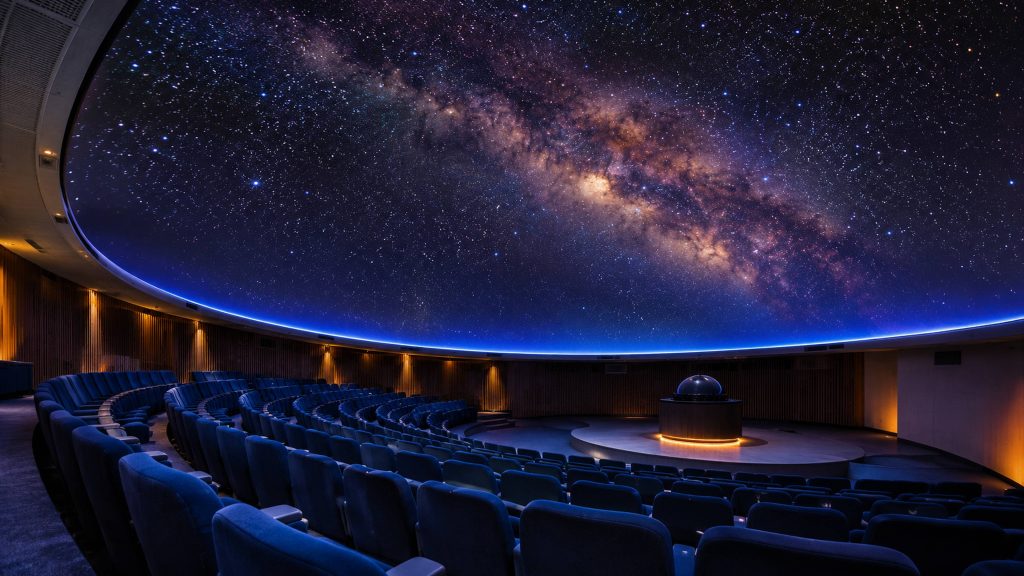
India’s first tilted LED dome planetarium opens alongside a centre for training students and teachers
By: Obnews Editorial Staff
MYSURU, Karnataka: When Prime Minister Narendra Modi inaugurated the COSMOS-Mysuru Planetarium on November 13, India added a new kind of public science facility to a university campus below Chamundi Hill. The dome is designed to take visitors through the night sky, while the centre behind it has a broader job: helping students and teachers work with the information that astronomers collect.


COSMOS stands for the Cosmology Education and Research Training Center. The project is a field station of the Indian Institute of Astrophysics, which developed it through an agreement with the University of Mysore. It sits on the university’s Jayachamarajendra campus. That setting puts a visitor attraction alongside an institution whose staff and students can use it as a place to teach, study and build new learning material.
The technology differs from what many families remember from a planetarium outing. A conventional dome is a surface onto which images are projected. At COSMOS-Mysuru, LED panels form the display itself. The institute describes it as India’s first tilted LED dome planetarium, a qualification that matters in a country with an established network of older planetariums.
The new equipment gives presenters options beyond prerecorded shows. According to the institute, the dome can display live visuals and data from telescopes and field stations. Such capabilities could let a presenter move from an illustration of a galaxy to an actual image and show how astronomers interpret it. The technology makes that possible; what visitors see will depend on programming and observation schedules.
A planetarium can make abstract ideas tangible. A classroom diagram has limited room to show why the Moon appears in a different part of the sky from one evening to the next. Under a dome, a presenter can advance the clock, change the viewing location and invite students to predict what will happen. A demonstration becomes a way to test an explanation instead of simply memorizing one.


Training teachers and students to analyze data is part of the project’s stated purpose. That is especially valuable for schools whose students have never looked through a research telescope. A class can learn why repeated measurements matter, why different wavelengths reveal different features and why a spectacular image may still need careful interpretation. Experienced teachers can carry those ideas back to students who never make the trip.
India’s study of the sky extends well beyond its recent space missions. Historical traditions of astronomy involved questions about calendars, eclipses and the motion of planets. Modern astronomy uses different instruments and methods to answer questions about objects that can be far beyond the range of unaided sight. A good historical exhibit can show the continuity of curiosity without treating every explanation from the past as equivalent to a modern scientific finding.
For students with family ties to Karnataka, the location provides another point of connection. Visits to Mysuru often focus on the palace, the city’s cultural institutions or Chamundi Hill. A science centre gives families another reason to explore the city, particularly for children intrigued by a mix of stories, demonstrations and experiments.
The inauguration also raises a practical question: who will be able to use the facility? An impressive public launch does not tell families when tickets will be available, which languages shows will use, what accessible seating is offered or how schools can reserve a visit. Families and teachers planning a trip should consult the institute’s show calendar and public programme rather than assuming the ceremony marked the start of routine admission.
The lasting value of Mysuru’s new dome will depend on what happens after visitors look up. If students leave with a question they know how to investigate, and teachers gain material to keep that investigation going, the centre will have made astronomy accessible well beyond its campus.