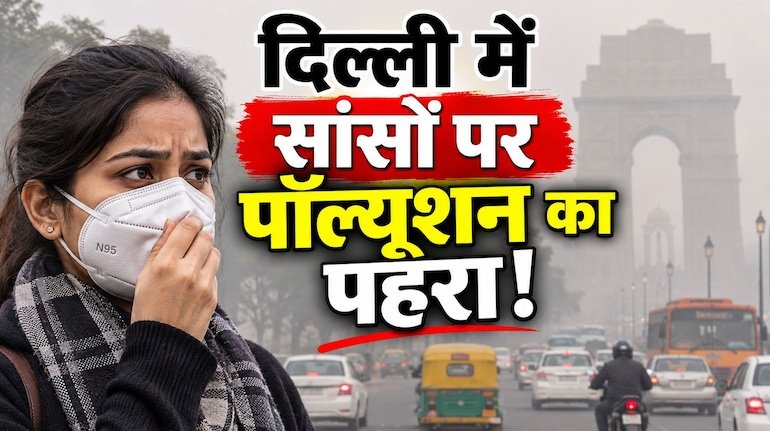
The morning of Sunday, November 15, 2026, once again dawned with poisonous smog and suffocating air in the national capital Delhi and surrounding NCR cities. According to the latest data from the Central Pollution Control Board (CPCB) and Delhi Environment Department, Delhi's overall air quality index (AQI) has crossed the level of 363 to 365, remaining in the 'Very Poor' category. In the morning, there was a thick layer of fog on the duty road, India Gate and major highways, due to which visibility was also affected. Due to the wind speed being only 5.6 kilometers per hour and the humidity in the atmosphere increasing to 91 percent, the pollutant particles have stopped at the ground level. PM 2.5 remains the major pollutant at most of the 59 monitoring centers in the capital, with levels recorded several times higher than the normal standard. AQI crossed 400 in these areas, air reached 'severe' category. Pollution level in many areas of Delhi has crossed the danger mark and reached 'severe' category i.e. above 400. According to the latest data received from Sameer App and monitoring stations, IIT Delhi has recorded the highest AQI of 428, which shows a very worrying situation. Immediately after this, the air quality index of 414 has been recorded in ITO, a busy area of central Delhi. A total of 7 to 8 major monitoring stations have recorded air quality in the 'severe' zone. Apart from this, 380 AQI has been recorded in Vasundhara Enclave, 379 in Mundka, 375 in Talkatora Garden, 374 in Vivek Vihar, 372 in Chhawla and 369 in Sirifort. The pollution level in East Delhi's Anand Vihar is around 364, Bawana 367, Aya Nagar 362 and Rohini 360, due to which local residents are complaining of irritation in eyes and sore throat. What is the condition of pollution in Noida, Gurugram and Ghaziabad? There does not seem to be any relief from air pollution in Delhi as well as in the adjacent NCR cities. On Sunday morning, Gurugram in Haryana recorded the highest AQI of 324 among the neighboring cities of NCR. Whereas, the air quality index has been recorded at 313 in Noida, Uttar Pradesh and 311 in Faridabad, Haryana, which falls in the 'very poor' category. Apart from this, 294 AQI has been recorded in Ghaziabad and 283 in Greater Noida, which remains in 'Poor' category. Morning walkers and office commuters are facing a lot of trouble due to deteriorating air quality in the entire NCR region. Why is pollution increasing in Delhi and what is the latest forecast of the Meteorological Department? According to environmental experts and meteorologists, the increase in pollution in Delhi is due to the combined effect of local emissions, vehicle smoke, construction work and incidents of stubble burning in neighboring states. According to the Indian Meteorological Department (IMD), the minimum temperature in Delhi on Sunday was recorded at 18.6 degrees Celsius, which is 5.1 degrees below normal. Due to drop in temperature and slow wind speed, fine particles of dust and smoke are not able to rise up. However, the Meteorological Department has predicted partly cloudy sky and possibility of light rain or drizzle during the day. If there is light rain in the capital, the pollutant particles dissolved in the air may settle down and people may get some temporary relief from the poisonous air. Doctors' advice and necessary precautions to avoid poisonous air: Delhi Environment Department and health experts have issued health advisory for common citizens in view of the deteriorating air quality. According to doctors, AQI beyond 350 to 400 is not only dangerous for asthma, heart patients, elderly and small children, but also has a bad effect on the lungs and metabolism of healthy individuals. Experts have advised people to avoid exercising or jogging outside the house in the morning and late evening. It is mandatory to use a good quality N95 or N99 mask while leaving the house. To keep the air inside the house clean, use air purifiers, drink adequate amount of water and take steam. Delhi government has also kept active helpline number 10741 and pollution control number 5051 for any emergency or pollution related complaint.