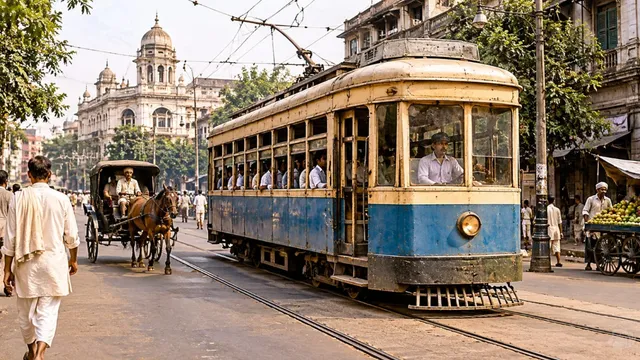
In today's modern era, when people have become accustomed to traveling in metro, electric buses and high-speed superfast trains, then in the window of old memories there is also a ride which was once the heartbeat of the metros of our country. We are talking about the tram, which looked exactly like a small train but ran on special tracks laid on the road. This eco-friendly and slow public transport system, introduced in India during the British era, was once the main mode of transport. Today, even though this journey of the tram through most of the cities of the country has been confined to the pages of history, its tinkling sound, the sound of bells and the way it slides on the tracks are still fresh in the hearts of the people of the olden times. Beginning of tram in India: The journey from the British era to the metropolitan cities of the country. If we look at the history of tram service in India, it started during the British Raj. Horse-drawn trams were first run in the country's financial capital Mumbai (Bombay), after which it expanded rapidly in other big cities of the country. Even in major cities like Kolkata (then Calcutta), Chennai (Madras) and Delhi, trams were seen running on the tracks. However, with time, due to increasing traffic, heavy vehicular traffic on the roads and advent of modern network of metro and buses, tram services started being discontinued from these cities one by one. While in Chennai the tram was stopped decades ago, in Mumbai too its operation was stopped long ago. Kolkata has become the only city in the country where historical trams still run on the tracks. While the existence of trams has completely ended in the rest of the metropolitan cities of the country, Kolkata, the cultural capital of West Bengal, is still known throughout the world for preserving this historical heritage. Even today, the trams passing through the streets and alleys of Kolkata bear testimony to the old memories and Victorian culture of this place. However, amidst the busy traffic and modern development of the metropolis, the routes of trams in Kolkata have been greatly limited, but despite this, its craze among heritage lovers and tourists has not diminished even today. Whenever the bell of a slowly moving tram rings on the streets of Kolkata, the entire city goes back in time for a moment. Way of the future and relevance of tram as an environment-friendly transport In today's modern era when the whole world is turning towards electric vehicles to reduce carbon emissions and save the environment, transport experts believe that a zero-emission transport system like tram can be extremely relevant for the future. Light rail and tram are still being used as the main mode of transportation in modern cities of many developed countries of the world. In some selected cities of India too, discussions are going on to bring back the modern tram network under eco-friendly urban mobility. This effort to escape from the pages of history and return to the track of modernity proves that old technologies never become completely old, rather their form changes with time.