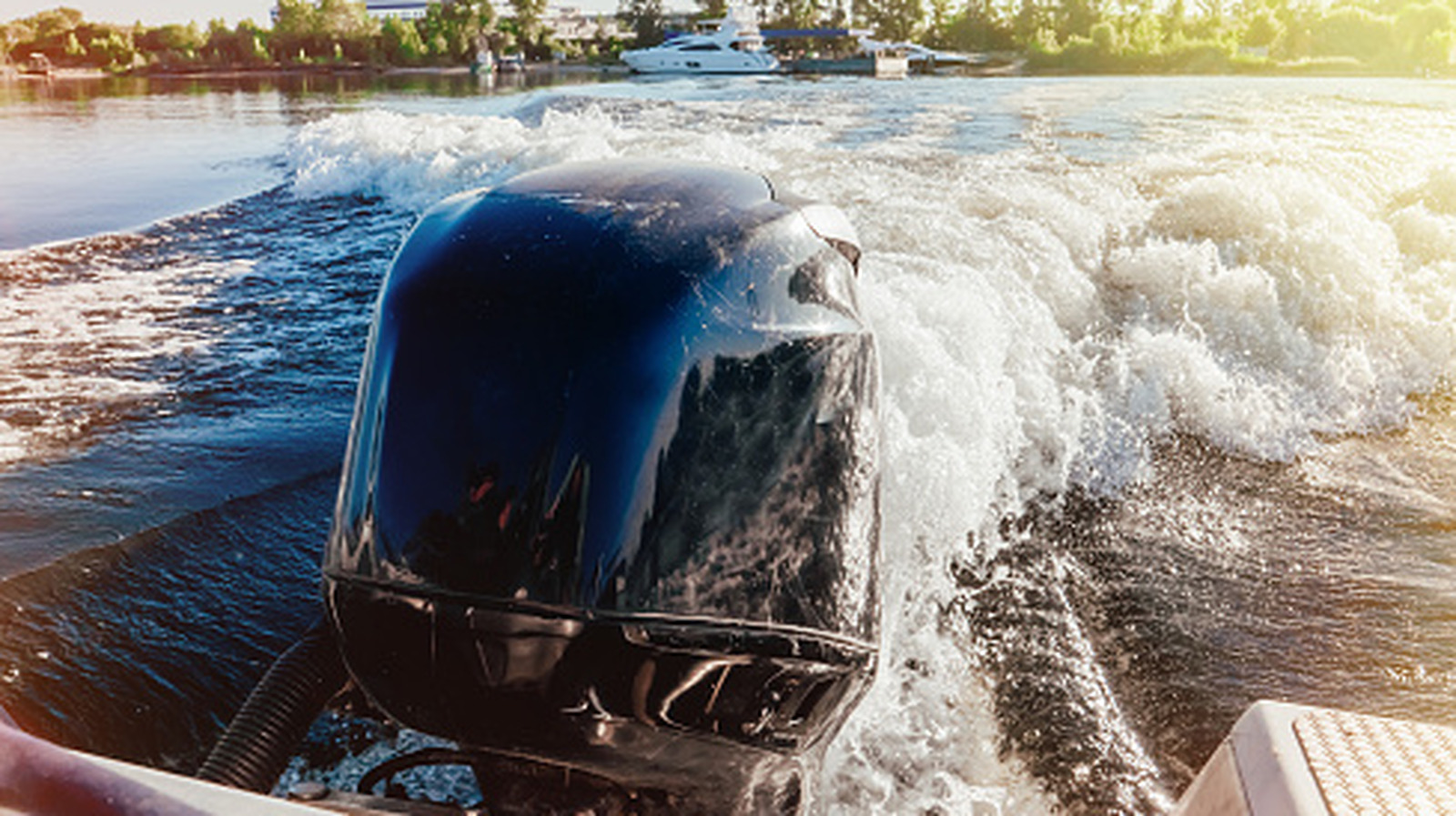
If you’ve ever taken up the oars of a small boat and rowed across a sizable stretch of water, the reasons behind the invention of the outboard motor are readily apparent. Rowing or paddling is a strenuous activity that uses several major muscle groups. While this can be a great form of exercise, it isn’t always ideal for those just looking to go fishing or relax out on the water.
A Frenchman named Gustave Trouvé is credited with inventing the first example of an outboard motor in the late 19th century, which was powered by an electric motor, rather than standard internal combustion. An outboard motor is just one of four basic types of boat engines, mounted to the exterior of smaller vessels. While inboard motors did exist prior to outboards, their expense and weight made them impractical for the average boater.
The 20th century saw production of outboards ramp up as boating for fun became more popular. Early brands like Evinrude helped kick things off and continued producing outboards for over a century. Some, like Mariner, came along much later and were quite popular, lasting several decades. Other brands like Seven Marine seemed poised to succeed, only to be shuttered after just 10 years. Despite these brands being gone, they left an indelible mark on the industry.
Evinrude
Back in 1909, a two-stroke, 1.5-horsepower outboard was launched by Ole Evinrude. It was a small operation at first, with his wife, Bess, handling multiple company departments, including marketing. He wasn’t the first to market, but made several contributions to the industry over the years and appealed to boaters looking for affordable, straightforward products. By the 1920s, Evinrude had launched a new company called ELTO, and a new, lighter, and more powerful outboard debuted, with even more advancements on the way. Convenient features such as a tiller (steering handle) that could fold down made storage easier, while a folding shaft model protected the prop from debris, with its ability to tilt upward.
The coming decades would bring innovations like electric starters and increasingly more potent performance. The 1950s Evinrude Starflite V4 output 50 horsepower, making it the go-to choice for recreational activities. By the 1970s and 1980s, outboards from Evinrude could produce 200 or more horsepower with V6 configurations. In the 2000s, emission concerns had outboard manufacturers looking for greater efficiency, and Evinrude launched the E-TEC line of outboards. The potent E-TEC G2 debuted in 2014, with the company releasing additional models before it closed shop in 2020 after more than a century in business.
Essentially, a mix of factors contributed to the downfall of the outboard company, including the COVID-19 pandemic. It had always relied primarily on two-stroke motors, even after the industry shift toward four-stroke configurations. Today, Yamaha’s XTO V8, a four-stroke, is one of the most powerful outboard boat engines ever built. In addition, the Evinrude E-TEC lineup experienced some hiccups toward the end, with high costs and some consumer complaints that proved too much to overcome.
Mariner
While a recognizable name in the boating world, Mariner has a shorter history than Evinrude, but nevertheless an interesting one. Launching in the United States in the mid-1970s, Mariner was positioned as a more affordable brand under the umbrella of Mercury and was meant to counter the likes of Evinrude. This gave Mercury the opportunity to use its distribution network to push multiple brands simultaneously, which appealed to different customer bases and broadened its reach. Mariner offered both two- and four-stroke outboards, with options starting at 2 horsepower and going all the way up to powerful 200+ horsepower models. Considered by many to be reliable options, one boater on iBoats has this to say about the Mariner: “I have an ’86 150HP …Still a strong motor.” A poster on In-Depth Outdoors described both his 1995 40-horsepower Mariner and his dad’s even older 115-horsepower motor as “pretty bullet proof.”
However, Mariner outboards were initially just Yamaha units in most cases, while the top-tier models were essentially borrowed from the Mercury lineup. Yamaha began selling outboards in the U.S. in the 1980s after a deal with Mariner owner Brunswick dissolved. The company gained a strong foothold in the States, which was the first sign of trouble. When Mariner decided to stop offering products to the U.S. in 1999, the differences between Mariner and Mercury were essentially negligible. The industry had also pivoted toward factory installation and away from dealer outboard fitting, rendering the dual-brand model less financially advantageous. The Mariner brand continued overseas, but word in 2025 notified dealers that Mercury would drop the name across all of the lineup. Some outlets in the U.K. may still have a few Mariner products in inventory, but only as supplies last.
Seven Marine
While the previous entries on this list have covered more economical outboard brands for everyday boaters, Seven Marine was a different animal. A focus on high-end performance was the aim when Seven Marine entered the scene in 2011. Started by Rick and Eric Davis (father and son), the original idea was to essentially swap multiple outboards for one especially potent one. This led to the supercharged Seven Marine 557, a 557-horsepower, 6.2-liter V8 outboard, which included notable features like a closed-loop cooling system that further protected the internals from ocean water and could run 18-inch-diameter props. Looking at other high-end competition, the Seven Marine 557 handily outperforms several of the most powerful Yamaha outboard boat motors ever made. There were other models later on, like the 527 CV and 627 CV, which showcased advanced engineering and performance power.
In 2017, Volvo Penta acquired a controlling share of the company, and at first, the situation looked positive. Volvo Penta was working to bolster and enhance Seven Marine’s product offerings and even moved production to its facility in Tennessee in 2020. However, in 2020, Volvo Penta announced that it would stop selling Seven Marine outboards in 2021. Why? A new CEO of Volvo Penta (at the time), Heléne Mellquist, headed up a push to become CO2 neutral over the next few decades. Apparently, Seven Marine and its massive internal combustion outboards didn’t fit the new direction. Some have also speculated that because Seven Marine outsourced practically everything, the supply chain process for Volvo Penta was complex and ultimately not worth it.