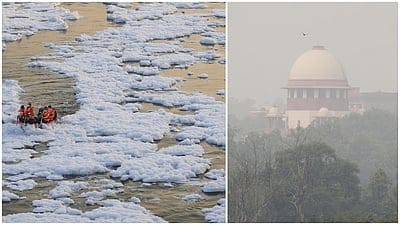
The Supreme Court of India has directed that states, Union territories, and individual districts be slapped with financial penalties if the water quality of the Yamuna River deteriorates on any parameter while flowing through and exiting their respective jurisdictions, seeking to enforce strict civic and administrative accountability across the entire river basin.
A bench of Justices Manoj Misra and Manmohan ruled that whenever water quality worsens within a jurisdiction, the concerned state, UT, or district must deposit compensation or fines directly into the Supreme Court registry. While the Central Pollution Control Board (CPCB) has been tasked with formulating the penalty structure, state governments will be free to recover the fines from defaulting polluters and negligent officials following formal inquiries.
Why Delhi & Basin States Face Major Scrutiny
Observing that the river’s toxic state reflects systemic civic failure across towns, cities, and villages along its banks—particularly through 520 drains discharging nearly 9,667 MLD of wastewater—the court invoked the principle of “common, but differentiated responsibilities” across Uttarakhand, Himachal Pradesh, Haryana, Delhi, and Uttar Pradesh:
-
- Delhi’s 22-Km Pollution Hotspot: The ruling carries major implications for the national capital, where the 22-km stretch between Wazirabad and Okhla accounts for barely 2% of the Yamuna’s length yet contributes the bulk of its total pollution load—with the bench noting that none of Delhi’s 37 existing sewage treatment plants (STPs) currently meet all prescribed standards.
- Encroachment Removal & Zone ‘O’ Protection: The bench ordered the removal of illegal colonies, jhuggi-jhopri (JJ) clusters along drains, unauthorized dairies, and riverbed settlements after rehabilitating eligible residents. It also directed strict protection of Zone ‘O’ under Delhi’s Master Plan 2047—barring permanent structures other than green parks and essential infrastructure, and suggesting its extension from the river’s source to its confluence with the Ganga.
“Everything that is wrong with civic administration in the towns, cities and villages situated along the banks of the river is reflected in the poor health of the river and in the 520 drains.”
— Supreme Court Bench of Justices Manoj Misra & Manmohan
Key Supreme Court Directives for Real-Time Monitoring
Examining a comprehensive Yamuna Action Plan prepared by a Union Home Secretary-led panel—which proposes 125 new STPs, 12 new CETPs in Haryana, and 23 biogas plants—the apex court mandated strict technological oversight:
-
-
- Tamper-Proof Meters & Live Public Dashboards: Every STP, common effluent treatment plant (CETP), and government-commissioned biogas plant must install tamper-proof smart energy meters within one month, alongside continuous inlet/outlet sensors tracking pH, BOD, COD, TSS, and ammoniacal nitrogen. All data must stream live on CPCB and state pollution board websites, with any data break exceeding 24 hours treated as a presumption of plant shutdown.
- Independent IIT/NIT Audits & GPS Septage Tracking: CPCB must conduct unannounced quarterly inspections of all STPs (5 MLD capacity and above) and CETPs via IITs, NITs, or accredited labs, publishing results within 30 days. Urban local bodies must also mandate GPS tracking for all septage tankers, while nodal officers of at least Special Secretary rank must be appointed within two weeks ahead of the next hearing on January 13, 2027.
-