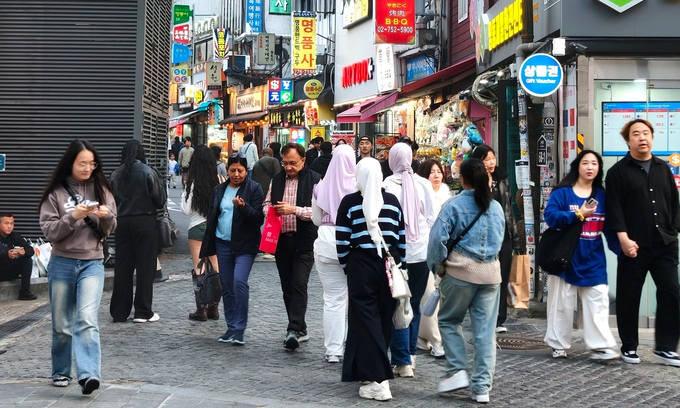
Lena, a tourist from Germany, spent nearly an hour looking for somewhere to throw away a chicken skewer while visiting Myeongdong, the city’s busiest shopping hub, in late October, Chosun Ilbo reported.
She asked a shop to take it, but the request was refused.
Minh Minh from Ho Chi Minh City who recently visited Seoul recalled he had carried an empty bubble tea cup for nearly half an hour until his group reached another sightseeing spot with a trash can where he could dispose of it.
“There are many street food stalls in the area, but public trash cans are scarce,” Minh said.
|
Tourists at Myeongdong shopping street in Seoul, South Korea. Photo by Minh Minh |
Despite being one of Seoul’s busiest shopping and street-food destinations, Myeongdong has no public trash cans along a 500-meter stretch. The entire tourist district has 35 bins, The Korea Herald reported.
The shortage is also reported in other popular areas, including Hongdae, Bukchon and Seongsu.
Seoul had 7,142 street-side trash cans as of September, according to local data, but their distribution varies widely across the city’s 25 districts, The Korea Herald reported.
Gangnam had the highest number, at 992, while Jung-gu, where Myeongdong is located, had just 146.
The shortage is partly rooted in a waste management policy introduced in 1995, requiring residents to buy designated garbage bags and pay disposal fees based on the volume of household waste.
Some people have used public bins to dispose of household garbage without paying the fees, leading to overflowing containers. In response, authorities reduced the number of public trash cans from 7,607 in 1995 to 3,707 by 2007.
Seoul has tried to increase the number of bins in recent years, but the efforts have faced resistance from residents and small business owners.
The shortage of public trash cans came at a time South Korea has seen a tourism boom.
South Korea welcomed more than 20 million foreign visitors in a single year for the first time as of Nov. 12, 14 years after the milestone of 10 million was reached.