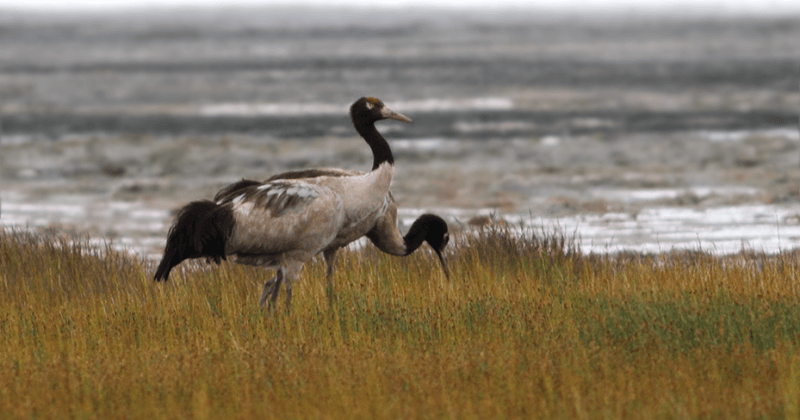
The population of Ladakh’s state bird, the black-necked crane, has increased to 108 in 2026 from 87 in 2025, registering a rise of approximately 25 per cent in just one year.
This growth is being viewed as a significant indicator of the efforts being made to conserve the rare bird and protect its natural habitat in the cold desert region.
“A monumental milestone for Ladakh. Delighted to share that the population of our State Bird, the revered and endangered Black-necked Crane, has reached 108 in 2026, registering an increase of nearly 25 per cent from 87 birds in 2025,” Lieutenant Governor of Ladakh, Vinai Kumar Saxena, posted on his social media handle.
“Compared to 70 adults and 17 juveniles in 2025, the count has gone up to 86 adults and 22 juveniles this year, with breeding sites at Chushul (16), Tso Kar and Kargyam (15 each), and Korzok (14) recording the highest bird numbers, accounting for nearly 56 per cent of the total population of 108 birds in 2026,” he further stated.
“This milestone follows a steady growth trend from 2021 to 2025, during which the adult population of Black-necked Cranes rose by an average of 12 per cent annually. I appreciate the ex-servicemen inducted into our Environmental Protection Force for protecting the birds’ nests and hatchlings from the severe threat posed by free-ranging dogs,” the Lieutenant Governor further mentioned.
“I also commend the local communities, especially the youth, whose active participation in initiatives like the first-ever Black-necked Crane Festival has been vital to our conservation success. The UT Administration remains fully committed to preserving Ladakh’s ecological heritage and ensuring that these majestic birds continue to thrive in the years to come,” he assured.
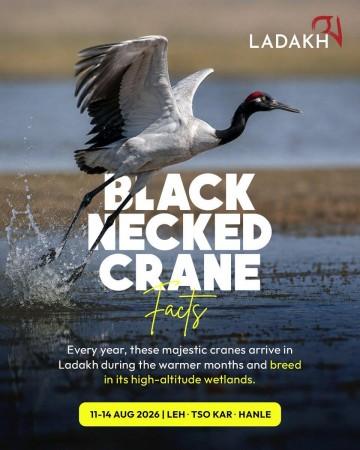
After attaining Union Territory (UT) status following the bifurcation of the erstwhile state of Jammu and Kashmir in 2019, the Ladakh Administration declared the black-necked crane its state bird in September 2021.
Importantly, the black-necked crane was also the state bird of the erstwhile state of Jammu and Kashmir. As the species is found in the mountainous region of Ladakh, the UT Administration subsequently notified it as the State Bird of Ladakh.
A monumental milestone for Ladakh.
Delighted to share that the population of our State Bird, the revered and endangered Black-necked Crane, has reached 108 in 2026, increasing by nearly 25% from 87 birds in 2025.
Compared to 70 adult and 17 juveniles in 2025, the count has gone up to 86 adults and 22 juveniles this year, with breeding sites at Chushul (16), Tso Kar and Kargyam (15 each) and Korzok (14) recording the maximum birds’ abundance; i.e. nearly 56% of the total 108 bird population in 2026.
This milestone follows a steady, monotonic growth from 2021 to 2025, where adult population of Black-necked Cranes rose by an average 12% annually.
I appreciate the ex-servicemen inducted in our Environmental Protection Force for protecting birds’ nests and hatchlings from the severe threat of free-ranging dogs.
I also commend the local communities, especially the youth, whose active participation in initiatives like the first-ever Black-necked Crane Festival, has been vital to our conservation success.
The UT Administration remains fully committed to preserving Ladakh’s ecological heritage and ensuring these majestic birds continue to thrive in the years to come.
— LG Ladakh (@lg_ladakh) November 17, 2026
Classified among the 15 critically endangered bird species in India, the Black-necked Crane (Grus nigricollis) is a tall bird, measuring about 1.35 metres in height, with a wingspan of approximately 2–2.5 metres and a body weight of 6–8 kg. It has a distinctive bright red crown on its head. Usually seen in pairs, its courtship dance has inspired one of Ladakh’s famous folk dances, Chartses.
Black-necked Crane: A symbol of good luck
Ladakhis believe that sighting a black-necked Crane is a sign of good luck. The bird is held in high regard by the people of Ladakh. Its mating dance is an important feature of cultural programmes and festivals, while many monasteries also feature paintings of the crane alongside other spiritual artwork.
Steps taken to protect endangered bird species
The Black-necked Crane (Grus nigricollis) is listed in Schedule I of the Wild Life (Protection) Act, 1972, thereby according it the highest degree of legal protection.
The species is also listed in Appendix I of the Convention on International Trade in Endangered Species of Wild Fauna and Flora (CITES) and Appendix I of the Convention on the Conservation of Migratory Species of Wild Animals (CMS).
Important habitats of the Black-necked Crane have been notified as protected areas, including the Changthang Wildlife Sanctuary in Ladakh.
The Tso Kar Wetland Complex, an important foraging and breeding ground for Black-necked Cranes, was designated a Ramsar Site in December 2020.
The National Wildlife Action Plan (2017–2031), released by the Ministry in October 2017, provides specific chapters and priority actions covering various aspects of wildlife conservation, including the conservation of threatened species, mitigation of human-wildlife conflict, conservation of inland, coastal and marine ecosystems, and landscape-level conservation.