
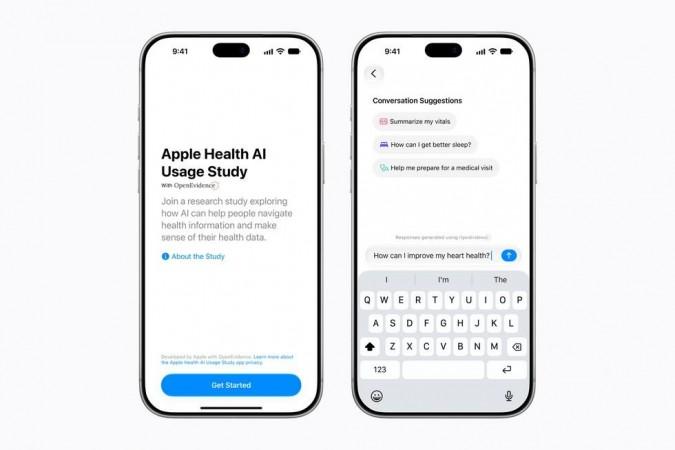
Apple has launched a dedicated artificial intelligence (AI)-powered health research app in collaboration with healthcare-focused AI company OpenEvidence to study how people use AI tools to seek medical information and advice.
The initiative, called the Apple Health AI Usage Study, aims to understand how users interact with conversational AI for health-related queries, whether they trust the responses and how access to personal health information can improve the quality and relevance of AI-generated answers.
The app will allow participants to ask everyday health questions and receive responses based on established medical research and clinical literature, including The New England Journal of Medicine, the Journal of the American Medical Association (JAMA) and Nature.
The responses will include links to peer-reviewed medical sources and explain complex health information in simpler language, making it easier for users to understand medical topics.
Apple health AI study: Who can participate?
Apple plans to enrol up to 200,000 participants aged 21 and above across the United States for the research initiative.
To participate, users must have an Apple Intelligence-enabled iPhone 15 Pro or a later model running iOS 26 or a newer version. The dedicated research app is available for eligible users in the US.
Participants will be able to ask health-related questions, rate AI-generated responses and provide feedback about their experience. Apple will also conduct monthly surveys to understand how well users comprehend and trust the information provided by the AI tool.
Users can share Apple Health data for personalised responses
The research app will also allow participants to voluntarily share selected health information through Apple’s HealthKit platform.
This includes resting heart rate, physical activity, sleep patterns and laboratory results. Apple aims to examine whether access to personal health information can make AI-generated responses more relevant and useful.
The study will also explore whether conversational AI can help people better understand their health concerns and prepare for consultations with healthcare professionals.
Apple outlines privacy safeguards for AI health study
Apple has highlighted privacy and safety measures as key aspects of the research initiative. The company said participants will retain control over whether they share their HealthKit information and survey responses.
Apple has also clarified that data collected through the study will not be used to train AI models.
The app includes safety measures designed to identify potentially concerning health-related queries and encourage users to consult healthcare professionals or seek appropriate medical assistance.
However, Apple clarified that the research app is not intended to diagnose or treat medical conditions or replace professional medical advice.
Apple explores AI-powered healthcare as competition intensifies
The launch comes as major technology companies, including OpenAI and Anthropic, expand their focus on AI-powered healthcare tools.
With more people turning to conversational AI platforms for health-related information, Apple aims to understand how these tools can deliver clearer, more reliable and clinically grounded responses.
The findings from the study could help inform the responsible development of future AI-powered healthcare experiences for Apple and the wider technology industry. However, Apple has not announced whether the research will lead to the introduction of AI health features in its existing Health app or Siri.