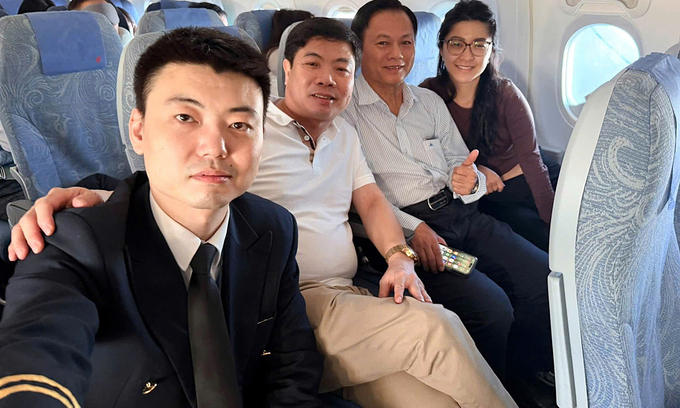
The mid-air medical crisis began shortly after 4 a.m. on Nov. 17, more than an hour after the Air China flight departed from Tan Son Nhat International Airport in Ho Chi Minh City.
A male passenger, estimated to be between 40 and 50 years old, suddenly developed excruciating abdominal pain, broke into a heavy sweat, and began vomiting.
He writhed in agony in his seat for nearly 20 minutes before his distressed family alerted the cabin crew for assistance.
Following an overhead emergency announcement requesting medical personnel, two specialists immediately left their seats to intervene.
|
Doctor La Van Phu (R) and doctor Phan Hai Thanh (C) sign a report confirming and taking responsibility for the medical procedures they performed on a Lithuanian passenger during a HCMC-Beijing flight. Photo courtesy of the doctors |
Doctor La Van Phu, head of the General Surgery Department at Can Tho City General Hospital, and doctor Phan Hai Thanh, deputy director of Hue Central International Hospital, were traveling together to attend a scientific conference in Beijing.
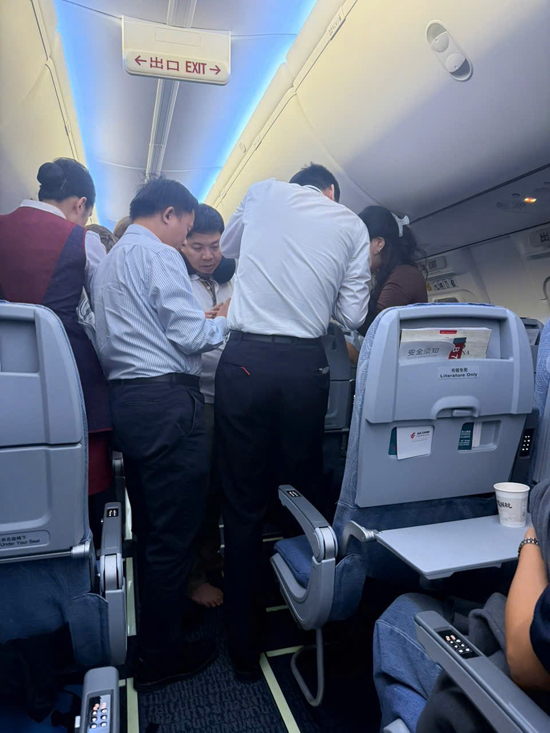
Phu noted that they rushed across four rows of seats to reach the stricken passenger, moving so quickly they did not even have time to put on their shoes.
They instructed the man to lie on his back so they could check his pulse, blood pressure, and temperature, followed by a thorough abdominal examination.
Finding his vital signs stable and noting no immediate indications of an acute surgical abdomen—a critical condition that would require emergency surgery, the doctors quickly formed a working diagnosis.
“Based on our examination, we suspected left renal colic,” Phu explained, describing a condition that causes severe lower back pain and is most commonly triggered by urinary stones.
 |
|
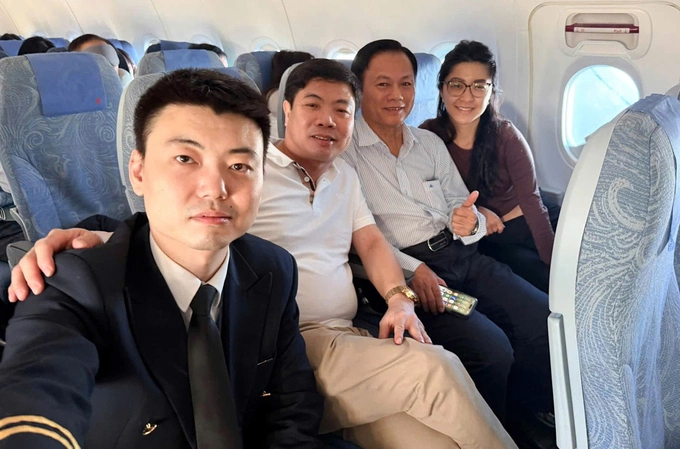
Doctor Phan Hai Thanh (2nd, L) and doctor La Van Phu (3rd, L) pose for a photo with Air China cabin crew members. Photo courtesy of the doctors |
The most significant challenge the doctors faced was the severely limited medical equipment available on board.
The plane’s emergency medical kit contained only a blood pressure monitor, a stethoscope, and a small supply of basic oral medication, completely lacking any injectable painkillers for rapid relief.
Forced to improvise, the doctors administered oral pain medication and applied medicated oil to the passenger.
They also utilized three to four bottles of warm water as makeshift hot compresses, applying them to his left abdomen for half an hour while keeping a close watch on his vital signs.
The pain did not subside immediately, and for the first 15 minutes, the man continued to writhe in agony.
His wife repeatedly asked the medical volunteers if her husband’s life was in danger and whether they needed to ask the pilot to make an emergency landing.
The doctors took turns monitoring the passenger and reassuring his family, explaining that oral medication naturally takes longer to take effect compared to intravenous injections.
Because their initial examination showed no immediate life-threatening signs, they advised the family that they needed to reassess him after a 15-to-30-minute window before deciding on any further measures.
“Those were truly minutes filled with responsibility,” one of the doctors recalled, noting that the aircraft still had more than two hours of flight time remaining before reaching its destination.
 |
|
The two Vietnamese doctors rushed to help the passenger after hearing an emergency announcement requesting medical assistance from the cabin crew. Photo courtesy of the doctors |
About 30 minutes after taking the medication and receiving the improvised compress treatment, the passenger’s pain gradually began to ease.
He soon became alert, appeared noticeably more comfortable, and was able to eat a light meal.
The flight was able to continue as scheduled without requiring an emergency diversion, aided further by a Vietnamese nurse working in the U.S. who stepped up to assist the medical team.
Once the patient’s condition was fully stabilized, the flight attendants formally documented the examination and the treatment provided.
Air China officially classified the incident as a Category 1 event, representing the mildest level of inflight medical emergency.
Both doctors signed an official report confirming specific medical procedures they had performed, formally accepting professional responsibility for their inflight work.
“The passenger and his wife repeatedly thanked us, and other passengers congratulated us and asked to take photos with us,” doctor Thanh shared.
This incident was not the first time either physician had stepped up to provide emergency medical assistance at cruising altitude.
Nearly a year prior, Phu had aided a French passenger experiencing a medical episode aboard a Vietnam Airlines flight traveling from Ho Chi Minh City to Paris.
Thanh had also volunteered his medical expertise during flights on several occasions, though this marked his first time treating a foreign passenger on an international route.
His previous inflight cases had involved less critical conditions, such as high blood pressure and severe headaches, primarily occurring on shorter domestic routes.
According to both doctors, providing emergency medical care on a commercial aircraft places immense professional responsibility squarely on the practitioners.
They noted that medical professionals may even face substantial legal risks if they make an incorrect assessment in such a high-stakes environment.
Medical resources in the air are heavily restricted, offering zero access to essential laboratory tests or diagnostic imaging.
Every medical decision made onboard carries heavy weight, possessing the potential to affect both the patient’s survival and the travel plans of hundreds of other passengers, as an emergency landing can trigger significant logistical and financial consequences.
After determining through careful observation that the case was serious but did not pose an immediate threat to the man’s life, the doctors made the call that the flight could safely proceed.
“We relied on more than 30 years of clinical experience, direct examination, and close monitoring to accurately assess the patient’s condition,” Thanh explained.
Phu considered the event a profound moment in his medical career.
“This was a beautiful memory of human kindness and professional responsibility,” Phu said. “A doctor’s duty does not end at the hospital door.”