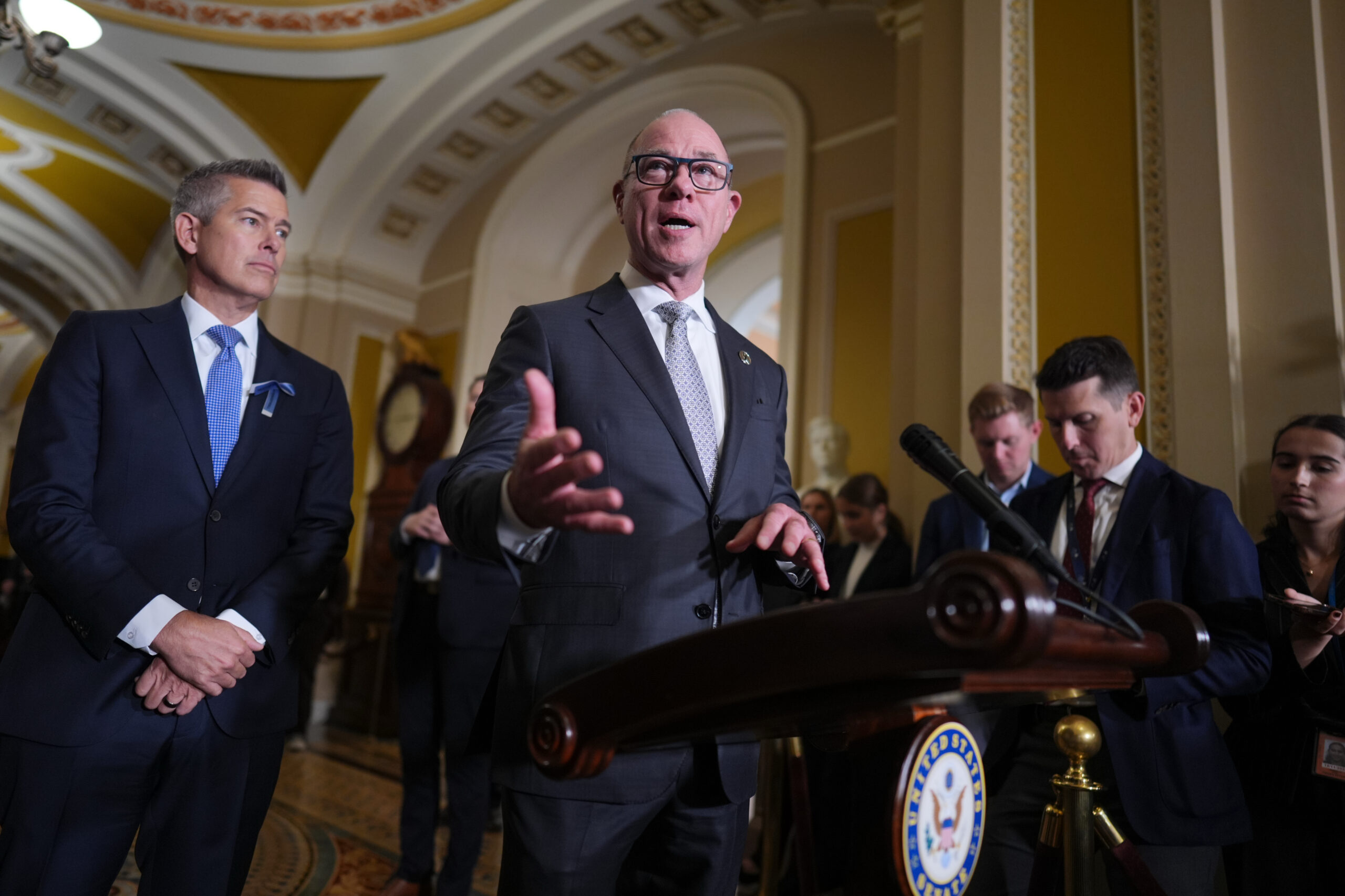
Duffy Blames L3Harris for FAA Ground Stop as FAA Chief Takes Responsibility / NEWSLOOKS/ WASHINGTON/ Jehan Mansour/ Transportation Secretary Sean Duffy continued criticizing contractor L3Harris over Friday’s nationwide ground stop, although investigators have not determined the root cause. FAA Administrator Bryan Bedford accepted responsibility as officials paused affected router installations and disabled a function linked to the disruption. Lawmakers are questioning a roughly $50 billion modernization request while previously approved funding remains unspent.
FAA Ground Stop Investigation: Quick Look
- Duffy says L3Harris failed to identify and isolate the network problem quickly enough.
- Investigators have not established why the newly installed router malfunctioned.
- The disruption affected radar and communications at 17 of 22 major air traffic control centers.
- Friday’s nationwide ground stop lasted more than four hours.
- New installations of the affected routers remain paused.
- Bedford said the FAA bears ultimate responsibility for the failure.
- Congress is unlikely to immediately approve the full modernization funding request.
- Airline representatives praised the FAA’s communication during the shutdown.

FAA Ground Stop Investigation: Deep Look
Duffy criticizes contractor while investigation remains unresolved
Transportation Secretary Sean Duffy continued blaming L3Harris on Wednesday for its handling of the network failure that triggered last week’s nationwide ground stop, even as investigators worked to determine the underlying cause.
L3Harris owns and maintains the Federal Aviation Administration’s telecommunications network. Before Friday’s disruption, a contractor was replacing old copper connections with fiber optic lines in El Dorado, Arkansas.
Duffy said during an appearance on “The Morning Meeting” that the contractor had not identified and isolated the router problem quickly enough.
“The monitoring of the network matters,” he said.
Officials are working to address that issue, Duffy said. New installations of the same routers have been paused, and technicians have disabled the function associated with Friday’s outage.
The FAA provided no additional investigative findings Wednesday.
New router overwhelmed older network equipment
Officials have linked the disruption to a newly installed Juniper router that began sending thousands of connection inquiries every few seconds, overwhelming older equipment elsewhere in the network.
The resulting instability affected radar and communications signals at 17 of the country’s 22 major air traffic control centers, prompting the FAA to halt departures nationwide.
The ground stop lasted more than four hours and was only the second nationwide halt since the Sept. 11, 2001, terrorist attacks.
Investigators still do not know why the Arkansas device behaved differently from equipment installed during 68 previous copper-to-fiber upgrade projects across the FAA network.
An incorrect configuration has been raised as a possibility, but it has not been established as the cause.
Bedford said the technician responsible was a highly trained Air Force veteran who had performed the same work dozens of times.
L3Harris declined to provide further comment Wednesday. Its most recent statement, issued Saturday, pledged support for the FAA investigation.
Bedford accepts responsibility for FAA failure
While Duffy focused criticism on the contractor, Bedford said responsibility ultimately rests with the agency.
“I am the chief accountability officer. I take full responsibility for it,” Bedford said at an event hosted by The Hill. “I wish people would lay off the secretary. He’s got a lot of work to do, but I’m the guy they hired to get this done. So, blame me.”
His remarks placed accountability for the disruption with the FAA even though L3Harris performed the installation work.
The investigation must still explain both what caused the router’s unusual behavior and why the network problem was not contained before it spread.
Lawmakers question expanded funding request
The outage has intensified debate over the cost and pace of modernizing the country’s air traffic control infrastructure.
Following Friday’s shutdown, the FAA nearly doubled its funding request to approximately $50 billion to complete the broader overhaul. Congress approved $12.5 billion last year to begin the work.
Bedford acknowledged that lawmakers might have “some indigestion associated with that.”
Several influential lawmakers said Tuesday that immediate approval of the entire request was unlikely, particularly because the FAA has not yet spent all the money previously authorized.
About $10 billion of the new request would fund air traffic control technology. The remainder would support other improvements, including runways, airport towers and aging control centers, some dating to the 1960s.
The distinction has become central to questions about how much additional funding is needed immediately and which projects it would cover.
Airlines praise communication during shutdown
Chris Sununu, president of the Airlines for America trade group, credited Bedford with keeping carriers informed throughout the disruption.
Within roughly 30 minutes of the ground stop beginning, Bedford requested a conference call with airline chief executives and operational leaders, Sununu said. Additional briefings followed as officials learned more.
“To be honest, he stayed on the phone effectively with all the CEOs all night long,” Sununu said.
Sununu also emphasized the difficulty of replacing equipment in a network that must operate continuously while protecting aviation safety.
He described the task as modernizing “what is really the most robust telecom system on the planet while you’re using it 24 hours a day and ensuring the safety of everyone who is part of it.”
Integrating new and older equipment presents continuing challenges, he said, comparing the process to making an iPhone communicate with a flip phone.
“Can we say, ‘oh, you know, this is really the last time we’re going to have a bump like this?’, No, no. Because the technologies we’re replacing and that we’re asking to talk to each other are literally multigenerational,” he said.
More on US News