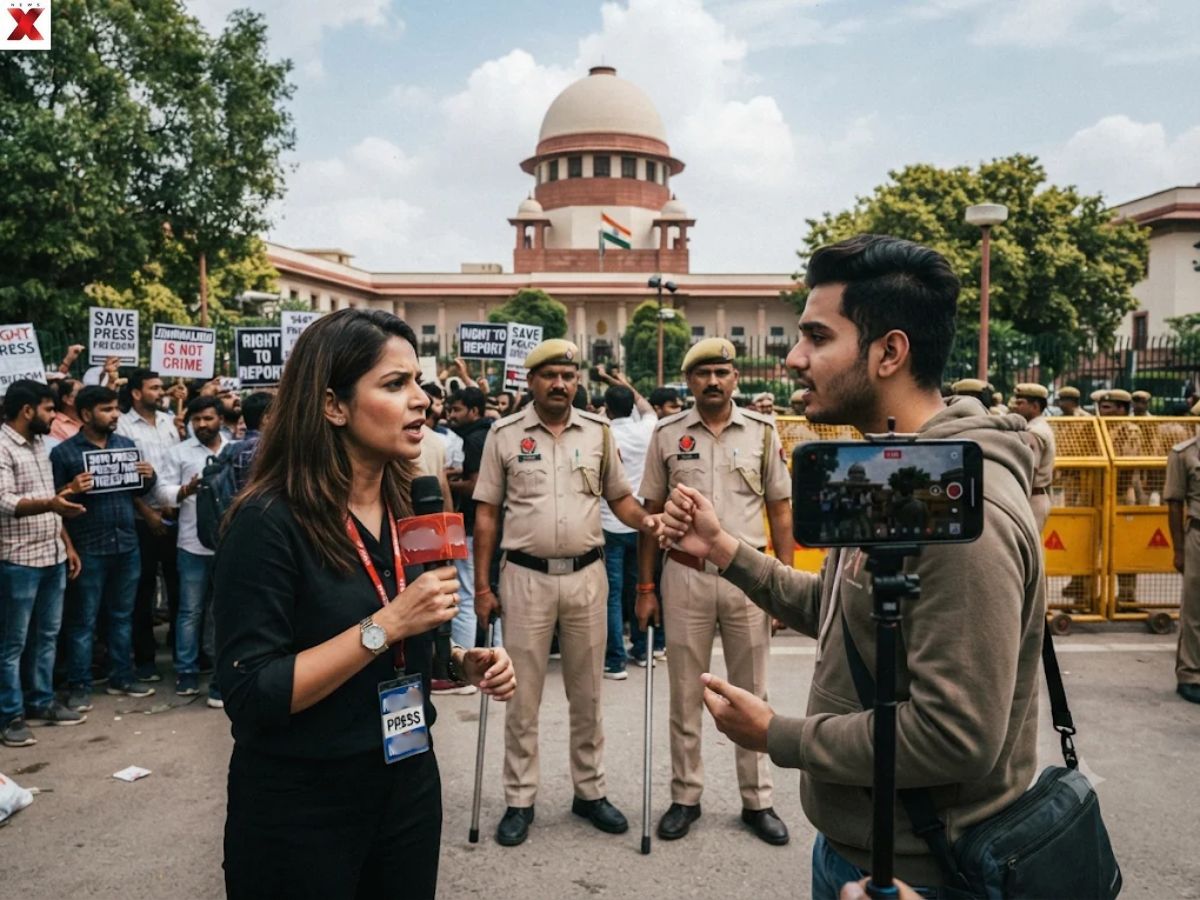
An order issued by the court to allow reporters to report on protests without being harassed is now under fire again. Through a sworn statement, Delhi Police claims social media influencers are not covered by the order. Bodies of journalists say the police interfered with their work.
Affidavit Makes It To Supreme Court
Through an affidavit presented before the Supreme Court, the Delhi Police said social media influencers, content creators and reel makers cannot claim protection from an order that allows journalists to report on protests without any interference. This was part of an application filed in connection with the recent protest by the Cockroach Janta Party.
The protests demanded the resignation of the Chief Election Commissioner Gyanesh Kumar over the special intensive revision of electoral rolls.
How The Matter Reached The Court
During earlier hearings, the Supreme Court had warned the police not to obstruct the media from covering the protests. Journalists had complained that they were being prevented from doing their work. The petitioners cite the Court’s October 11 order, which said lawyers, journalists and other professionals must not be hindered in their professional duties. They claim the police actions violated it.
The petitions include those by the Network of Women in Media, India, Free Speech Collective, Delhi Union of Journalists and Kerala Union of Working Journalists.
What Police Say
In the affidavit filed by the police, the force stated that it has never tried to obstruct the legitimate discharge of journalistic activities. This is because they believed that the direction issued by the Court was to protect the activities of professional journalists and not exempt reel makers, influencers, or “unruly elements” from the provisions of law or lawful directions of the police during a prohibited assembly.
The Line Between Reporter And Creator
The police mentioned that it was not yet decided whether the creators of the video can be considered as journalists. According to them, there are many people who create videos, upload them and earn money out of them. The police also believe that some of the protesters carried cameras and microphones and pretended to be journalists, making it difficult to distinguish between a reporter and creator.
It was requested by the police that the Court may consider the difference between one who reports facts objectively and one who creates content through recording of events.
A Concession On Digital Media
The affidavit also accepted some ground. It acknowledged that the constitutional freedom to gather, record and publish news covers independent media persons, freelancers, citizens and people reporting on YouTube or other digital platforms. That freedom, it said, cannot be denied only because someone lacks PIB accreditation, an employer’s press card or a job with a recognised organisation. Even so, such creators remain subject to the general law and lawful police directions, like every other citizen.
The Police Answer Individual Complaints
The affidavit further rebutted claims made by journalists.
- Claims against police officer: There had been complaints about sexual harassment by a police officer filed by three journalists on October 3. Police claimed that two of the three did not wish to proceed with their complaints and the other refused to be part of the investigation. After reviewing the CCTV footage, the police stated that there was no case of harassment and the issue remains closed.
- Reporters of Peek TV: It was reported that a Deputy Commissioner had subsequently met the reporters who had apparently been dragged and detained.
- Ryan Thomas of The Caravan: He had complained about assault and detention on October 11. The police denied this and stated that he was forcibly removed from the scene under statutory powers during crowd control.
- The Hindu and Indian Express reporters: The police said a reporter from The Hindu was released once recognised, and that three Indian Express reporters were released after 45 minutes when their credentials were recognised.
- Paranjoy Guha Thakurta: The police denied illegal detention. They said that by his own account he was not taken to a police station and was released around 1 pm.
- Shyam Meera Singh: The police questioned whether he was a journalist or a participant. They cited his own statement that he was shouting slogans during a confrontation at Connaught Place.
- Seizures: The police said nothing was seized from any journalist and that items taken from others, such as unclaimed mobile phones, were seized under statutory powers.
The police urged the Court to dismiss the petitions.
The Other Side
Neither the journalists nor their organizations have accepted the version presented by the police in the materials at hand. Their complaints claim that reporters were arrested or manhandled or prevented from reporting about the demonstrations in violation of the Court’s order. The description provided in the affidavit for each incident in turn is a version provided by the police, which has yet to be ruled upon.
And What Now?
Will the Supreme Court make a distinction between journalists and content producers, or will it leave it undecided? Will it accept the version presented by the police concerning each incident, or will it demand further examination? By what criterion will it define a journalist – employment, accreditation, or intent? And will the journalists’ organizations respond to the police version?
Khushi Patel is a Senior Sub Editor at NewsX, covering automotive, technology, Lifestyle, entertainment, and mainstream news. She previously worked as a Copy Editor at Times Network and has written automotive editorial content, including comparison pieces, for TimesDrive.
The post Delhi Police To Supreme Court: Reel-Makers Cannot Claim Journalists’ Protection During Protests, Must Follow Crowd-Control Rules appeared first on NewsX.