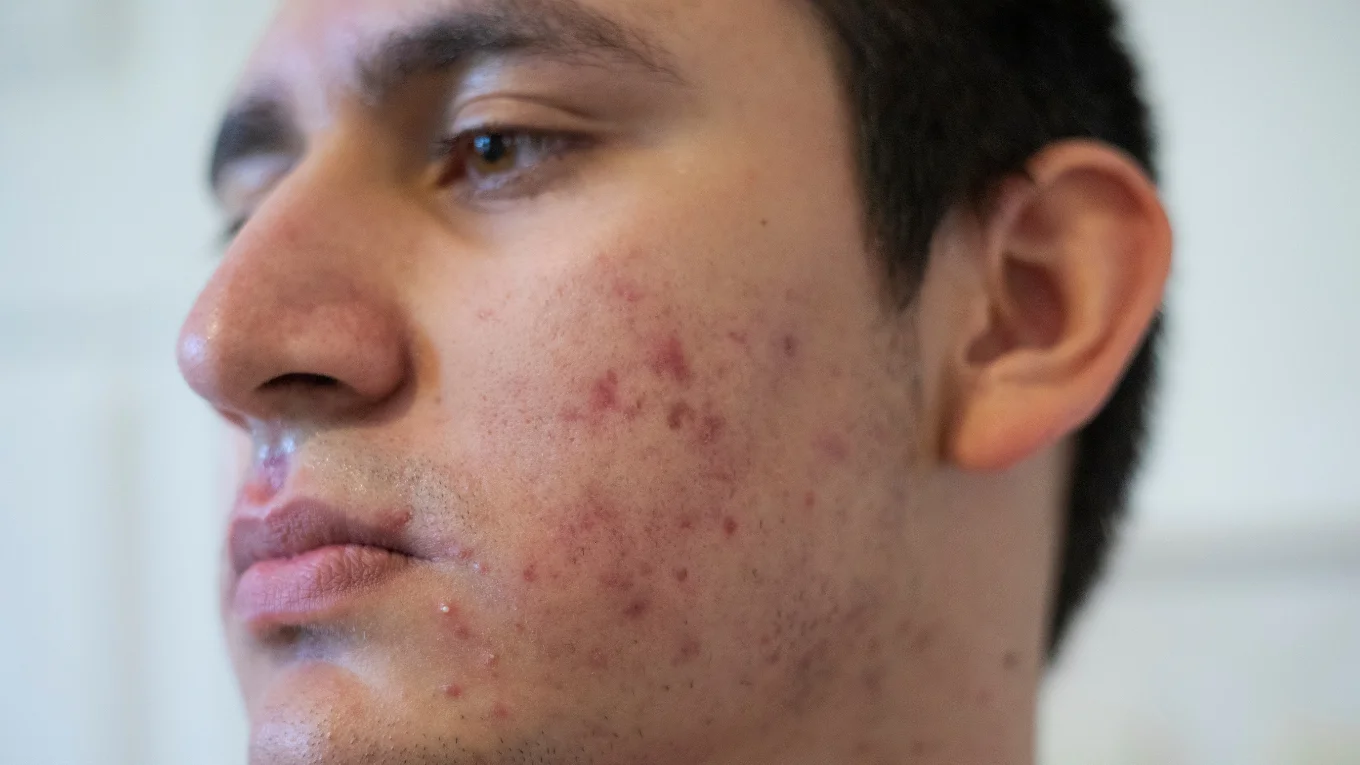
As someone who grew up with chronic cystic acne and loathed looking in the mirror when it got really bad, I may finally believe there’s some semblance of justice in the universe: A King’s College London study found that people who suffer from acne actually have an inherent genetic protection that slows the aging of their skin and increases their overall lifespan.
People who suffer from acne often live longer, research says
maxbelchenko | Shutterstock
And honestly? If there’s anyone who deserves some later-in-life justice, it’s the people like me who had to spend their awkward teenage years struggling with their self-esteem while battling pimples, oily skin, and under-the-skin welts that could only be rectified by paying a $25 dermatologist co-pay to have it injected — #iykyk.
It just feels right that somewhere, deep down in their genetic code, something said, “Hey, I know they called you ‘Pizzaface’ and you felt so insecure that you burned your class picture every year, so, as restitution, you’re going to be confident and cute when you’re retired.”
Doctors noticed people with a predisposition for oily skin tended to have fewer wrinkles as they age, but they didn’t know why
The evidence in the King’s College study suggests that people with acne have significantly longer protective caps at the end of their chromosomes. These caps, known as telomeres, are like the protective candy shell around your DNA.
When telomeres wear down over time, it can trigger what’s known as “cell death,” a rapid deterioration of our body’s cells, which happens naturally while you age.
But those poor, unfortunate souls who had to spend their high school years reeking of Clearasil? According to the study’s laboratory findings, their telomeres are thicker and more virileprotecting their cells longer than Johnny No-Pimples ever could imagine.
Dr. Veronique Batailleone of the authors of the study, explained that “Longer telomeres are likely to be one factor explaining the protection against premature skin aging in individuals who previously suffered from acne.” The researchers also highlighted a gene pathway called p53 — which is known to regulate “cell death” — that appears far less active in the skin of people who suffer from acne (i.e., that’s a good thing). But what does this all mean?
It means that occasionally, the universe likes to reward people who suffer from terrible acne
It reminds me of an embarrassing story. When my daughter was 3 years old, I took her to a diner for lunch. Our teenage waiter arrived at our table, and the poor guy was riddled with cystic acne. It looked so painful, so hard to hide. He was literally wearing his greatest discomfort right on his face.
My daughter took one look at him and screamed. She screamed, “Get away from me! He has chicken pox, Daddy! Don’t let him touch me!”
I was mortified. Mortified by my daughter’s behavior (she had no idea what acne was), but mostly mortified for my waiter, who handled my kid’s revulsion like a pro.
You could tell this wasn’t his first time experiencing this sort of thing, which depressed me more than anything. There was nothing I could do to take back my daughter’s comments, so I did the only thing I could do. At the end of the meal, I tipped him 90%.
This is why I love this study about people with acne. Because it feels like the universe is tipping them 90%.
Yes, high school was hard, but when it really matters, later in life, when everyone is scrambling for a little more time, scientists have confirmed that “the skin of acne sufferers appears to age more slowly than in those who have not experienced any acne in their lifetime.”
And that just feels right. They’re owed that. And I hope they enjoy it.
Tom Burns has served as a contributing editor for 8BitDad and The Good Men Project, and his writing has been featured on Babble, Brightly, Mom.me, Time Magazine, and various other sites.