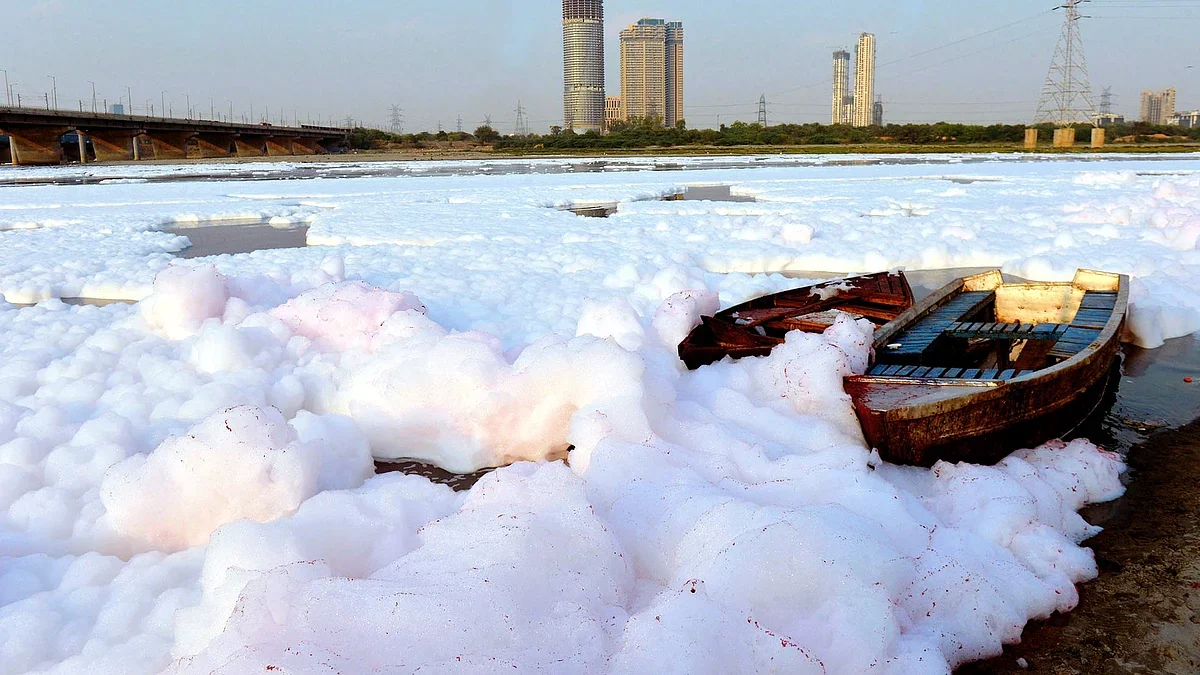
New Delhi. Pollution of Yamuna River in the country's capital Delhi is not limited to only sewage and industrial waste. A dangerous mixture of drug residues, pesticides and industrial chemicals is also present in the river water. In a new study by researchers at Delhi University, 321 chemical compounds have been identified in Yamuna water. Of these, 36 chemicals are included in the categories hazardous to health and environment.
This study has been published in 'Journal of Hazardous Materials Advances'. Researchers collected water samples from eight different locations along a 48.8-km stretch of the Yamuna from Palla to Asgarpur. The investigation found chemicals that are linked to dangerous categories like cancer, adverse effects on fertility, acute toxicity and harm to aquatic organisms.
of microplastics 2,289 particles found
During the study, a total of 2,289 particles of microplastic were found in Yamuna water. Their average quantity was recorded at 3.18 particles per liter. According to researchers, the highest amount of microplastics was found around the barrage. After this, there was a flood area where many drains meet. At the same time, the least amount of microplastic was found in the agricultural and forest areas of Palla. Microplastics included 44.1 percent polyethylene and 27.3 percent polypropylene.
Residues of medicines and pesticides were also found
The study found 50 such chemical compounds, which were present in at least four places in a form different from microplastics. Seven of these chemicals were found at all eight sampling sites. These include 2-naphthylamine, lidocaine and monopropyl phthalate. Apart from this, chemical residues related to drugs like atomoxetine, domperidone and telmisartan were also found. At the same time, the presence of agricultural chemicals like diuron and thiamethoxam has also come to light.
22 Pollution reaching Yamuna from drains
Radheshyam Sharma, co-author of the study and head of the Department of Environmental Studies, Delhi University, said that Yamuna pollution cannot be understood on the basis of microplastics alone. It is also necessary to investigate the complex mixture of different chemical substances present in the river. He said that sewage, effluent from agricultural activities and industrial waste reach Yamuna through 22 tributary drains. To reduce river pollution, there is a need to increase greenery on its banks and strengthen the natural ecosystem.
Presence of dangerous chemicals does not mean disease
Researchers have clarified that the presence of hazardous chemicals in water does not in itself prove that they are causing real health harm to people. For this, detailed testing of the concentration of chemicals, duration of exposure and their effects is necessary.
Study is also being done on the foam of Yamuna
Here, a study is also being conducted by the Delhi government regarding the problem of foam formed in Yamuna during Chhath Puja. For this, the help of Irrigation Research Institute (IRI) based in Roorkee is being taken. In the study, work is being done on the causes of foam formation in the river as well as measures to reduce it. A new study has indicated that to clean the Yamuna, it will not be enough to remove only the visible waste and scum, but it is also necessary to identify and control the invisible chemical pollution present in the water.