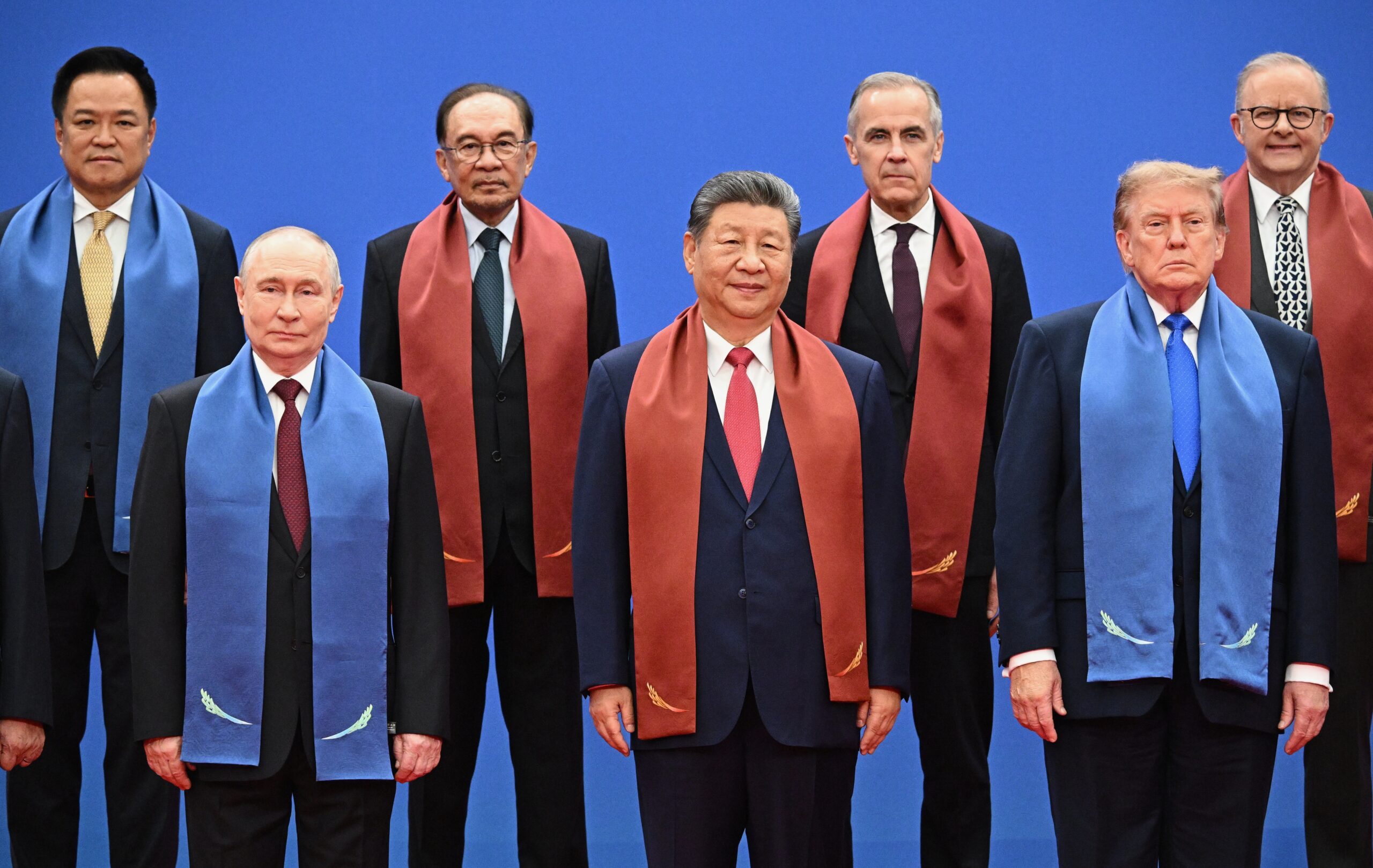
Trump-Xi-Putin Meeting Overshadows APEC Talks on Summit and AI/ NEWSLOOKS/ WASHINGTON/ Jehan Mansour/ APEC’s trade and technology agenda competed for attention with historic talks between Donald Trump, Xi Jinping and Vladimir Putin. Xi called for cooperation and open technology development, while Trump opposed international efforts to restrict artificial intelligence. IMF chief Kristalina Georgieva said AI investment is supporting global growth despite the economic damage from Middle East energy disruptions.

APEC Trade and AI Talks: Quick Look
- Xi urged the 21 APEC economies to strengthen cooperation on trade and technology.
- The first Trump-Xi-Putin trilateral meeting overshadowed the economic gathering.
- Trump promoted U.S. investment and signaled additional trade agreements.
- He also opposed what he described as “globalist” efforts to regulate AI.
- Xi and other Asian leaders emphasized equitable access and safeguards for AI.
- Washington recently tightened restrictions on remote access to advanced computing technology.
- The IMF said APEC economies are growing at 3.4%, compared with 3.1% globally.
- AI investment is helping drive global trade growth of 4.6%, according to the IMF.


APEC Trade and AI Talks: Deep Look
Great-power diplomacy competes with economic agenda
SHENZHEN, China — Chinese President Xi Jinping urged Pacific Rim leaders Thursday to preserve open trade and cooperate on technology development, as a historic meeting with President Donald Trump and Russian President Vladimir Putin drew attention away from the Asia-Pacific Economic Cooperation summit’s economic agenda.
The gathering in Shenzhen showcased China’s technological ambitions through robots, elaborate light displays and the infrastructure of one of its leading financial and innovation centers.
But discussions about regional commerce and artificial intelligence shared the spotlight with diplomacy involving nuclear weapons and the conflicts in Ukraine and the Middle East.
As the trilateral meeting began, Trump defended direct engagement with governments that disagree with Washington.
“Too often, past leaders avoided talking to nations with whom they had disagreements. No problems are ever solved by refusing to talk about it,” he said.
“Let’s see if we can get something done,” Trump added.
Xi calls for shared interests in trade and technology
Opening the APEC leaders’ meeting earlier Thursday, Xi encouraged members to work together despite geopolitical tensions.
“APEC members are like passengers riding the same boat,” he said. “To weather the winds and waves of the Pacific, we should join forces and watch out for one another and strengthen the bonds of shared interests.”
His appeal reflected APEC’s longstanding ambition to establish a Pacific Rim free trade zone while maintaining dialogue through economic crises, trade disputes and wars.
Putin, attending an APEC summit for the first time in nine years, echoed the call for cooperation.
“APEC must set a tone of unity and develop a constructive agenda for cooperation,” he said.
The summit retained its familiar diplomatic rituals, including bilateral meetings, a gala dinner and a group photograph. Leaders wore business attire with broad red or blue scarves draped over their shoulders.
Trump promotes investment and opposes AI restrictions
Trump used his remarks to promote the American economyclaiming his policies had attracted trillions of dollars in investment and generated trillions in additional wealth.
He also said he expected to sign more trade agreements soon.
On artificial intelligence, Trump promised to resist “globalist” attempts to regulate or constrain the technology, which he calls “super intelligence.”
That position contrasted with the emphasis from Xi and other Asian leaders on sharing AI’s benefits while establishing safeguards for financial stability, cybersecurity and equitable growth.
The differences underscored a central challenge for APEC: encouraging technological cooperation while its largest economies compete over access, security and regulation.
Advanced-chip controls remain a source of friction
U.S. restrictions on Chinese access to advanced computer chips continue to strain relations between Washington and Beijing.
The issue has received renewed attention following the controversy involving Nvidia founder and former CEO Jensen Huang’s relationship with a Chinese technology executive.
Earlier this week, Washington tightened restrictions on remote access to advanced computing technology.
Experts said the changes closed a significant loophole that had enabled Chinese access to billions of dollars’ worth of high-end Nvidia chips used for AI.
The restrictions highlight the gap between calls for open technology development and government efforts to protect strategically sensitive capabilities.
IMF says AI investment is supporting growth
Despite those tensions, AI spending is providing a significant economic boost, IMF Managing Director Kristalina Georgieva told the leaders.
She said the technology is having a “material impact” on global growth, helping offset the damage from energy shocks linked to war in the Middle East.
APEC economies are expanding at an annual pace of 3.4%, slightly ahead of global growth of 3.1%, Georgieva said.
Global trade is growing at 4.6%, with the AI investment boom contributing substantially to that expansion.
“While the energy shock will eventually dissipate, AI is forever, the most significant factor for medium-term competitiveness, productivity, and growth,” she said.
“This is the fastest transformation in human history,” Georgieva added. “And to put it very simply, you snooze, you lose.”
Her remarks placed technological competitiveness at the center of the region’s economic outlook, even as geopolitical negotiations dominated attention at the summit.
More on US News