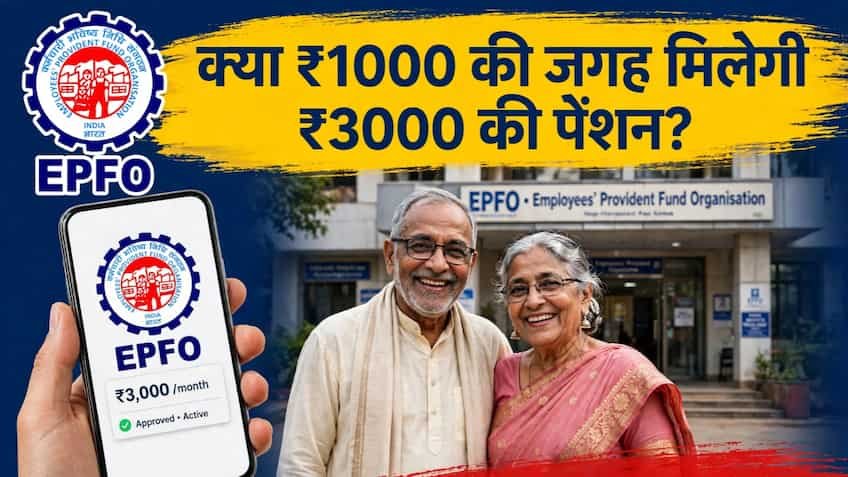
New Delhi: The eyes of lakhs of retired private sector employees and pensioners across the country are fixed on the capital New Delhi today. A very important meeting of the Central Board of Trustees (CBT) of the Employees' Provident Fund Organization (EPFO) is being held in Delhi today. The biggest issue in this general meeting is to increase the minimum monthly pension available under the Employees Pension Scheme 1995 (EPS-95). Today, a new ray of hope is visible for crores of pensioners who have been continuously demanding increase in their minimum pension for the last 12 years. There is a strong discussion that in today's meeting, the government and the board can seriously consider the proposal to increase the minimum pension amount from the current ₹ 1,000 to ₹ 3,000 per month. If this proposal is approved, it will be no less than a great gift for crores of elderly people of the country. The demand for increasing the minimum pension has been stuck for 12 years. If we look at the history of the Employees Pension Scheme, in the year 2014, the Central Government had fixed the limit of minimum monthly pension at ₹ 1,000 per month. Since then, inflation has increased manifold, but the amount received by pensioners has not increased even by a single rupee. Lakhs of pensioners living in different parts of the country, especially Uttar Pradesh, Maharashtra, Karnataka and Delhi-NCR, have been demanding an increase in this amount for a long time, calling it inadequate. In today's era of inflation, it is becoming difficult for the elderly to meet the expenses of medicines even with an amount of ₹ 1,000. This is the reason why labor organizations and pensioners associations across the country were continuously putting pressure on the Labor Ministry and EPFO to make a respectable increase in the minimum pension. What points will be discussed in the general meeting in Delhi? Many agendas related to the interests of employees have been included in this high level meeting of EPFO being held under the leadership of the Ministry of Labor and Employment in the capital Delhi. According to sources, the most important point in the meeting is to increase the minimum pension from ₹1,000 to ₹3,000. However, some employee organizations are adamant on the demand of increasing it to ₹ 7,500, but considering the financial burden and budget mathematics, the formula of ₹ 3,000 is most likely to be agreed upon. Apart from this, important topics like PF interest rates, making digital services more transparent and speeding up the claim settlement process will also be discussed in the meeting. Every aspect of this financial proposal is to be discussed in detail in the meeting between employer representatives, leaders of employee organizations and government officials. How much will the ₹3,000 pension affect the government treasury? The decision to increase any pension scheme is directly linked to the balance of the pension fund of the government treasury and EPFO. Experts from the Finance Ministry and the Labor Ministry have made a thorough assessment that if the minimum pension is increased from ₹1,000 to ₹3,000, it will put an additional financial burden of thousands of crores of rupees per year on the Central Government. In the last few years, the Finance Ministry had not given its consent to the proposals to increase pension due to this additional budget. But now under the changing economic conditions and the government policy to strengthen the social security cover, a positive attitude is being adopted on this. Economists believe that if the government agrees to bridge this gap through budgetary support, there will be a direct improvement in the standard of living of crores of elderly people. Crores of families of the country including Uttar Pradesh will get direct benefits. The impact of this possible decision will not be limited only to Delhi or metro cities, but families living in small and big cities and towns across the country will get direct benefits. In states like Uttar Pradesh, Bihar, Madhya Pradesh and Rajasthan alone, there are lakhs of families whose elders are dependent only on EPS-95 pension after retirement from private companies, factories or institutions. Thousands of senior citizens who have worked in industrial areas like Lucknow, Kanpur, Noida and Ghaziabad have expressed their expectations regarding this meeting. Three times increase in pension will not only reduce the economic dependence of the elderly, but will also increase cash flow in the rural and semi-urban economy, which will also strengthen the local markets. What are the main demands and expectations of pensioners? The National Struggle Committee (NAC) representing EPS-95 pensioners across the country and other major trade unions have placed their clear demands before the government ahead of this meeting. He says that to live a respectable life in old age, it is very important to have a pension of at least ₹ 3,000 to ₹ 7,500 and add dearness allowance (DA) to it. Along with this, there is also a strong demand to provide free medical facilities (medical cover) to pensioners and their spouses. Union leaders argue that the employees have spent their entire youth in increasing the industrial development and production of the country, hence now it is the moral responsibility of the government to protect their old age. What will be the further process and when will the increased money be received? If the proposal to increase the minimum pension to ₹ 3,000 is approved in the EPFO's Central Board of Trustees meeting being held in Delhi today, then it will be sent to the Union Finance Ministry and the Union Cabinet for final approval. After getting the approval of the Cabinet, an official notification in this regard will be issued by the Labor Ministry. Experts believe that if an in-principle agreement is reached today, this new system can be implemented within the next few months. At present, the heartbeats of crores of pensioners of the country are fast and everyone is eagerly waiting for the big good news coming from Delhi by evening, which can make their future financially secure.