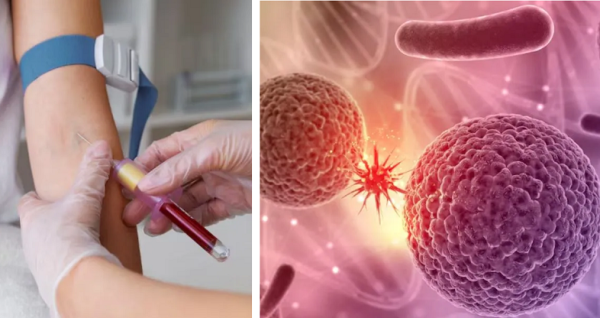
New Delhi .As soon as the name of Cancer is heard, many questions arise in the mind of the patient and his family regarding the treatment as well as the process of investigation. People are especially worried about biopsy, because it involves removing a tissue sample from the affected part of the body. But now a new technique has emerged for early detection of cancer. Indian company Strand Life Sciences has developed an Artificial Intelligence based blood test named CancerSpot. It is claimed that signs related to 14 types of cancer can be detected from only 20 ml of blood sample.
The specialty of this technique is that very small pieces of DNA present in the blood are analyzed in it. For this, modern sequencing technology and artificial intelligence are used. Its objective is to identify possible signs related to the presence of cancer in the body at an early stage.
The four-year study included samples from 43 hospitals.
A four-year study called EMERGE was conducted to assess the utility and performance of the CancerSpot test. A total of 1,480 samples of people from 43 hospitals of the country were included in this research. In these, samples of healthy persons along with patients suffering from cancer were also taken.
According to the results of the study, this test identified about 72 percent of cancer cases. The rate of results falsely indicating cancer was reported to be 1.4 percent. These data demonstrate the potential utility of this technique, but cannot be considered a guarantee of equal accuracy in all patients. Further extensive studies will be necessary to understand its reliability and performance under different conditions.
How is cancer detected by DNA present in blood?
The cells of the human body continuously release small fragments of DNA into the blood. These are called cell free DNA. When cancer develops in the body, some fragments of DNA from the tumor cells also start reaching the bloodstream. These fragments may contain certain chemical changes, called DNA methylation patterns.
The CancerSpot test analyzes these changes. First of all, sequencing of DNA fragments from the blood sample is done. After this, AI technology studies the patterns of millions of DNA fragments. In this process, an attempt is made to identify the difference between DNA coming from normal cells and DNA related to cancer.
On the basis of this analysis, signs related to possible cancer present in the body are estimated. In this way, an attempt is made to detect the possibility of cancer in different parts of the body through the same blood sample.
Claim to test for which 14 cancers?
According to the company, with this test, signs related to lung, liver, stomach, kidney, ovary, alimentary canal, urinary bladder, uterus, breast, prostate, colorectal, pancreas, gall bladder and cervical cancer can be identified.
In this, signs of cancer developing in many important organs of the body are detected from a single blood sample. This is why this technology is being seen as a possible new option in the field of early cancer screening.
Will the need for biopsy go away now?
The most important question regarding the CancerSpot test is whether there will be no need for biopsy after its introduction. At present there is no answer to this. This is a screening test, not a final confirmatory test for cancer. If there are signs related to cancer in its report, then the doctor may advise scanning, biopsy or other tests according to the patient's condition.
Similarly, a negative test report does not mean that the possibility of a person having cancer is completely eliminated. Therefore, any report should be evaluated only on the basis of medical advice.
The main objective of CancerSpot is to identify possible signs at an early stage and ease the way for further investigation. If its accuracy and usefulness are confirmed in future studies, it could play an important role in the field of early cancer detection.