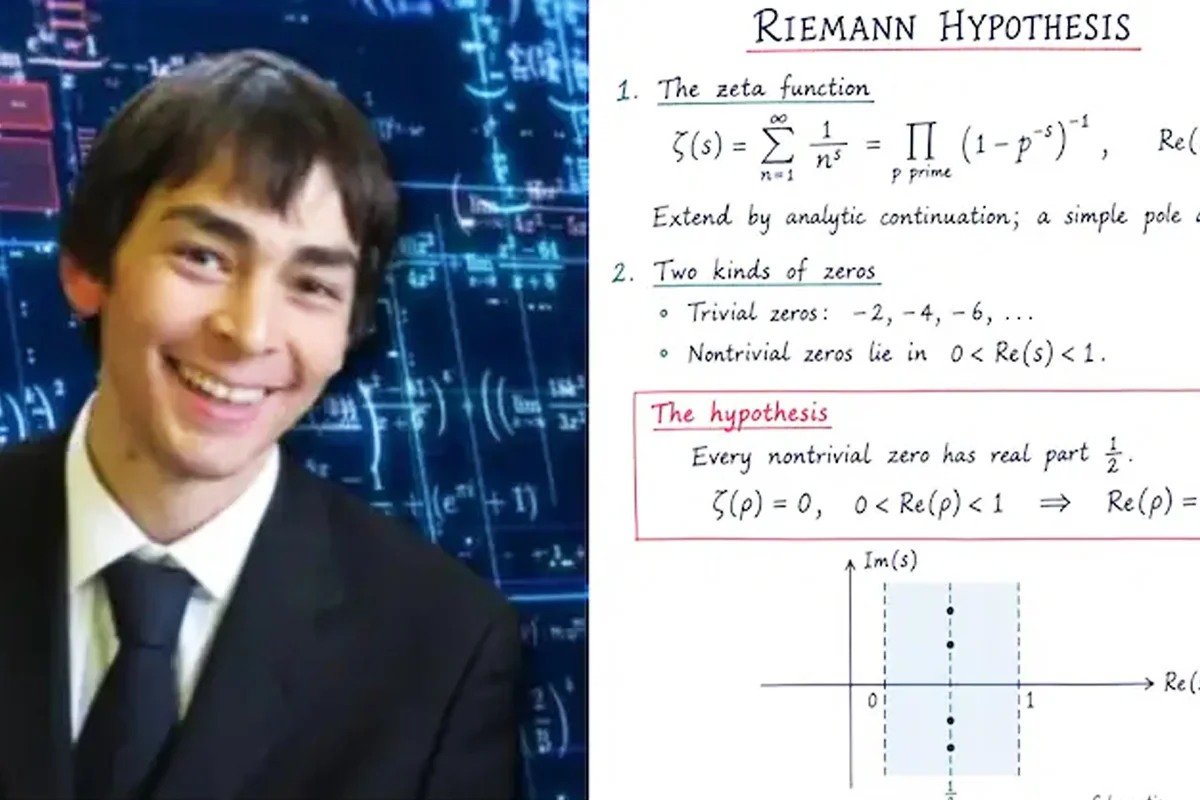
About 167 years old incomprehensible entanglement. Not even mathematicians bothered to find the root. Artificial intelligence (AI) has solved the most difficult problem in mathematics. This is claimed by Levant Alpoge, a mathematician working at the multinational American artificial intelligence company 'Anthropic'. According to him, with the help of the company's artificial intelligence model 'Claude', he found a proof of the Riemann hypothesis.
But what is this Riemann hypothesis? This is one of the most famous unsolved problems in mathematics. It was first proposed by the German mathematician Bernhard Riemann in 1859.
Numbers that are divisible by 1 and that number only are called prime numbers. For example 2, 3, 5, 7, 11. This theory seeks to answer the question of how these prime numbers are distributed in the number system, whether there are any deep mathematical rules or patterns. The Riemann hypothesis essentially offers a method by which this pattern can be understood and predicted very precisely. Once this is proven, it will be easy to understand exactly how regularly or irregularly arranged the prime numbers are. In addition, it would strengthen many mathematical results that are currently based on this assumption. This hypothesis is one of the seven problems included in the 'Millennium Prize Problems'. There is a chance to get a prize of 10 lakh USD if you can solve each problem correctly.
But how did 'Claude' solve this complex number? Alpoz said he spent years behind the scenes to solve this problem. He has been working with 'Claude' for the past few months. “I steered the AI model towards the correct mathematical approach. But Claude made tremendous progress towards the ultimate goal,” he said. He added, “I got the matter into the correct position consistent with a simpler mathematical framework. Then Claude began to shock me.” Alpoz said the proof was formalized using a computer language called 'Lin'. Simply put, 'LEAN' is a method that can check mathematical proofs step-by-step and helps to confirm whether the arguments are correct or not. But if Alpoz's claim is ultimately proven correct, it will be a watershed moment in the world of AI.