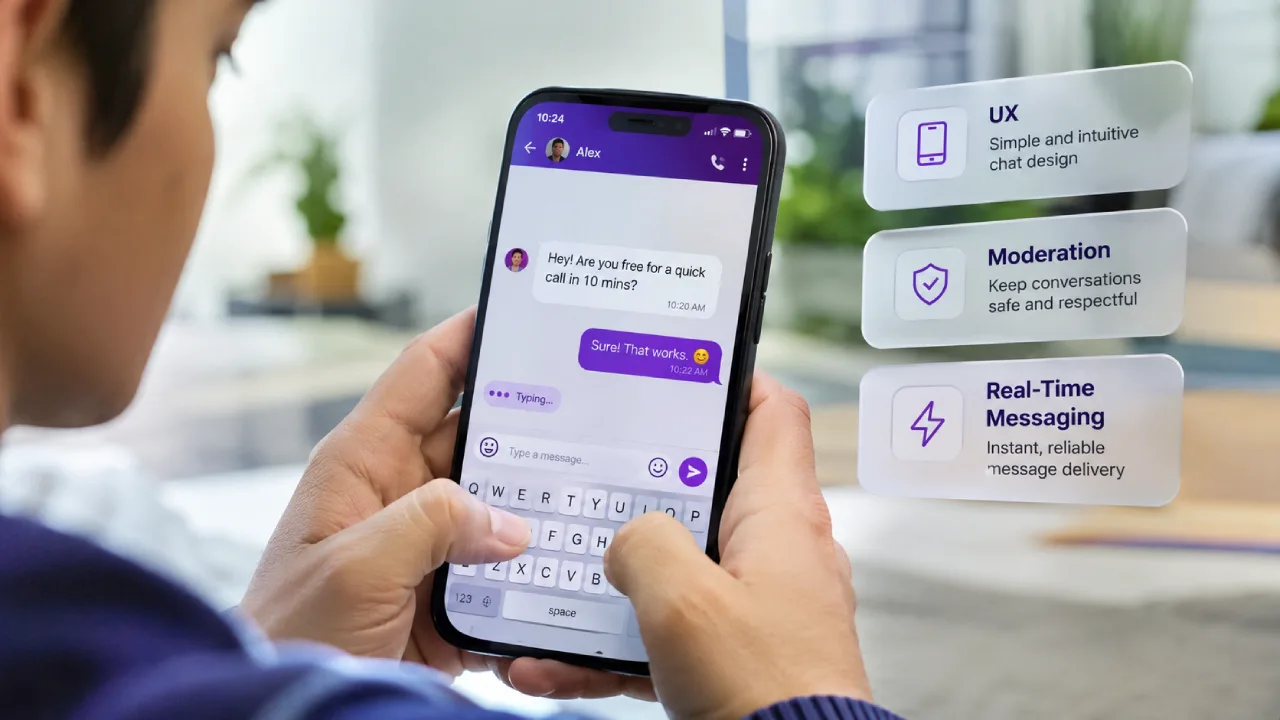
Chat Features: Chat is one of the most complex features a mobile app team can build, and one of the most underestimated. From the user’s side, it looks like a text field and a list of messages. From the engineering side, it is a persistent connection management problem, a distributed message storage problem, a real-time synchronization problem across devices, a notification delivery problem, and a content safety problem all running simultaneously, all expected to work reliably under conditions that include poor mobile connectivity, concurrent user spikes, and the full range of human communication from supportive to abusive.
In 2026, the quality bar for in-app chat includes escalation flows, moderation controls, and service-level expectations. The best chat experiences combine speed with governance, two requirements that must be designed for simultaneously from the beginning. Teams that treat moderation as a post-launch problem and governance as a compliance formality risk discovering that retrofitting both can be more expensive than designing for them upfront.
The Real-Time Infrastructure: What Makes Chat Feel Instant
The subjective experience of “real-time” in a chat interface depends on a chain of technical events happening quickly: the sender’s message leaves their device, reaches the chat server, is stored, and is pushed to every recipient’s device, where it appears in the conversation thread. Delays can degrade the conversational quality that makes chat valuable.
Modern chat apps aim to deliver messages in near-real time using WebSockets and optimized server infrastructure. WebSocket is a widely used protocol for real-time chat because it maintains a persistent, full-duplex connection between the client and server. Unlike repeated HTTP polling, WebSocket allows the server to push messages to connected clients as they become available.
Discord uses WebSockets for real-time communication. Other messaging services use different combinations of persistent connections, custom protocols, and HTTP-based communication. Telegram, for example, uses its own MTProto protocol. The consistent goal across platforms is fast and reliable delivery, although their underlying implementations differ.
Long-polling, where the client sends an HTTP request and the server holds it open until a message arrives or a timeout expires, can serve as a fallback when WebSocket connections cannot be maintained. This may be useful in certain network environments, including restrictive corporate networks. A robust chat implementation should handle connection failures and recovery without unnecessarily interrupting users.
Backend languages such as Node.js, Go, and Elixir can support high-concurrency chat applications. The appropriate choice depends on workload characteristics, team expertise, and measured performance.
Message brokers also help systems scale. Kafka supports high-throughput event streaming, RabbitMQ offers flexible message routing, and Redis Pub/Sub supports low-latency event broadcasting. Unlike durable messaging systems, ordinary Redis Pub/Sub does not store messages for subscribers that are disconnected.
Chat Features: Core UX Features: The Baseline Users Expect
Real-time message delivery, read receipts, typing indicators, and robust abuse prevention are important requirements for modern chat experiences. Which features are essential depends on the application and its users.
Typing indicators are the “…” animation showing that a conversation partner is composing a message. They can reduce the uncertainty of waiting for a response. Implementation often involves a real-time event sent when a user begins typing, which expires after a short inactivity timeout.
Read receipts close the information gap between sending a message and knowing whether it was opened or viewed. Implementation typically requires a delivery-status model covering states such as sent, delivered, and read. These states can be updated through server acknowledgments and client-side events. However, a message appearing on screen does not guarantee that the recipient actually read it.
The UX decision is whether read receipts are always shown, configurable by users, or absent. Each approach carries different privacy and communication expectations.
Message reactions allow users to acknowledge messages through emojis without sending a full reply. They can reduce unnecessary messages and communicate tone where text alone may be insufficient.
Offline message queuing helps make chat usable on unreliable mobile networks. A message created while offline can be stored locally, transmitted when connectivity returns, and marked as delivered after the appropriate acknowledgment.
Messages that fail delivery after reconnection should display a visible failure state and provide a retry option. Duplicate prevention is also important when users or applications retry sending the same message.
Data Storage: The Three-Layer Architecture
In-app chat storage can be organized into three layers that serve different access patterns.
- Hot storage: Redis or an in-memory cache can serve recent messages, temporary presence information, and typing states with low latency.
- Durable storage: PostgreSQL, DynamoDB or equivalent systems can store message history and conversation metadata.
- Blob storage: Amazon S3, Google Cloud Storage or similar services can store images, files and media attachments, with access controlled through signed URLs or other authorized methods.
The data-model decision that most directly affects chat performance at scale is how messages are indexed.
- A conversation-centric indexorganized around conversation IDs and timestamps, helps retrieve message threads efficiently.
- A user-centric indexorganized around user IDs and relevant timestamps or conversation metadata, supports user-specific views and unread-message tracking.

Some production chat systems maintain multiple indexes or materialized views to support these access patterns, accepting additional storage and write costs in exchange for faster reads.
Encryption in transit and at rest is an important security requirement. Transport connections should use supported TLS configurations, while sensitive stored information should receive appropriate encryption and access controls.
End-to-end encryption provides stronger message confidentiality by keeping decryption keys under the control of communication participants rather than the service provider.
However, end-to-end encryption also complicates server-side content search and moderation. These trade-offs must be considered during architecture planning, alongside mobile application security and privacy requirements.
Moderation: The Three-Layer System That Scales
Chat moderation can use three complementary layers, each addressing different forms of harmful or unwanted activity.
Pre-send filtering identifies content that clearly violates platform rules before delivery. Examples include blocked URLs, known harmful content patterns, and certain forms of spam.
Post-send analysis handles more nuanced moderation. Machine-learning classifiers can examine context, identify repeated harassment patterns, and flag suspicious behavior across multiple messages.
User-driven moderation provides reporting, muting, and blocking tools. Users can flag behavior that automated systems overlook and control who can contact them.
The audit-log requirement is an important governance layer. Platforms can record moderation actions, including the content or event reviewed, the decision made, the applicable policy, and the reviewer or automated system responsible.
These logs can support:
- Accountability when users challenge moderation decisions.
- Quality assessment and improvement of moderation systems.
- Compliance where applicable laws require records or explanations of moderation decisions.
Audit logs should also follow appropriate privacy, security, and retention controls.
AI-powered content moderation can help process message volumes that human reviewers cannot examine individually. Automated classifiers evaluate text, images, and links for potential violations, while uncertain or serious cases can be escalated for human review.
Additional research into AI moderation highlights the limitations of automated systems, including false positives, missed violations, and difficulty understanding context.
User controls complement automated moderation. Muting, blocking, and reporting help people manage unwanted interactions. When reporting systems provide no meaningful response, users may lose confidence in the platform’s ability to protect them.
Notifications: The Signal That Drives Re-Engagement
Push notifications bring users back to in-app conversations when the application is not actively being used.
The challenge is balancing useful alerts against notification fatigue. A group conversation with ten active participants can generate many messages in a short period. Sending a separate notification for each message may overwhelm users.
Notification grouping can combine multiple messages from one conversation into fewer alerts, making updates easier to manage.
Message previews let recipients understand an incoming message without opening the application.
However, showing message content on a locked screen can expose private conversations to nearby people. Applications should provide clear notification privacy controls, including the option to hide message previews.
A privacy-conscious design may use generic alerts when users have not chosen to display message content.
Choosing Between Building and SDK Integration
The decision to build chat infrastructure internally or integrate an SDK depends on the product’s requirements.
Custom chat infrastructure may be appropriate when messaging is a core product feature, when engineering teams have the necessary expertise, or when control over storage, encryption, and moderation justifies the investment.
SDK-based integration may be more appropriate when chat supports another primary feature or when time-to-market is important.
Providers such as Stream Chat, Sendbird, PubNub, and QuickBlox offer messaging capabilities that can reduce the amount of infrastructure developers need to maintain.
Depending on the provider, these services may handle connection management, message delivery, presence information, and moderation tools.
The trade-off is dependency on a third party’s infrastructure, data-handling practices, and product roadmap.
Teams should evaluate chat SDKs against requirements such as:
- Encryption and access controls.
- Data residency and retention options.
- Message delivery and offline recovery.
- Moderation and reporting features.
- Audit logging and administrative controls.
- Pricing, scalability, and service reliability.
What to Watch Next
Chat features in mobile applications are increasingly incorporating AI-assisted functions.
Smart replies can suggest responses, conversation summaries can help users catch up on missed discussions, and translation can support multilingual communication.
These features introduce additional questions about data access, user consent, content accuracy, and privacy.
GDPR also affects how organizations handle personal data in chat systems. Under certain conditions, users can exercise data portability rights and obtain applicable personal data in a structured, commonly used, machine-readable format.
Data residency requirements depend on the relevant jurisdiction and processing activity. GDPR does not impose a universal rule that all conversation data must remain within a particular country.
These requirements are easier to address when privacy and storage architecture are considered before the product scales.
The teams that build effective chat features in 2026 are those that treat speed and governance as parts of the same quality requirement.
A fast chat system that users do not trust may struggle to retain them. A secure chat experience that is too slow or unreliable can create similar problems.
Reliable communication, appropriate moderation, privacy controls, and scalable infrastructure must therefore be designed together.
(Source)