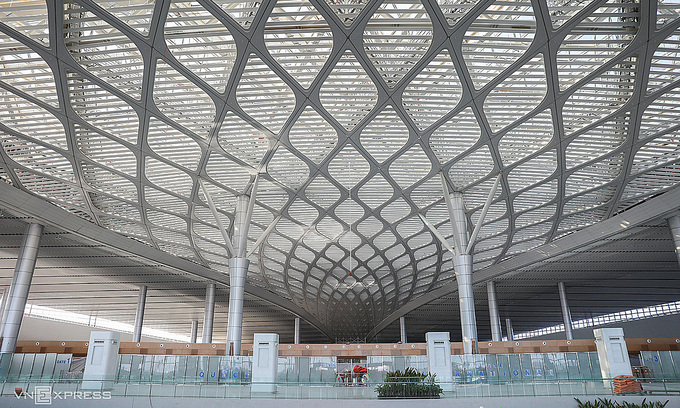
The airport in Dong Nai City, 40 km east of Tan Son Nhat International Airport in Ho Chi Minh City, is expected to open its doors on Dec. 24.
The Airports Corporation of Vietnam (ACV) has proposed moving long-haul international flights, including cargo services, from Tan Son Nhat to Long Thanh during the summer 2027 flight schedule, which begins in late March.
The remaining international flights will also move to the new airport for the winter 2027 flight schedule that will run from late October, except for routes of less than 1,000 kilometers operated by Vietnamese airlines.
But a survey by the Civil Aviation Authority of Vietnam (CAAV) found that 34 foreign carriers had proposed deferring the transition, with 24 seeking to delay the move until the winter 2027 schedule and the rest eyeing the summer 2028 schedule or later.
All airlines polled said they support an eventual transition, but worry that moving too soon could affect their operations, service quality and competitiveness.
A representative of an airline operating flights between HCMC and India said the carrier has reservations about the timing because operational conditions have yet to be clarified.
“Moving (our) entire operational setup from Tan Son Nhat to Long Thanh before its infrastructure is fully integrated will pose major challenges to operations,” he said.
|
The exterior of Long Thanh International Airport’s passenger terminal, Nov. 17, 2026. Photo by Read/Quynh Tran |
He noted that though his airline operates an average of just one flight a day at Tan Son Nhat, such a move would still require detailed planning, covering everything from route networks and aircraft deployment to flight crews, personnel, ground handling services, ticketing systems and support activities.
The preparation process typically takes 6-12 months and can be more complex for airlines with extensive route networks.
In some countries, airlines must also wait for aviation authorities to inspect and assess safety conditions and approve their operations before they can begin flying from a new airport.
The representative also said ACV has not provided sufficient information about its operational plans or when certain infrastructure components and services at the new airport will be ready.
“If operations at Long Thanh can run as smoothly as Tan Son Nhat does, the airline could move early,” he said. “However, that is not yet guaranteed.”
Connectivity with HCMC is also a major obstacle. A representative of another international airline, which operates flights to Japan, said most of its passengers have HCMC as their ultimate destination.
However, traveling from the new airport to HCMC currently depends on road transport, with many routes frequently congested and connecting infrastructure projects still unfinished, and could take a few hours or even longer, the representative said.
This could increase the total journey time for passengers, posing a particular concern for business travelers or those on tight schedules, he said.
 |
|
Inside the passenger terminal of Long Thanh International Airport, Nov. 17, 2026. Photo by Read/Quynh Tran |
The availability of services outside the airport has also been cited as a concern. The same representative said that when flights are delayed for several hours or overnight, his carrier must arrange meals, hotel accommodation and transportation that meet international standards for passengers.
At Tan Son Nhat, these services are already established and operating smoothly while those around Long Thanh may not yet be up to par.
If passengers have to be moved to HCMC for temporary accommodation and then back to Long Thanh, the airline must arrange for transport and take into account potential traffic congestion.
Even a single flight delay can trigger a series of complex logistical arrangements, increasing costs and affecting service quality.
“Passengers only see the services provided by the airline; they do not care whether the airport has sufficient facilities or services to meet their needs,” the representative said, adding that passengers may switch to another airline if they repeatedly experience such inconveniences.
For cargo services, the challenges lie in the warehouse facilities, ground handling services and logistics chain.
A representative of an international carrier said it has yet to determine how it would operate a dedicated warehouse at Long Thanh, as well as how to transport goods from satellite warehouses used by agents, importers and exporters to the airport.
The carrier has taken steps toward the transition, including discussions with ground handling service providers and warehouse operators, but is still unsure whether its existing partners will be allowed to provide services at the new airport.
This uncertainty makes it difficult for the airline to sign contracts, arrange staffing and organize training. Each carrier has its own procedures and standards for ground handling operations, requiring staff to undergo training before services officially begin.
The representative said moving to Long Thanh will only go smoothly when the infrastructure and essential services are in place and can operate in a coordinated manner.
 |
|
The HCMC-Long Thanh-Dau Giay Expressway connecting to Long Thanh International Airport, Nov. 20, 2026. Photo by Read/Quynh Tran |
These concerns also highlight the need for sufficient time to test the new airport’s operations in practice, not only at individual components but also in terms of coordination between different units.
A report by ACV said the Operational Readiness and Airport Transfer program at Long Thanh comprises 55 scenarios, to be carried out in three rounds from September to December.
The Ministry of Construction said this is a relatively short testing period for a new airport with many complex systems, leaving less time to identify and fix problems and conduct further testing.
It noted that putting the airport into operation must be based on its actual level of readiness, ensuring safety and continuity in aviation operations.
The ministry earlier this month instructed ACV to work with CAAV and relevant agencies to finalize the operational plan and review the progress of individual components, acceptance inspections, trial operations and legal procedures.
CAAV was also tasked with providing guidance on licensing requirements and reviewing ACV’s operational plan before submitting it to the ministry.
At a meeting with Dong Nai leaders on Nov. 19, ACV reiterated its target of beginning commercial operations on Dec. 24.
In the initial phase, the airport is expected to operate its west wing and the central section of the passenger terminal, handling around 20-30 flights a day.
Dong Nai is accelerating work on connecting transport infrastructure and coordinating preparations for the airport’s operations.
Long Thanh Airport is being built on an area of around 5,000 hectares and will be developed in three investment phases.
The first phase has a designed annual capacity of 25 million passengers and 1.2 million tonnes of cargo.