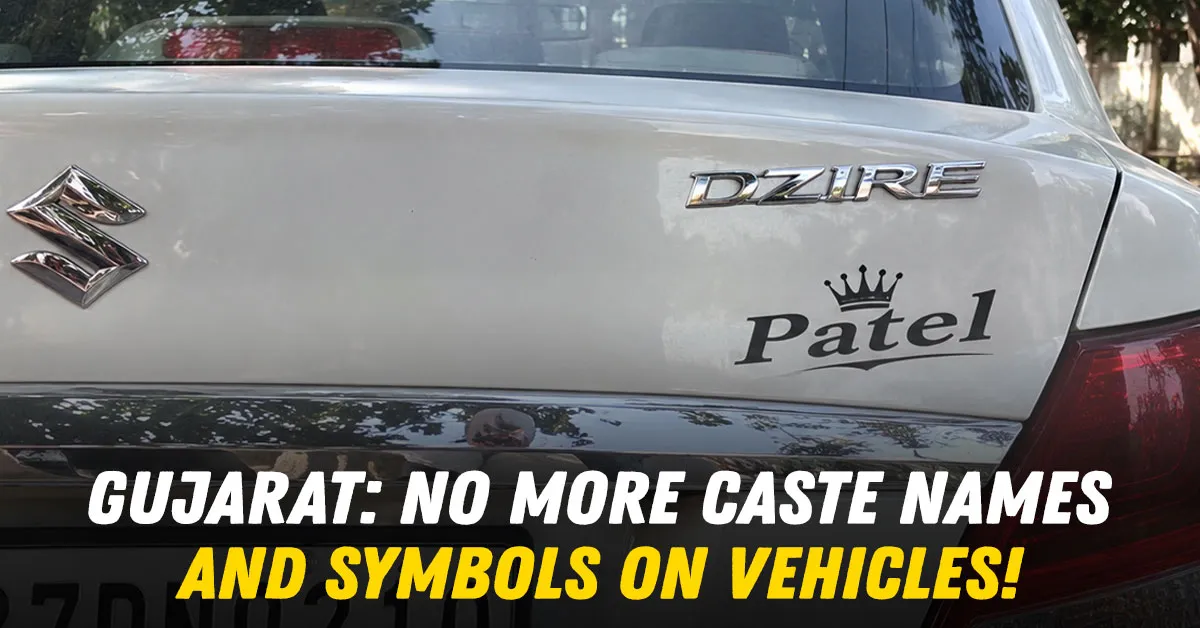
Car and motorcycle owners in Gujarat can no longer display caste-identifying words, symbols or signs on their private vehicles. The state government has amended its motor vehicle rules to specifically prohibit such displays, giving traffic police and transport officials a clearer legal basis to act against them.
The Gujarat Ports and Transport Department notified the Gujarat Motor Vehicles (Third Amendment) Rules, 2026, on November 17. The change applies to private vehicles and is not restricted to cars: the reporting on the notification also includes two-wheelers, three-wheelers and privately registered buses or trucks.
The amendment changes Rule 125(1) of the Gujarat Motor Vehicles Rules, 1989, by specifically adding caste signage to an existing provision about advertising devices and figures. It also inserts Rule 138(3), which prohibits advertising devices, caste signage, figures or writing on private vehicles unless the state government allows them through a general or special order.
In simple terms, a driver should not assume that a caste name written across a windscreen, a community-identifying slogan on a rear window or a symbol on a door is allowed merely because it is not printed on the number plate. The restriction concerns displays on the vehicle, not only stickers that obscure registration details.
The rules provide for exceptions authorised by the state government. That means motorists should also avoid assuming that every sign or marking needed for an authorised purpose is automatically banned. The exact treatment of a particular display will depend on the notified wording and any government exemptions.
The state had published draft changes in June 2026 and invited objections and suggestions for 30 days. According to the government, it received none during that period, after which the final amendment was issued in November.
Reports also say the Centre had advised states on caste-based signage and that Uttar Pradesh had earlier introduced a similar change following an Allahabad High Court judgment. Gujarat’s action therefore comes as part of a wider effort to discourage the public display of caste identity on vehicles.
Vehicle stickers are not always harmless decorations. When a large slogan, banner or symbol covers the glass, it can interfere with visibility. Writing that attracts attention to community or status may also create disputes on the road.
The immediate step is to inspect the windscreen, rear glass, bumpers and body panels for caste names, caste-identifying slogans and symbols. Removing a questionable sticker is simpler than trying to argue about its meaning during a roadside check. Owners should also avoid replacing it with lettering that could be interpreted in the same way.
Number plates are a separate issue. Registration plates must already meet their own specifications, and decorative writing or symbols that obscure them can invite action under existing law. Keeping a number plate clear does not make other prohibited body stickers legal.
There is an important distinction on penalties. The reports on the amendment describe the new prohibition, but they do not mention a separate fixed fine applicable to every caste-related sticker. The amount and legal provision used in a particular challan will depend on the violation recorded by the authorities.
Officials have indicated that RTOs and police jurisdictions will receive instructions on implementation. That matters because a straightforward caste name is easier to identify than an ambiguous abbreviation or symbol. Clear guidance can reduce arguments about what counts as caste signage and help prevent inconsistent treatment of motorists.
The amendment also uses broad language about advertising devices, figures and writing. Authorities will need to explain how this interacts with legitimate identification marks and any specific exemptions. Owners should follow official transport-department instructions rather than social-media claims that all stickers are banned or that only registration-plate stickers are affected.
Source