Mainland China and Hong Kong accounted for the biggest share of shipments, worth $1.42 billion, according to the Vietnam Association of Seafood Exporters and Producers.
Exports to the U.S. were worth over $563 million, followed by Japan with $503 million, the EU with $461 million and Australia with $241 million.
Whiteleg shrimp exports amounted to $2.62 billion while green lobster and black tiger shrimp generated $915 million and $407.2 million, respectively.
The association said the global shrimp market is projected to see abundant supplies from Ecuador and India next year, intensifying price competition.
Demand is expected to vary across markets and segments while trade will be affected by tariff policies and import barriers, it noted.
Value-added, convenient and premium shrimp products are becoming increasingly important while production costs, traceability and sustainability are emerging as key factors determining competitiveness, it added.
|
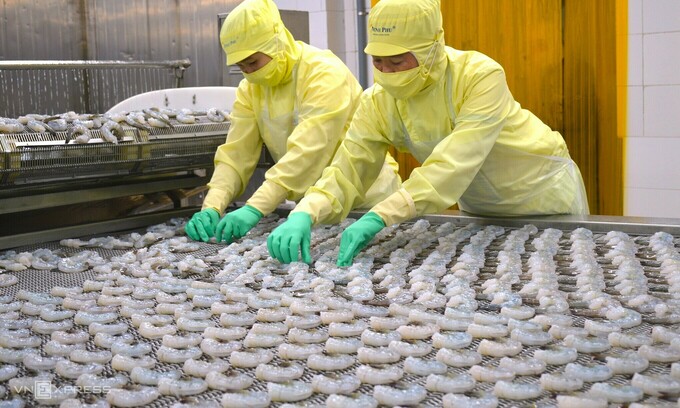
Shrimps being processed at a factory in Ca Mau Province, southern Vietnam. Photo by VnExpress/Chuc Ly |
Roughly 759,500 hectares are used for shrimp farming across Vietnam, including 637,400 hectares for black tiger shrimp and 122,100 hectares for whiteleg shrimp, according to official reports.
Production is estimated to jump 5% year-on-year to 1.47 million tonnes this year, with whiteleg shrimp accounting for 69% and black tiger shrimp the remainder. The target output for next year is 1.5 million tonnes.
The Mekong Delta is the top producer, accounting for 94% of area and 88% of nationwide output.
Vietnam currently has 488 shrimp-processing facilities that qualify for export with a combined designed capacity of around 1.4 million tonnes a year.
The industry faces several challenges, including fragmented production, inadequate infrastructure in farming areas and a lack of consistent controls over the quality and traceability of shrimp seed.
Data on environmental monitoring, disease outbreaks and production are not effectively integrated while cooperation among farmers, cooperatives and businesses remains weak.
The Department of Fisheries and Fisheries Surveillance pointed out that higher production does not necessarily translate into higher profits and incomes for farmers.
The ability to coordinate and manage the entire value chain, from shrimp seed and farming conditions to purchasing, processing and distribution, also needs improvement, it said.