8
BJP leader says technology must complement human reasoning, creativity and independent thinking.
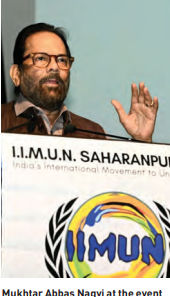
Senior BJP leader and former Union Minister Mukhtar Abbas Naqvi on Saturday cautioned against excessive dependence on Artificial Intelligence (AI), saying that indiscriminate reliance on machine-based intelligence at the expense of human reasoning and original thinking could weaken mental capabilities.
Addressing an event organised by the India’s International Movement to Unite Nations (IIMUN), Naqvi said Artificial Intelligence should be treated as a supportive tool rather than a substitute for natural human intelligence. Describing AI as a “Tashan” and not a “Tonic” for original intelligence, he said technology could provide convenient assistance in addressing problems but could not be considered a definitive solution.
Naqvi argued that the growing tendency to seek results without putting in sufficient effort, while depending heavily on AI, was gradually restricting human capabilities. He emphasised that technological advancements should complement an individual’s thinking, reasoning and analytical abilities rather than make people dependent on machines.
“Focus on intelligence, not imitation,” Naqvi said, stressing that AI-driven technologies should strengthen human capabilities and confidence instead of becoming a compulsion that limits independent thinking. He cautioned that blindly relying on artificial intelligence could sometimes lead users in the wrong direction and undermine their ability to distinguish between reliable and misleading information.
Raising concerns over the credibility of digital information, Naqvi also said fact-checking tools should not be trusted unquestioningly, as some platforms could be influenced by their commercial interests and commitments. He urged people, particularly young users, to exercise caution and independent judgement while accessing digital resources. He added that even leading experts in artificial intelligence were increasingly raising questions about the reliability and credibility of the technology.
Highlighting India’s progress in education and technology, Naqvi described the country’s journey from “Gurukul to Google” as a reflection of its educational legacy and technological transformation. He said India’s historical contribution to learning, represented by institutions such as Takshashila, combined with its growing technological capabilities, had established the country as a major centre of educational excellence, or a “Shaktipeetha of Shiksha”.
However, Naqvi acknowledged the transformative potential of Artificial Intelligence and digital literacy in reshaping the global education system. He said generative AI was a significant technological development that could be effectively used to improve teaching methods, facilitate learning and strengthen skill development, provided it was utilised alongside human intelligence and critical thinking.
Referring to the government’s vision of building a developed India by 2047, Naqvi said Prime Minister Narendra Modi considered the country’s younger generation the principal pillar of this national ambition. He highlighted initiatives such as Skill India, Startup India and Digital India, stating that the government was consistently working to create opportunities for young people and equip them with the skills required to compete in an increasingly technology-driven global economy.