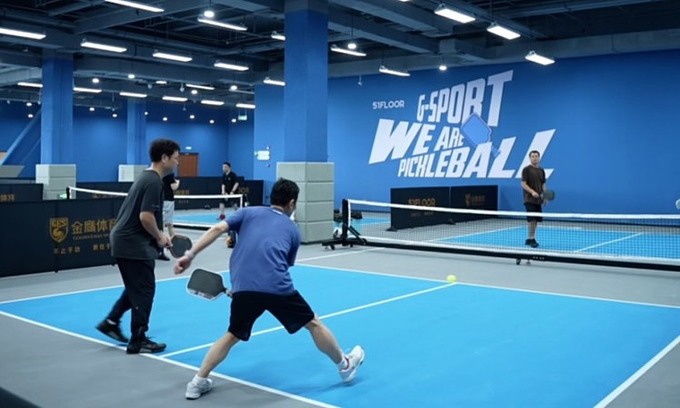
As night falls, the 51st floor of the Golden Eagle World building in Nanjing remains lively with the pop of bouncing balls. On the pickleball courts up high, players move constantly, swinging paddles and chatting between matches. For many, the venue is more than just a place to exercise after work. It’s a social hub where friends gather before taking the elevator downstairs for dinner or shopping.
Spanning roughly 12,000 square meters, the sky-high sports complex began trial operations on May 30 this year. According to authorities in Nanjing’s Jianye District, the facility features 11 international-standard pickleball courts, an indoor golf zone, and a fitness and rehabilitation center.
This complex reflects a trend across China, as sports are no longer confined to traditional stadiums or gyms, but are increasingly integrated into retail, entertainment, tourism and social life, according to Chinese media.
|
A pickleball court on the 51st floor of the Golden Eagle World building in Nanjing, China, Photo by Instagram/@inanjingjs |
In Chongqing’s Liangjiang New Area, unused space beneath a bridge has been transformed into a complex featuring sports courts, hot pot restaurants and a gathering hub for motorcycle enthusiasts. Similarly, a sports park beneath Wuhan’s Erqi Yangtze River Bridge now integrates cafés, fast-food outlets and a supermarket, allowing residents to combine workouts, dining and other activities into a single outing.
According to Xinhuathis shift mirrors changing consumer demands. Besides physical fitness, they also value social connection, experiences and mental well-being, turning pickleball, group runs and cycling clubs into parts of their social life.
From sports venues to a multi-billion-dollar market
This surge in participation has fueled rapid growth in sporting equipment sales. Cycling enthusiast Li Bin told Xinhua that after buying a bicycle for 2,500 yuan (US$374), he recently upgraded to a custom build whose frame and components alone exceeded 10,000 yuan, on top of helmets, lights, apparel, eyewear and action cameras.
By the end of August 2025, China has more than 130 million cyclists, with the cycling industry’s total output reaching roughly 300 billion yuan ($44.92 billion).
Outdoor pursuits such as trail running, mountaineering and camping have also boosted the retail market. Across four major Chinese e-commerce platforms, sales of products related to these activities reached 142.37 billion yuan in 2025, a 22.22% year-on-year increase, with trail running shoes and technical apparel remaining top sellers during the Nov. 11, 2026 Singles’ Day sales.
Not just equipment sales, grassroots and amateur tournaments are also generating new customers for tourism, hospitality and retail.
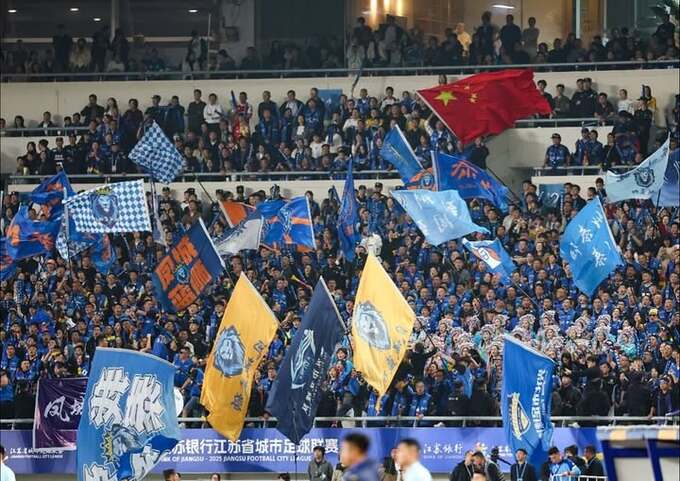
A prime example is Jiangsu Province’s inter-city football league, widely known as “Suchao.” Across 91 matches in the 2026 season, the league attracted 3.0395 million in-person spectators, a nearly 25% jump from the previous season, with average attendance climbing from 28,600 to roughly 33,400 per match, China Daily reported.
 |
|
Spectators during the “Suchao” championship match at Nanjing Olympic Sports Center on Nov. 1, 2026. Photo by Instagram/@inanjingjs |
Outside packed stadiums, more than 700 public viewing zones popped up in shopping malls, tourist zones and residential neighborhoods, allowing fans to watch big-screen broadcasts alongside local food stalls and cultural fairs. In Changzhou, one ready-to-eat food vendor and league sponsor reported that sales tripled or quadrupled on major matchdays thanks to visiting supporters.
Jiangsu authorities also tied match tickets to regional tourism, offering ticket holders discounts at scenic spots, hotels, restaurants and malls across all 13 cities, some valid for up to 15 days before and after kickoff, turning single games into multi-day trips.
In Guizhou Province, a similar sports-tourism model saw more than 3,800 sporting events hosted during the first nine months of 2026, generating an estimated 4.2 billion yuan in consumer spending.
Star power drives purchasing power
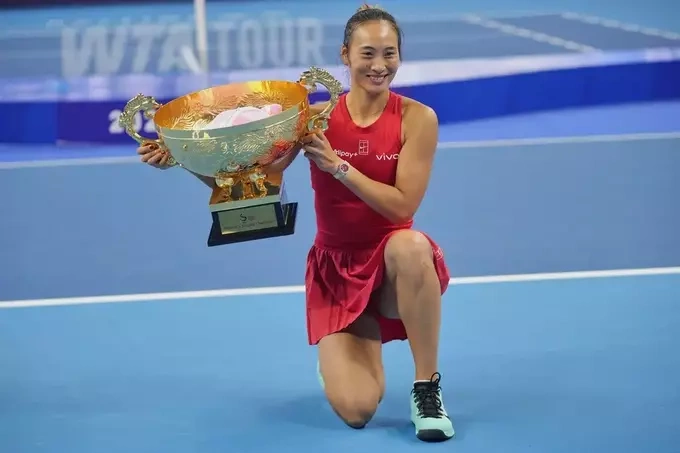
Alongside grassroots competitions, professional tournaments remain crucial for attracting visitors and spending. At the 2026 China Open in Beijing, tennis star Zheng Qinwen’s run to the women’s singles title packed the Diamond Court to near capacity.
Organizers reported record ticket revenue of 132 million yuan, a 48% surge over the previous year, as total attendance at the National Tennis Center topped 450,000, up 25%. Roughly 60% of spectators traveled from outside Beijing, underscoring how star-driven events generate hotel bookings, dining and retail consumption.
Citing the Beijing Municipal Bureau of Sports, financial outlet Yicai reported that the 2026 China Open generated roughly 2.59 billion yuan in direct economic impact and another 6.67 billion yuan in indirect economic impact. These figures are distinct from ticket sales or direct income from on-site commercial activities.
In Shanghai, flagship events such as the Formula 1 Chinese Grand Prix, the ATP Shanghai Masters and the Shanghai Marathon helped push the city’s sports-related consumption past 100 billion yuan in 2025.
 |
|
Zheng Qinwen poses with the trophy after defeating Mirra Andreeva in the women’s singles final of the China Open on the Capital Group Diamond Court, National Tennis Center, Beijing, China, on Oct. 11, 2026. Photo by AP |
The challenge of sustaining momentum
Despite rapid expansion, China’s sports economy faces many challenges. Many local amateur events draw crowds during competition only to see interest drop afterward, while copycat event formats and high venue operating costs make consistent traffic difficult to maintain. Inconsistent coordination between event organizers, tourism boards, and local businesses also leaves commercial value unutilized.
Associate Professor Zhang Youyin of Beijing Sport University suggests in his study that cities create distinctive sporting identities rather than chasing trends, investing not only in global tournaments, but also in grassroots competitions and traditional cultural sports like martial arts, dragon dances and lion dances.
Strengthening cross-industry partnerships is another solution. Local authorities could establish a mechanism where sports event ticket holders receive special discounts on shopping, transportation or sightseeing in other cities.
Technology also presents more business opportunities. During the final round of the Chinese Super League on Nov. 8, cinemas across Liaoning Province broadcast the title-deciding matches live on the big screen, drawing over 10,000 fans while boosting cinema food, beverage and entertainment sales.
Under its 2026–2030 sports development plan, China aims to expand the total scale of the sports industry to more than 7 trillion yuan by 2030. From sky-high pickleball courts in Nanjing to packed provincial football stadiums, sports are becoming increasingly integrated into urban life.
The biggest next challenge is no longer attracting people to the events, but rather turning fleeting interest of spectators into lasting, sustainable habits of fitness and consumption.