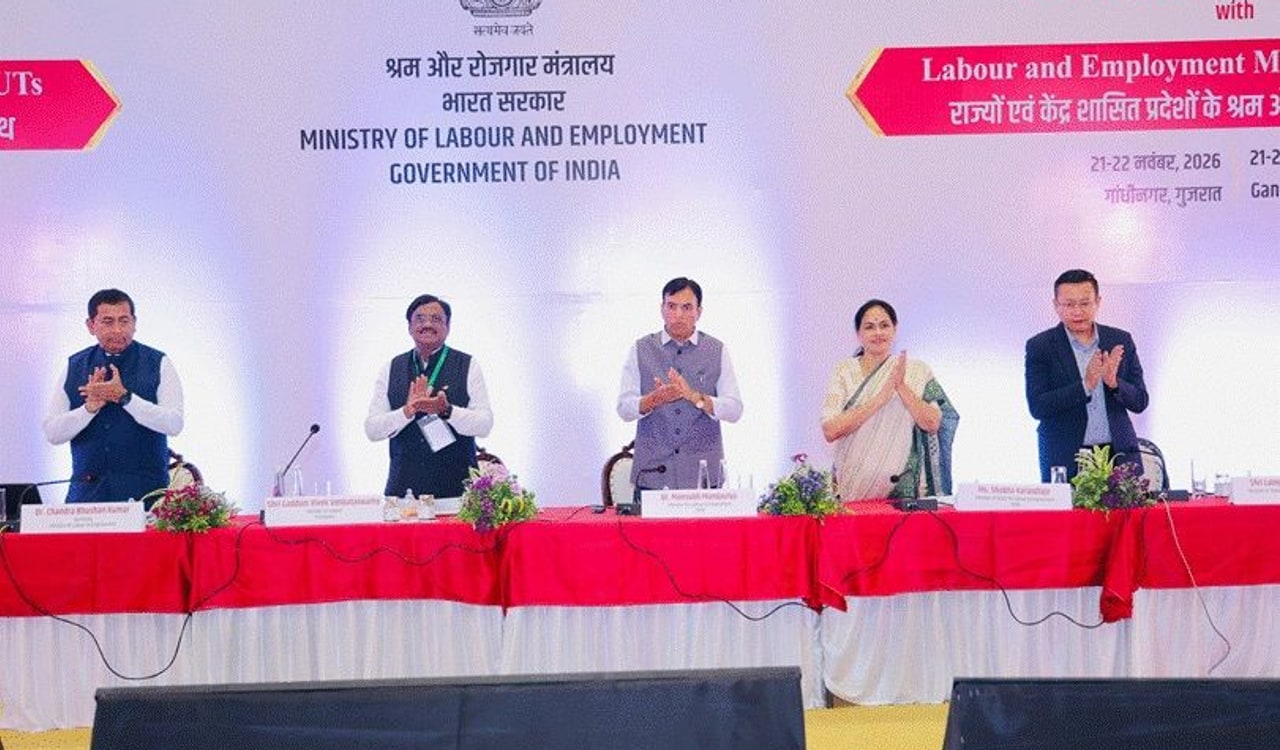
Union Labour Minister Mansukh Mandaviya launched the NCS ONE Portal, Occupational Shortage Index and e-Shram Livelihood Profile Module at the Chintan Shivir in Gandhinagar to strengthen employment, skilling and social security services.
Updated On – 22 November 2026, 11:03 PM
Union Minister of Labour and Employment Mansukh Mandaviya launches the National Career Service (NCS) Open Network for Employment (ONE) Portal at the Chintan Shivir in Gandhinagar on Sunday.
Gandhinagar: Union Minister of Labour and Employment Mansukh Mandaviya on Sunday formally launched the National Career Service (NCS) Open Network for Employment (ONE) Portal, with new features including a Voice Bot, Chat Bot, Occupational Shortage Index (OSI) and e-Shram Livelihood Profile Module.
The initiatives, aimed at strengthening India’s labour and employment ecosystem, were rolled out on the second day of the two-day Chintan Shivir here in the presence of ministers from all States and Union Territories.
The NCS ONE Portal links jobseeker applications, employer applications, State employment portals, private job platforms and campuses. The OSI is a data-driven tool to assess labour market demand and supply gaps.
The OSI will help jobseekers make informed career choices, employers identify shortages and plan recruitment, education and training institutions align skilling, re-skilling and up-skilling with industry demand, and policymakers make targeted employment and skilling interventions, according to an official statement.
The e-Shram Livelihood Profile tracks a worker’s livelihood information alongside five essential social security protections, or Panch Suraksha: food security, health protection, life insurance, accident and disability protection, and pension security.
Mandaviya also virtually launched eight Career Lounges at Jaipur, Ludhiana, Bhubaneswar, Kanpur, Bengaluru, Varanasi, Hyderabad and Guwahati under the Ministry’s Career Lounges initiative.
Career Lounges are being established as a strategic extension of Model Career Centres (MCCs) under the NCS framework. A total of 200 centres will be set up in employment exchanges, universities and educational institutions, particularly in Tier-II and Tier-III cities, in collaboration with industry partners.
The Career Lounges will provide career guidance, skill and aptitude assessments, mentoring, employability training, industry interactions, internships, apprenticeships and placement support.
They will also provide exposure to international employment opportunities, global labour market trends, international skill requirements and occupational standards, including language and cross-cultural preparedness. This is aimed at enhancing the global employability of India’s youth and connecting them with emerging opportunities in domestic and international labour markets.
Mandaviya unveiled two publications — the Addendum to the National Classification of Occupations (NCO-2015) and Compilation of Existing and Emerging Green Occupations — at the event.
In his closing remarks, Mandaviya said the two-day Chintan Shivir had brought forward a wide range of practical insights, field experiences and policy perspectives from States and Union Territories.
He said decisive action on the deliberations, in line with Prime Minister Narendra Modi’s vision, would guide the nation towards Viksit Bharat while empowering India’s Shram Shakti.
Mandaviya said the suggestions and learnings exchanged during the conclave would help safeguard and strengthen workers’ interests while supporting more effective ground-level implementation of the Labour Codes.
He emphasised the importance of sustained Centre-State partnership, saying coordinated efforts and shared resolve would help build a responsive, inclusive and future-ready labour and employment ecosystem across the country.
The second day of the Chintan Shivir included sessions on the Labour and Employment Stack and Career Lounges for International Labour Mobility. The sessions featured presentations by officials, while participating States shared best-practice videos.
Across both days, thematic plenary sessions covered Labour Codes implementation, employment initiatives, Employees’ Provident Fund Organisation (EPFO) reforms, Employees’ State Insurance Corporation (ESIC) reforms, social security for unorganised workers and labour statistics.