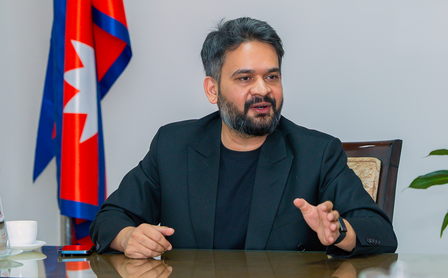
New Delhi: Shoring up bilateral ties in energy, hydropower, railways, connectivity and infrastructure is set to be the key focus of talks between Prime Minister Narendra Modi and his Nepalese counterpart Balendra Shah Monday.
The meeting between the two leaders is expected to provide political direction for a major upswing in the relationship in the coming years, people familiar with the matter said.
Shah is kick-starting his two-day trip to New Delhi later this afternoon. It will be his first visit to India after assuming the charge of the top office in March.
Following their talks, the two Prime Ministers would virtually inaugurate several projects in Nepal, the people cited above said, adding that a number of “forward-looking” bilateral documents in diverse areas are expected to be concluded and exchanged between the two sides.
This visit comes at an opportune time, as there is considerable synergy between the national priorities of both countries regarding economic growth, social development, infrastructure expansion, technology adoption and addressing issues like natural disasters and climate change, one of the people said.
Major outcomes to expand cooperation are likely to be announced in sectors like energy, hydropower, railways, connectivity and infrastructure, the people said.
It is learnt that the two sides are also set to explore ways to enhance bilateral economic engagement. India is Nepal’s largest trade, transit and investment partner and the Himalayan nation enjoys duty-free access to the Indian market.
Also Read : Nepal PM Balendra Shah to hold talks with Modi November 23 during two-day state visit
India is also Nepal’s biggest export destination, receiving about 80 per cent of Nepal’s goods exports.
India is also the largest source of foreign investment in Nepal, accounting for almost one-third of the total foreign direct investment received by the country.
Both sides have nurtured a comprehensive development partnership that is one of the key pillars of bilateral interaction, featuring numerous operational and ongoing projects and initiatives.
In 2025-26, Nepal’s revenue from net electricity exports to India was approximately 1800 crore Nepalese Rupees.
India and Nepal share a substantial partnership in the field of energy, where the long-term supply agreement plays a key role in meeting the neighbouring country’s energy requirements.
In the connectivity sector, both sides are discussing new possibilities such as the Raxaul-Kathmandu railway link, which could open new avenues for cross-border passenger and freight connectivity.
A new passenger train service will commence between Ayodhya and Janakpur Dham, connecting two of the most revered centres of the Ramayana tradition, the people cited above said.
Nepal is important for India in the context of its overall strategic interests in the region, and leaders of the two countries have often noted the age-old “Roti Beti” relationship.
Land-locked Nepal relies heavily on India for the transportation of goods and services. Nepal’s access to the sea is through India and it imports a predominant proportion of its requirements from and through India.
In May, the bilateral relations came under some unease following Shah’s remarks seeking involvement of China and the United Kingdom to address the long-standing border dispute between India and Nepal.
Days later, New Delhi categorically rejected any role for third parties to resolve its boundary row with Nepal, saying the two countries have an established bilateral mechanism to deal with all aspects of the border issue.
Nepal and India have had an old boundary dispute over Lipulekh, Limpiyadhura and Kalapani. India has consistently maintained that the territories are part of Uttarakhand.