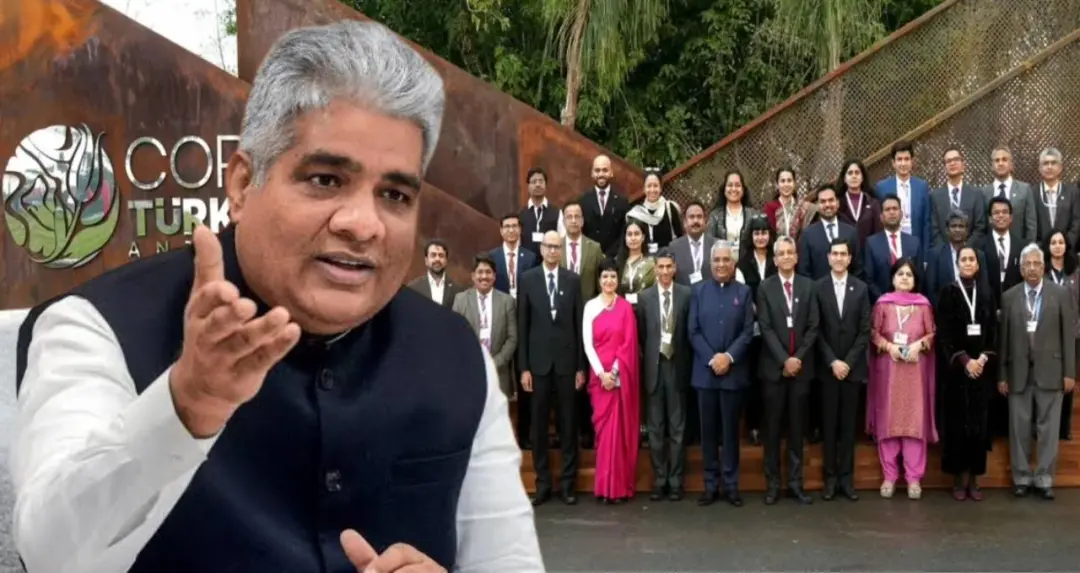
The climate conference COP31 held in Turkey ended without any major agreement. Nearly 200 countries participated in the talks that lasted more than two weeks, but no consensus could be reached on issues like fossil fuels and economic aid.
COP31: This time the major decision that the world was expecting from the COP31 conference held in Antalya, Turkey regarding climate change could not be taken. The conference ended on Sunday, but the countries were unable to approve any common plan to reduce the use of coal, oil and gas. The issue of financial assistance also remained complicated. India has expressed disappointment over the results of the conference and said that the climate crisis cannot be solved by ignoring the needs of developing countries.
Union Environment Minister Bhupendra Yadav said that the Indian delegation participated in the talks till the last moment. India's effort was to find a solution that could be accepted by developed and developing countries, keeping in mind the interests of all countries.
The meeting lasted two days more than scheduled
The COP31 conference began on 9 November. Earlier the plan was to complete it by November 20. But the dispute over the terms of the final agreement increased so much that the talks had to continue till Sunday, November 22. Even after getting extra time, the delegations could not resolve their differences. The biggest hurdle came regarding the use of coal, oil and natural gas. Many countries, including the European Union, demanded that the world should make a clear time-bound plan to reduce dependence on fossil fuels.
At the same time, some countries dependent on oil and gas production opposed it. He said that it would be difficult to take such decisions without keeping in mind the energy needs and economic situation. Due to this tussle, the main political agreement remained incomplete. However, separate decisions were taken at the conference on some other topics related to energy transition and environment.
India kept its point till the last moment
After the conference, Union Environment Minister Bhupendra Yadav shared India's side on social media platform X. He said that India tried to take forward the dialogue with the BASIC group and other developing countries. India's main concern was that in the name of preventing climate change, such responsibilities should not be imposed on developing countries, which would be economically difficult for them to fulfill.
India believes that the needs and resources of every country are different. Even today in many developing countries it is necessary to expand basic facilities like electricity, transportation and industry. In such a situation, they will need both time and cooperation to move towards clean energy. Bhupendra Yadav said that India also had objections to some parts of the final agreement. Despite this, instead of withdrawing from talks, India continued trying to build a consensus.
Countries again embroiled in financial aid issue
Another big issue in the conference was climate finance. Poor and developing countries demanded that rich countries provide more financial assistance to reduce the damage caused by climate change and adopt clean energy. Their argument behind this demand is that due to long-term industrial activities, developed countries emit large amounts of carbon. Now climate change is also affecting those countries whose historical role in increasing this problem has been relatively less.
Floods, drought and rising temperatures are already affecting people's lives and employment in many countries. To deal with these problems, along with money, modern technology is also needed. India also raised this issue prominently. He says that merely setting targets for reducing emissions will not be enough. Necessary resources should also be available to achieve these goals. However, this time the expected consensus could not be reached on new commitments related to financial assistance.
India's emphasis on increasing solar energy
Despite no major agreement in COP31, India has made it clear that work on clean energy related schemes will continue in the country. According to Environment Minister Bhupendra Yadav, India's installed solar power capacity has crossed 170 GW. By the end of October 2026, this figure was reported to reach around 175 gigawatts.
The government is also promoting the installation of solar panels on rooftops of homes along with large solar power plants. Apart from this, attention is being given to expansion of wind energy and electricity saving technologies. It is also important for India to meet the increasing demand for electricity. For this reason, the government is trying to strike a balance between increasing energy production and reducing pollution.
Now what is expected from the next conference?
UN Climate Change Executive Secretary Simon Steele also expressed disappointment over the lack of a major agreement at COP31. However, he noted the progress made on some topics during the conference as important. Now the next climate conference COP32 is to be held in Addis Ababa, the capital of Ethiopia in the year 2027. It is expected that this time there will be talks again on the issues that remained incomplete.
At present, the biggest question is how long will the countries of the world be able to reach a consensus between their economic interests and environmental needs. Because the impact of climate change is continuously increasing and to deal with it, not only announcements but also concrete decisions are necessary.