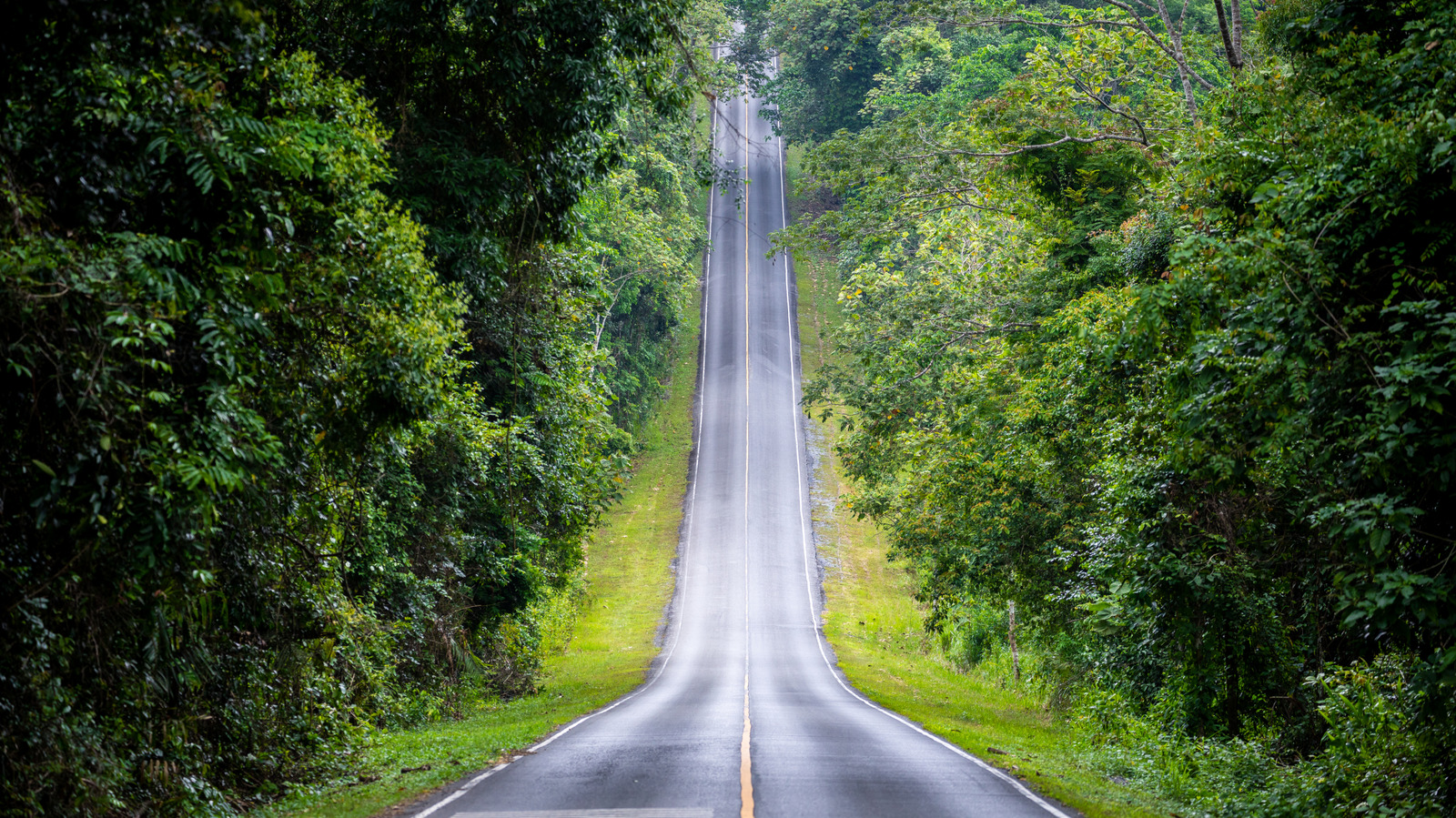
Doc Brown once told Marty McFly that they didn’t need roads where they were going, and then zipped off into the future in the iconic time-traveling DeLorean. Sadly, we still live in the real world where we do indeed need roads. Scattered across the United States are thoroughfares technically classified as roads, but they require such Herculean courage that only daredevils would attempt to scale them.
First, let’s establish some ground rules. A road’s steepness equals the elevation change divided by horizontal distance. So, if the elevation increases 4 feet over a horizontal distance of 100 feet, the roadway grade equals 4% (expressed as a percentage). A 45-degree incline equals a 100% grade, and it’s that angle where the force you can accelerate matches the force pulling you backward. If the car doesn’t have the power or traction to combat that gravitational pull, it’ll slide back down the hill.
To climb such a beast, a vehicle needs a tire-to-road coefficient of friction — the grip — of at least 1.0. In other words, a full “one G” of traction vertically and horizontally is needed just to keep from sliding backward. Most standard passenger cars don’t have the traction, engine torque, or clearance to climb anything steeper than a 30-degree slope (a 58% grade). Even the road surface can determine whether a climb succeeds. One exception is the Mercedes G-Wagon, which can clamber up a 45-degree hill, but only under the proper conditions.
Waipio Valley Road in Honokaa, Hawaii
The city streets on this list aren’t known for their length or beauty, so they’re not something you’d drive on a leisurely Sunday afternoon, certainly not like any of those on our list of curviest roads to drive in America. Interestingly, eight of the top 11 steepest streets are located in California, which is also home to one of the crookedest streets in the world. Their steepness makes them unique, and they aren’t for the faint of heart.
Back in 1944, when the federal government first began creating urban interstates, the design standard for road grades stated that they “shall preferably be not steeper than 3 percent and shall in no case exceed 5 percent.” That’s no longer the case, as engineering standards now account for vehicle performance limits, road classification, design speed, and terrain type, as outlined by the American Association of State Highway and Transportation Officials (AASHTO).
Leading the pack is a road most people will need an airplane to reach. Waipio Valley Road sits on the Big Island of Hawaii. At just 1.4 miles, it traverses the valley’s overlook and drops down into the valley some 800 feet in elevation in a mere 0.6 miles, with an average grade of 25%. One particular section hits as much as 45%. It’s recently been restricted to county residents and tour operators driving low-range, four-wheel-drive vehicles. It’s so steep, the infamous professional road racing cyclist Lance Armstrong said, “You know it’s steep when the people walking down are walking backwards.” (via HuffPost).
San Francisco, California
Next is Bradford Street in San Francisco, California, which winds through the Bernal Heights neighborhood. A good chunk of it has a 24% grade, but for a brief patch of about 30 feet (above Tompkins Avenue), it hits its maximum gradient of 41%, making it the steepest in the City by the Bay. Believe it or not, some of Bradford Street wasn’t completely paved until 2010.
Here’s where things take a major turn. Most lists have Canton Avenue in Pittsburgh, Pennsylvania, with its maximum grade of 37%, listed as the next steepest street. In fact, it’s often referred to as the steepest public street “officially recorded” in America. That may have been true until software engineer and computer scientist Stephen Von Worley came along. In 2025, Worley published a new list of 12 of the steepest streets in San Francisco — all with at least a 31% grade — using data from the National Elevation Dataset and an Open Streets Map grid.
Two sit at 31%, while four others tie at 31.5%; two of those had never been measured. Interestingly, none of them matter now because he found four others that also had never been measured. Romolo (between Vallejo and Fresno) has a 37.5% grade, which makes it slightly steeper than Canton Avenue in Pittsburgh. Prentiss (between Chapman and Powhattan) has a 37% grade, tying Canton. Nevada (above Chapman) has a 35% grade, and Baden (above Mangels) has a 34% grade. All four of these newly measured streets bump others from any previous list.
Los Angeles, California
Los Angeles, California, is home to four of our final five steep streets in the U.S. Consequently, LA’s roads are getting worse, just not for the reason you might think. Despite Worley’s new findings about San Francisco, these LA streets barely managed to stay on the list. Four of the final five tie with a 32% maximum grade. Now you see why the six streets up north in San Francisco with 31% or 31.5% got bumped off the list.
Three have a 32% max grade and include 28th St. (between Gaffey St. and Peck Ave.), Baxter St. (between Allesandro and Alvarado), built in 1872 and is used by dealerships to show off a vehicle’s engine power, and Fargo St. With a max grade of just 1% more is Eldred Street in the Highland Park neighborhood northeast of Los Angeles. A majority of Eldred has a 33% grade, but a stretch of about 400 feet above Avenue 48 tops out at 33.3%. This makes it the longest, steepest incline in the City of Angels. It’s so steep, in fact, the U.S. Postal Service doesn’t deliver mail to houses on the incline, and special mini rear-loading garbage trucks are needed to collect trash along the route.
Lastly, we have Maria Ave. in Spring Valley, California — also at 32% on Dictionary Hill just north of Chestnut Street. Worley’s findings pushed other roads long thought “steep,” like Dornbush (also in Pittsburgh) at 31.98%, 22nd St., and Filbert St. (both in San Francisco) at 31.50% — right off any list. Considering what Worley did recently, it’s probably only a matter of time before someone else does the same thing for streets in other cities.