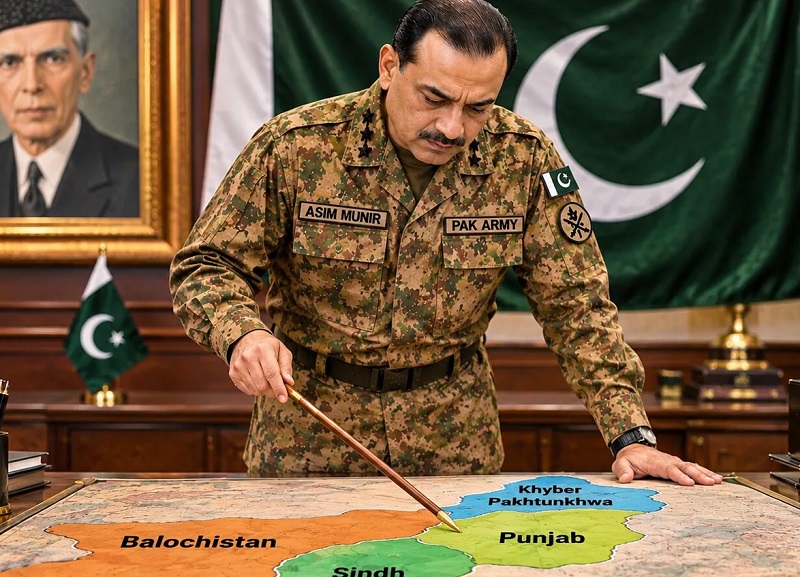
Islamabad. Pakistan Army Chief Field Marshal Asim Munir is preparing to change the political and administrative map of the country. Under this, a proposal to divide the existing four provinces into 12 to 15 smaller provinces is under discussion. It is being said that it is a plan to improve administration and provide government facilities to the people, but there are also allegations of an attempt to increase the strength of the army behind it. There is a fear that this step may weaken the opposition parties. However, no official blueprint of this scheme has been released by Munir yet. Pakistan's Punjab, Sindh, Khyber Pakhtunkhwa and Balochistan have their own political identities and strong regional bases. In such a situation, their division can change the entire equation of the country's politics.
About 128 million people live in Punjab, the largest province of Pakistan. Here Nawaz Sharif's family's Pakistan Muslim League-Nawaz (PML-N) has influence. Bhutto-Zardari family's Pakistan People's Party (PPP) is strong in Sindh. Karachi is also in this province, which is the major business center of the country. Imran Khan's Pakistan Tehreek-e-Insaf (PTI) has a strong base in Khyber Pakhtunkhwa, while Balochistan has long struggled with separatist violence and political unrest. Dividing these provinces into smaller parts may reduce the strength of existing political parties. There is a possibility of increasing the influence of the Center due to the formation of separate governments in the new provinces.
Discussion on the option of creating 15 provinces
Pakistan's Home Minister Mohsin Naqvi in July had described the existing administrative system as weak and had expressed the need for new administrative areas. In September, Planning Minister Ahsan Iqbal had discussed the options of creating 15 provinces or strengthening governance at the district level. Opposition to this proposal has also started. On September 3, the Sindh Assembly unanimously passed a resolution against partition of the province or separation of any part of it. The Assembly cited Article 239(4) of the Constitution, according to which the approval of at least two-thirds of the members of the concerned Assembly is required to change the boundary of a province. That is, the central government cannot divide the provinces merely by issuing orders.
The division of Punjab could weaken the political base of the Sharif family and the division of Sindh could weaken the PPP. At the same time, this proposal is also being seen as an attempt to reduce the influence of PTI in Khyber Pakhtunkhwa. The situation in Balochistan is more sensitive. There has been long-standing resentment here over political rights, natural resources and relations with the central government. The strategic importance of this province is also very high due to China-Pakistan Economic Corridor and Gwadar Port.
Economic burden will increase on Pakistan
Division of provinces may also increase the economic burden on Pakistan. According to the report, dividing Punjab into three provinces alone could cost 4690 crore to 5620 crore Pakistani rupees every year. At the same time, the annual expenditure on creating 30 provinces can reach Rs 6.09 lakh crore to Rs 7.30 lakh crore. Legislative assemblies, governors, chief ministers and government departments will have to be created for the new provinces. There may also be disputes regarding taxes and distribution of water.
Defense Minister Khawaja Asif said on November 17 that the new provinces could be created as early as 2027, although he did not give a firm timeline. This initiative of Munir is also being linked to his political ambitions. However, there is no official confirmation of his becoming President or dividing the provinces for power. The incident of separation of East Pakistan and formation of Bangladesh in 1971 is also being remembered in Pakistan. At that time, ignoring political rights and democratic mandate had increased the crisis. In such a situation, ignoring regional identity and public consent can create new problems for Pakistan.