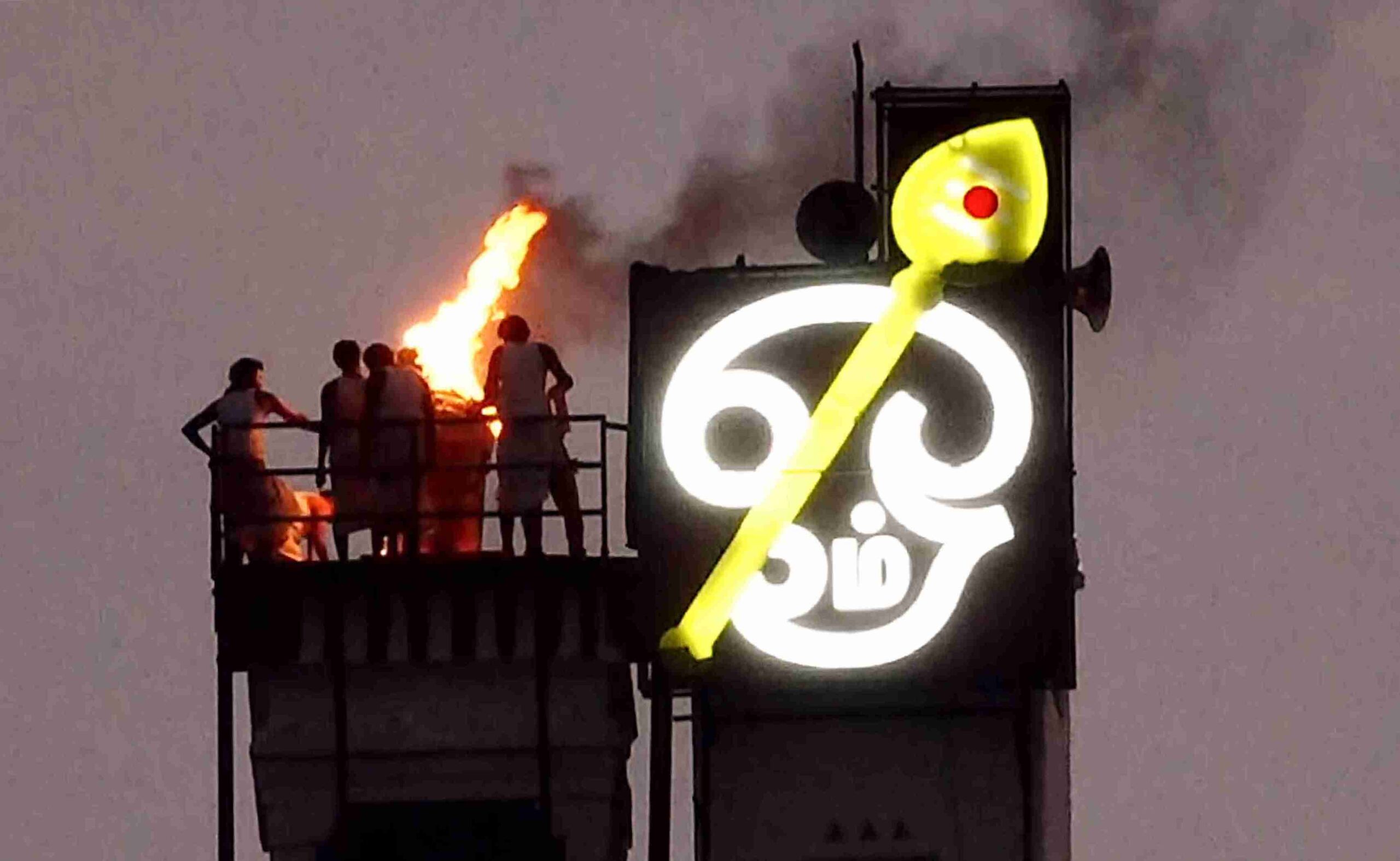
On Tuesday (November 24), the Karthigai Deepam lamp at Thirupparankundram in Madurai was lit at the customary Deepa Mandapam, not at the Deepathoon, the disputed stone pillar on the hill.
Three readings of the Supreme Court’s November 20 interim order have emerged. On one reading, it permitted a second lighting at the pillar and directed officials to make arrangements, but it did not expressly require the temple to authorise a team.
On the second reading, which the Madras High Court adopted on November 24, the Supreme Court required the lamp to be lit at the pillar that day. Under this reading, officials had to see the ceremony take place, not just arrange it.
Also read: Thirupparankundram: TN govt apologises to SC; blames temple board
The trustees’ statement suggests a third reading, but on a different point—the first two concern whether lighting at the pillar was permitted or required. The trustees appear to have seen the pillar as an alternative to the customary Deepa Mandapam, rather than as a site for additional lighting. That apparent understanding is hard to square with paragraph 14(vi), which expressly directed that customary observances continue undisturbed.
Madurai District Collector’s report
In his preliminary status report to the Supreme Court, Madurai District Collector Nishant Krishna said his office had completed the arrangements and repeatedly sought the Devasthanam’s authorisation for a team to light the lamp at the Deepathoon. He said no authorisation was communicated to him.
Paragraph 14(vi) of the Supreme Court’s November 20 interim order expressly says that existing religious observances at customary locations shall continue undisturbed. The one-time permission in paragraph 13 was for lighting at the Deepathoon in addition to the customary lighting at the Deepa Mandapam.
Also read: TVK govt defies SC order, Karthigai Deepam not lit at Thirupparankundram; ‘deceptive act’: BJP
The permission was subject to safeguards. In paragraphs 14 and 18, the Court directed officials to make the arrangements, including regulating access, keeping the public away from the pillar and taking steps to ensure the ceremony could proceed peacefully.
The devil in the details
The distinction becomes clearer when the Supreme Court’s November 20 interim order is read alongside the Madras High Court’s January 6, 2026, judgment. Paragraph 141(1) of that judgment said: “The Devasthanam must light the lamp at the Deepathoon.” Paragraph 12 of the Supreme Court’s November 20 interim order stayed the High Court’s findings in paragraphs 1 to 141 insofar as they concerned the challenge before it, subject to its own interim directions.
The words “consider it appropriate to permit” in paragraph 13 of the Supreme Court’s November 20 interim order cannot be construed as a direction to the temple authorities to light the lamp at the Deepathoon.
Also read: Thirupparankundram hill is shared heritage, says archaeologist C Santhalingam
Paragraph 14(i) specified who could light the lamp at the pillar: a team authorised by the Devasthanam. The Collector, in consultation with the temple’s executive officer, the Commissioner of Police and the Archaeological Survey of India, was to settle the team’s composition and size.
The Collector could settle the team’s composition, but only the Devasthanam could authorise its members to light the lamp. The order did not say what should happen if the Devasthanam authorised no one.
The trustees’ account
The temple’s November 24 statement gives the trustees’ own account of their decision. They said the Deepa Mandapam near the Uchi Pillaiyar temple sits directly above the presiding deity’s head and has long served as the ritual site. They cited consultation with the temple’s hereditary ritual functionaries, as well as religious records and the Agama rules governing worship. They unanimously resolved to light the lamp at the customary site and bring the temple’s practices to the court’s attention. The statement records that they lit the lamp there around 6 pm.
The Collector’s account distinguishes the Executive Officer’s preparations from the trustees’ decision. He says the Executive Officer proposed a ten-person team for the pillar on November 22. On November 24, she told him in writing that she had asked the trustees to authorise those named and that preparatory work and lighting would proceed once the trustees approved (paragraphs 10 and 21 of the report).
Madras HC’s stricter view
Paragraph 14(iv) left the timing, route and duration of the Deepathoon ceremony to the district administration in consultation with the authorities concerned. The Collector says the ceremony was scheduled for 6 to 6.30 pm on November 24, as the Executive Officer herself had proposed. He says he renewed his authorisation request that afternoon. No authorised team arrived at that time, and the Executive Officer later told him she could not proceed because of the trustees’ resolution (paragraphs 24 and 27 to 29 of the report).
Also read: Tirupparankundram Deepam row: Writer Muthukrishnan debunks myths around stone pillar
The Madras High Court took a stricter view in its November 24 order. It read the Supreme Court’s November 20 interim order as requiring the lamp to be lit at the Deepathoon that day, not merely permitting it. In the High Court’s words, the Supreme Court had directed that the “lamp shall be lit”. The High Court also reminded the Collector, the police commissioner, the temple’s executive officer and its trustees of their duty to comply. It did not issue a fresh direction to light the lamp, having recorded the State’s assurance that it would comply with the Supreme Court’s order.
Requirement of “wilful disobedience”
How the order is read matters because civil contempt under Section 2(b) of the Contempt of Courts Act requires wilful disobedience. In Ram Kishan v Tarun Bajaj (2014), the dispute arose after the High Court ordered Ram Kishan’s reinstatement with all consequential benefits except back wages. The Supreme Court later awarded him back wages as well.
Ram Kishan read the two orders together as entitling him not only to the benefits of his old post, but also to the pay and pension of Joint Secretary (Legal), a higher post filled after his compulsory retirement. His employer read the orders as restoring his service benefits and awarding back wages, without granting him the higher post or its benefits.
The Supreme Court found no ground for contempt. It noted that the employee appointed to the higher post was not a party to the case and her appointment had not been challenged. The Court dismissed the contempt petition without deciding whether Ram Kishan was entitled to the higher pay and pension.
Did the trustees “wilfully” disobey the court?
In paragraph 13 of Ram Kishan, the Supreme Court said an order must be read as a whole. Where two interpretations are possible, and the conduct is not defiant, contempt proceedings are not maintainable. The Court also held that a genuine inability to comply cannot amount to contempt. There has to be a calculated action with evil motive on the part of the alleged contemnor. Even if there is disobedience of an order, if it results from compelling circumstances that made it impossible for the contemnor to comply, the contemnor cannot be punished, the Court added in that case.
Also read: Thiruparankundram Deepam row: Experts debunk claims of ancient pillar
On the Collector’s account, the temple’s Executive Officer took steps to prepare for the lighting at the pillar, but the trustees’ authorisation never reached him. That makes the question more specific: did the Supreme Court’s order require the trustees to authorise the team, and if so, did they wilfully disobey it? The Collector’s report sets out the requests and the Executive Officer’s response. It does not establish why the trustees did not authorise the team.
The Collector filed a preliminary report under paragraph 20 and sought leave to file a supplementary report with supporting documents. The fact that the pillar remained unlit calls for an explanation. The trustees’ decision to perform a ritual, which the Court expressly left undisturbed, is not, on its own, proof that they meant to defy the Court.