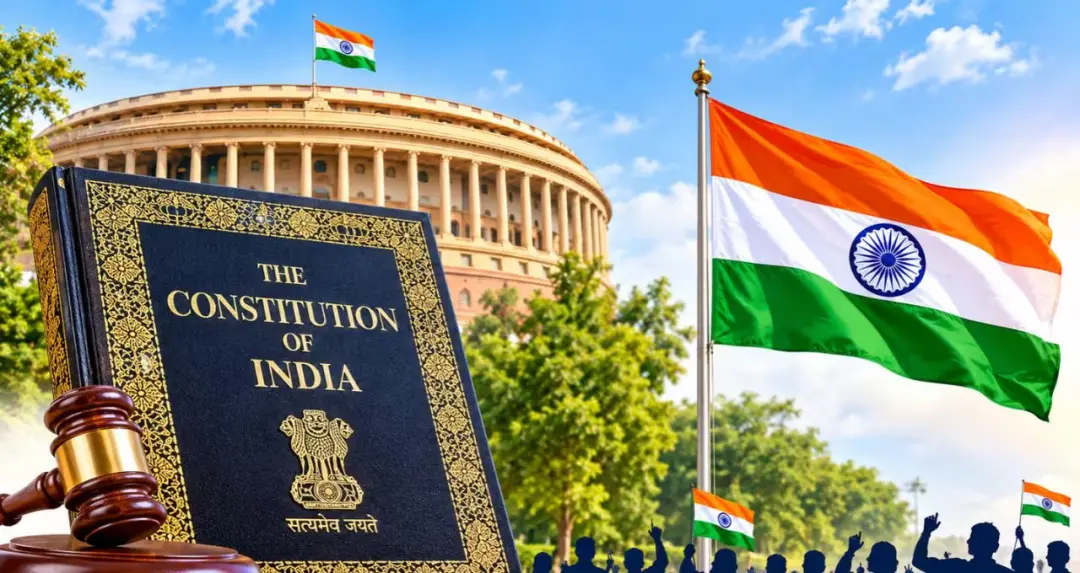
Constitution Day is celebrated every year on 26 November in the country. On this day in the year 1949, the Constituent Assembly adopted the Indian Constitution. It took 2 years, 11 months and 18 days to prepare it.
New Delhi: After getting independence, the biggest responsibility before India was to prepare its own governance system. People following different religions lived in the country. Their languages, lifestyle and traditions were also different. In such a situation, it was not easy to make a constitution in which the interests of all the citizens could be taken care of. Dr. Bhimrao Ambedkar and other members of the Constituent Assembly fulfilled this responsibility very well. Today, on 26th November, 77 years have been completed since the Constitution was adopted.
Why is Constitution Day celebrated only on 26th November?
The Constituent Assembly accepted the Indian Constitution on 26 November 1949. Most of its provisions came into force about two months later, i.e. on 26 January 1950. India became a republic on this day. Therefore, Republic Day is celebrated across the country on 26 January. In the year 2015, the Central Government decided to celebrate 26 November as Constitution Day.
Earlier this date was also known as National Law Day. The purpose of celebrating Constitution Day is to make people aware of their rights and responsibilities towards the country.
Meetings went on for 165 days to prepare the constitution
The first meeting of the Constituent Assembly was held on 9 December 1946. The country had not even got independence at that time. After this, on 29 August 1947, a drafting committee was formed to prepare the draft of the Constitution. Dr. Bhimrao Ambedkar was elected its president. There was a long debate among the members regarding what should be included in the Constitution and what should be the governance system of the country.
Members had differing opinions on many subjects. There were a total of 11 sessions of the Constituent Assembly and the meetings lasted for 165 days. After about three years of hard work, the Constitution of India was ready.
There were 395 articles in the original constitution
When the Indian Constitution was drafted, it had 395 articles, 22 parts and eight schedules. In later years, many amendments were made in it as per the need. At present the Constitution has 25 parts and 12 schedules. The Constitution of India is considered to be the longest written national constitution in the world. What will be the powers of the President and the Prime Minister, how will the state governments work and what will be the role of the courts, all these things are mentioned in it. Citizens also get the right to equality and freedom from the Constitution.
Rules have also been set for the government
The Indian Constitution not only talks about the rights of the citizens, but also makes the government aware of its responsibilities. In the fourth part of the Constitution, Directive Principles of State Policy are mentioned in Articles 36 to 51. These include helping the weaker sections of the society, giving equal pay to men and women for equal work, protecting the interests of workers and improving health facilities.
However, like fundamental rights, one cannot directly go to court to enforce them. The government is expected to keep these things in mind while making its policies.
Changes can be made in the Constitution if necessary
The makers of the Constitution also kept in mind that the needs of the country would change in the coming years. This is the reason why the provision for amendment in the Constitution was kept. The process of amendment is explained in Article 368. Some provisions can be changed by simple majority. At the same time, for many amendments, special majority in Parliament is necessary. For changes in some provisions related to the relationship between the Center and the states, the consent of at least half the states has to be taken. However, Parliament does not have the right to change the basic structure of the Constitution.
Why did Ambedkar consider Article 32 so important?
Dr. Bhimrao Ambedkar called Article 32 the heart and soul of the Constitution. The reason for this is also very special. If the fundamental rights of any citizen are violated then he can directly approach the Supreme Court under this article. On the occasion of Constitution Day, every citizen should know about their fundamental duties along with their rights.