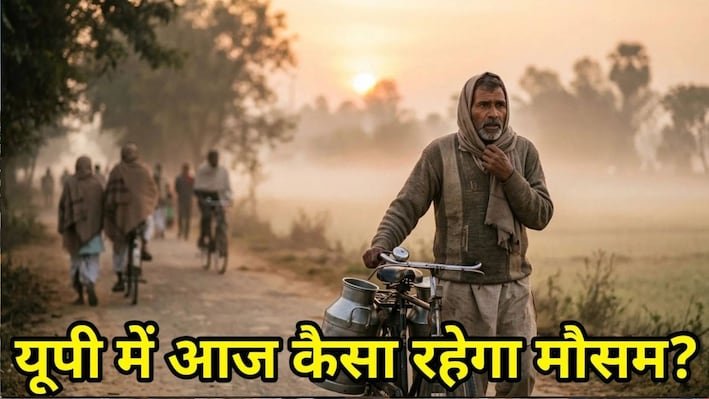
Lucknow: With the last week of November in Uttar Pradesh, winter has started showing its true colors. The morning of Thursday, 26 November 2026 was accompanied by severe chill and light fog in most of the districts of the state including the capital Lucknow, Kanpur, Prayagraj, Varanasi, Meerut and Bareilly. Even though the sky is clear and there is mild sunshine during the day, the temperature is falling rapidly in the evening and early morning. According to the Zonal Science Center of the Meteorological Department (IMD), Lucknow, due to dry and cold north-westerly winds (westerlies) coming from the mountains, melting has increased in the plains, due to which people now have to resort to warm woolen clothes and bonfires. Due to the effect of slow westerly winds, the minimum temperature will fall further by 2 to 3 degrees in the next 4 to 5 days. Meteorologists say that at present there is no active Western Disturbance or rain system present over Uttar Pradesh, due to which the weather remains completely dry in the entire state. However, after the snowfall in the Himalayan regions (Jammu-Kashmir, Himachal Pradesh and Uttarakhand), the slow-speed cold westerly winds blowing from there are directly entering the plains of UP. Due to slow wind speed, the earth's heat is rapidly escaping into the atmosphere at night (Radiative Cooling), due to which the minimum temperature is continuously falling. According to the forecast, the night temperature may drop further by 2 to 3 degrees Celsius in many parts of the state within the next 4 to 5 days. How much did the temperature reach in major districts including Lucknow, Kanpur, Meerut and Bareilly. If we look at the latest temperature data, the effect of cold is being felt the most in the districts of Western Uttar Pradesh and Terai. In Meerut, Muzaffarnagar, Bareilly, Shahjahanpur, Kanpur Nagar and Ayodhya, the minimum temperature has fallen to around 8 to 10 degrees Celsius, while the maximum temperature is being recorded between 24 to 26 degrees Celsius. A layer of light mist and fog was observed in the capital Lucknow this morning, where the minimum temperature is expected to be around 10 to 11 degrees Celsius and the maximum temperature is expected to be around 26 degrees Celsius. At the same time, in the districts of Eastern UP like Varanasi, Gorakhpur and Prayagraj, the night temperature has come down to around 11 to 12 degrees. Fog will prevail in the morning in the districts of Terai and Western UP, visibility will be low. The Indian Meteorological Department has warned that with the falling temperature in the coming days, the density of fog will also increase in the morning. Especially in the Terai region districts like Bahraich, Shravasti, Balrampur, Siddharthnagar, Maharajganj, Kushinagar, Lakhimpur Kheri, Pilibhit and Saharanpur, Bijnor, Moradabad and Rampur of Western UP, there is a possibility of moderate to dense fog in the early morning. Fog may affect visibility on national highways and expressways (such as Agra-Lucknow Expressway, Purvanchal Expressway and Yamuna Expressway) during the morning hours, so drivers have been advised to be cautious and use fog lights. Take special care of health and crops in the changing weather, advice from doctors and agricultural experts. In the changing weather, this huge difference in temperature between the sunshine of the day and the harsh cold of the night (Diurnal Temperature Variation) can be challenging for health. Doctors have advised children, elderly people and people suffering from asthma or heart disease to avoid cold air in the morning and evening, drink warm water and go out after covering their ears and chest properly. At the same time, according to agricultural experts, the dry weather and falling temperatures are extremely favorable for the sowing and initial growth of Rabi crops – especially wheat, mustard, gram and potato. However, in view of the possibility of fog and frost, farmers have been advised to maintain light irrigation of crops.