
Ola Electric is offering dealers margins of up to 9% as it tries to rebuild its retail network and arrest a sharp fall in sales. The company, which originally relied heavily on company-operated outlets and a direct-to-consumer sales model, is shifting towards independently run franchise dealerships. The higher commission is intended to attract partners quickly at a time when its market share has fallen sharply.
But there is an important condition behind that 9% figure. According to dealers cited in a Bussiness reportOla is offering a regular margin of 6%, with an additional 3 percentage points for the first three months. The extra amount is expected to be paid through credit notes rather than upfront. Dealers say the introductory period could be extended to six months in some cases, but it is not a guaranteed permanent 9% margin.
Retail data shared by the Federation of Automobile Dealers Associations (FADA) shows that Ola Electric recorded 1,18,830 electric two-wheeler sales between January and October 2026, nearly 36% lower than the corresponding period a year earlier. Its market share over that period fell to around 7%, against roughly 17% in the previous year.
That decline is particularly significant because the overall electric two-wheeler market has continued to expand. In other words, Ola is not simply facing slower demand for electric scooters across the industry. Competitors are winning a larger share of a growing market.
In October 2026, TVS led electric two-wheeler registrations with 60,490 units, followed by Bajaj with 49,126. Ather recorded 31,833 and Hero’s Vida brand 29,923, while Ola registered 12,098 units. These figures show how dramatically the competitive order has changed from the period when Ola was the segment leader.
The reasons cannot be reduced to a single factor. Buyers have more alternatives from established manufacturers, many of which have extensive dealer and service operations. Ola has also faced complaints involving breakdowns, delayed repairs and after-sales support. Even when a manufacturer improves its products, negative ownership experiences can take time to overcome.

Conventional two-wheeler dealers are reported to earn margins of roughly 3-5%, although actual arrangements differ by manufacturer and model. Ola’s reported 6% standard margin, plus the temporary 3% incentive, makes the initial offer attractive on paper.
Consider a simple example. If a scooter’s eligible invoice value were Rs 1.20 lakh, 6% would amount to Rs 7,200 and the additional 3% would be Rs 3,600, taking the total to Rs 10,800 during the introductory period. This is only an illustration: the actual commission depends on which price the agreement uses, the relevant deductions and when credit notes are issued. It is not a fixed Rs 10,800 payment on every Ola scooter.
A dealer also has expenses. Showroom rent, employees, local marketing, finance costs, stock holding and customer support can consume a significant part of the commission. What looks generous at 9% may be less attractive when the introductory payment ends and normal sales volumes have to support the business.
Some potential partners have reportedly raised another concern: agreements may not give dealers exclusive territories. Without protection for a defined area, a dealer could face another Ola outlet opening nearby. That can improve consumer access, but it makes a new dealer’s long-term sales forecast harder to judge.
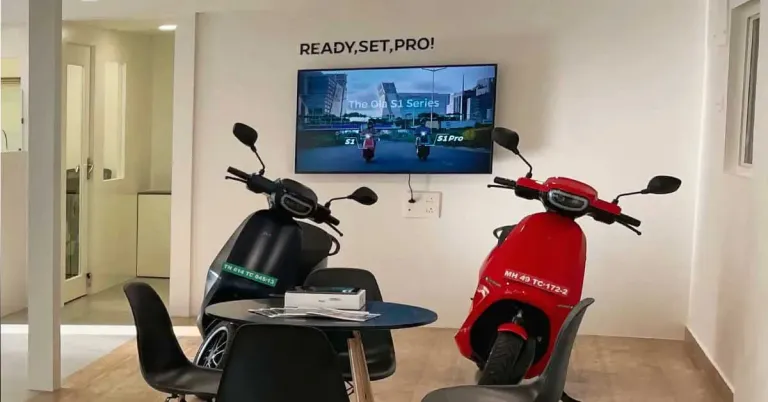
Ola said it had 255 dealer partners operating 319 stores as of November 8, 2026. Its stated target is about 450 stores by December and more than 700 by March 2027. The company has also said it stopped taking new orders through most of its own outlets from November 1 as it prepares to close much of that network.
There is a financial reason for the shift. Under a company-operated model, the manufacturer carries many retail costs itself. A franchise dealer typically pays for inventory and handles local showroom expenses. Ola expects shutting company stores to lower operating expenses by about Rs 50 crore, although higher dealer commissions will put some pressure on gross margins during the changeover.
That trade-off matters. Ola posted revenue of Rs 421 crore in the September 2026 quarter, down 39% year-on-year, with a consolidated net loss of Rs 362 crore. Paying more to dealers may help restart distribution, but it cannot by itself repair the company’s finances. Ola needs enough additional sales and better cost control to justify the higher commissions.