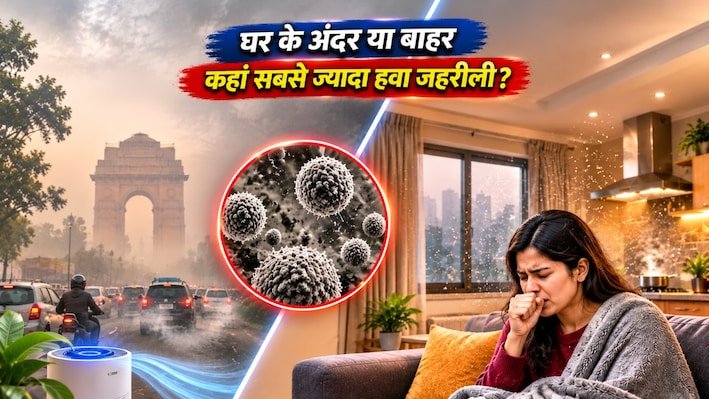
New Delhi: With the onset of winter and dense fog in the capital Delhi and NCR, air pollution has once again reached dangerous levels. Generally, people consider it safe to stay inside by closing the doors and windows of their homes to avoid outdoor poisonous air and smog. But a recent scientific research has made a very shocking revelation, proving this notion completely wrong. According to this study conducted by environment and air quality experts, the indoor air of four major residential areas of Delhi has been found to be up to 50 percent more polluted than the outside environment. This report has increased the concern of health experts and Delhiites manifold, because people spend about 80 to 90 percent of their time inside homes and offices. Which 4 areas of Delhi were found to have the most dangerous indoor air? During this detailed research, the levels of PM 2.5, PM 10, carbon monoxide and volatile organic compounds (VOCs) were monitored by installing state-of-the-art air quality sensors in hundreds of houses in different parts of Delhi. The investigation revealed that the level of pollution inside the houses of Anand Vihar, Jahangirpuri, Wazirpur and Rohini (and the surrounding dense residential and industrial clusters) was recorded to be one and a half times or 50 percent higher than outside. According to the researchers, in these areas, outdoor industrial emissions, vehicle exhaust and construction dust, along with the structure of houses and poor ventilation, have created a 'gas chamber'-like situation inside the house. After all, why is more poison accumulating inside the houses than outside, know the 5 main reasons. Experts say that when pollution increases outside, people completely close the doors, windows and skylights of the houses. Due to this, the pollution generated inside the house is not able to come out and gets trapped inside and increases manifold. Cooking in kitchens (especially tempering, frying and burning gas stoves without chimneys or exhaust fans) emit large amounts of PM 2.5 particles. Apart from this, regular burning of incense sticks, incense sticks, mosquito repellent coils, room freshener sprays, smell of paint and chemical cleaners used for cleaning make the air of the house extremely poisonous. If any member of the household smokes or uses a heater or fireplace in a closed room to escape the cold, the indoor air quality index (AQI) shoots straight across the 'severe' category. Indoor pollution is becoming a silent killer for children, elderly and asthma patients. According to All India Institute of Medical Sciences (AIIMS) and respiratory disease experts, indoor pollution can prove to be more deadly than outdoor pollution because a person breathes it continuously for several hours without any mask or protection. Due to this, the risk of obstruction in the development of lungs of small children, frequent cough and cold, irritation in the eyes, headache, fatigue and sudden attack in asthma and COPD patients is increasing rapidly. This polluted indoor air is also extremely harmful for pregnant women and heart patients. To keep indoor air pure and safe, immediately adopt these effective measures. Health and environment experts have advised to take some very practical and easy steps to avoid this hidden danger. First of all, it is mandatory to use chimney or exhaust fan while cooking in the kitchen. Secondly, when the level of outdoor pollution is slightly less when the sun shines in the afternoon (usually between 12 noon and 4 pm), then do cross-ventilation by opening the windows for some time. Third, minimize the use of incense sticks, incense sticks, mosquito coils and chemical sprays inside the house and instead of sweeping, wipe with a wet cloth so that dust particles do not fly in the air. Additionally, plant natural air purifying plants like snake plant, areca palm and peace lily in the bedroom and living room and use an air purifier with a HEPA filter if possible.