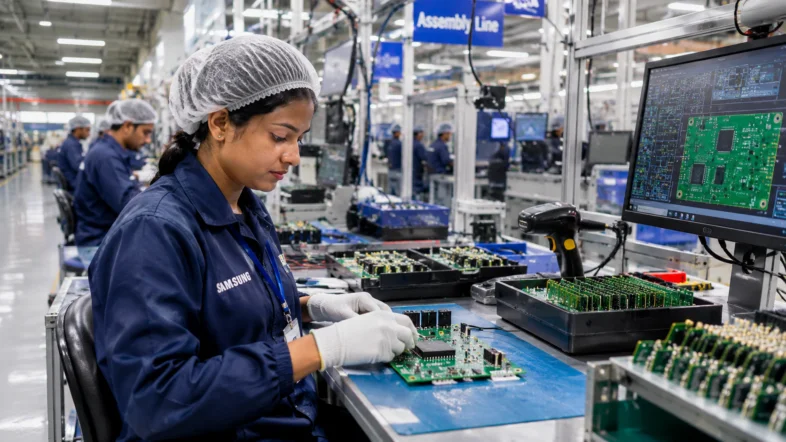
Nov 27: India’s electronics manufacturing industry is witnessing a significant shift as exports increasingly extend beyond smartphones to components, printed circuit boards, communication equipment and storage technologies. This changing trend is creating new opportunities for domestic manufacturers and strengthening India’s participation in global electronics supply chains.
According to the Ministry of Commerce and Industry, India’s electronic goods exports grew 44% to US$31.97 billion during April–September 2026–27, compared with US$22.20 billion in the corresponding period of the previous financial year. More significantly, non-smartphone electronics exports increased 56.5% to US$13.79 billion, outpacing smartphone export growth of 35.8%, which reached US$18.17 billion.
The figures, released by the Press Information Bureau (PIB) in November 2026, highlight an important development in India’s manufacturing story. While smartphones continue to account for the largest share of electronics exports, other product categories are gaining ground, indicating a gradual diversification of the country’s electronics industry.
This shift also presents an opportunity for India to move beyond assembly-led production and develop stronger capabilities in component manufacturing, specialised equipment and advanced technologies.
Non-Smartphone Electronics Emerge as a Major Growth Driver
Smartphone manufacturing has played a central role in establishing India as an important electronics manufacturing and export destination. However, the latest trade figures suggest that growth is increasingly extending into other segments.
Non-smartphone products accounted for 43.2% of India’s electronic goods exports during April–September 2026–27, compared with 39.7% in the corresponding period a year earlier.
Several product categories recorded significant growth:
-
Mounted printed circuit boards: Exports increased from US$63.3 million to US$2.10 billion.
-
Loaded printed circuit boards: Exports rose 304% to US$864.1 million.
-
Network transmission and routing equipment: Exports grew 98% to approximately US$1.45 billion.
-
Memory integrated circuits: Exports reached approximately US$562.4 million.
-
Solid-state storage devices: Exports increased to US$260.5 million.
These products support several industries, including information technology, telecommunications, automotive electronics and industrial automation.
The growth indicates that Indian manufacturers are finding opportunities in products that support modern electronic devices and digital infrastructure. Sustaining this momentum, however, will require continued investment in technology, production capacity and international quality standards.
Component Manufacturing Could Strengthen India’s Electronics Industry
One of the biggest opportunities emerging from the export growth is the development of India’s domestic electronics component industry.
Electronic products depend on a complex network of suppliers producing circuit boards, semiconductor devices, connectors, sensors and storage technologies. A stronger domestic supplier network can help manufacturers improve supply-chain reliability, reduce dependence on imported inputs and increase local value addition.
India has made considerable progress in assembling finished electronic products, particularly smartphones. The next stage of development will require greater investment in component manufacturing, precision engineering, testing facilities and specialised industrial infrastructure.
Printed circuit boards are particularly important because they are used in smartphones, computers, telecommunications equipment, automobiles and industrial machinery. Their growing contribution to exports highlights the potential of this segment.
However, higher exports do not automatically translate into complete domestic manufacturing capabilities. Developing expertise in materials, design, fabrication and advanced components will be essential for India to retain a larger share of the value generated within the electronics industry.
CII Report Highlights India’s Electronics Component Opportunity
A Confederation of Indian Industry (CII) report published in June 2024, titled Developing India as the Manufacturing Hub for Electronics Components and Sub-Assemblies, highlights the potential of domestic component manufacturing.
According to the report, India’s demand for electronics components and sub-assemblies stood at US$45.5 billion in 2023, supporting approximately US$102 billion worth of electronics production. The report projected that component demand could increase to US$240 billion by 2030, alongside India’s ambition to achieve US$500 billion in electronics production.
It also identified printed circuit board assemblies, batteries, camera modules, displays and mechanical components as important opportunities for domestic manufacturing.
These findings underline the importance of developing a stronger supplier network. As electronics production expands, demand for components will increase, creating opportunities for businesses to move beyond assembly and participate in higher-value manufacturing activities.
The report also highlighted challenges involving manufacturing costs, domestic design capabilities and raw material availability. Addressing these gaps will be important for building a competitive component manufacturing industry.
Government Incentives Support Manufacturing Expansion
Government initiatives have played an important role in encouraging investment in India’s electronics manufacturing sector.
The Production Linked Incentive (PLI) scheme for large-scale electronics manufacturing and IT hardware aims to increase domestic production, attract investments and improve manufacturing competitiveness.
Another important initiative is the Electronics Component Manufacturing Scheme (ECMS), which focuses on developing domestic capabilities in electronic components, sub-assemblies and essential manufacturing materials.
According to a Ministry of Electronics and Information Technology update, the ECMS received an increased budgetary allocation of ₹40,000 crore in the Union Budget 2026–27. By August 2026, 106 projects had been approved across 15 states, involving proposed investments of ₹69,548 crore. These projects are expected to generate ₹5.34 lakh crore in production and create direct and indirect employment opportunities.
Such initiatives could encourage manufacturers to establish new facilities, expand existing operations and develop stronger domestic supplier networks.
The long-term objective, however, should extend beyond increasing factory output. Building expertise in semiconductor manufacturing, component design, research and development, and advanced testing will be equally important.
Global Supply Chain Diversification Creates New Opportunities
Global electronics companies are increasingly reviewing their manufacturing and sourcing strategies to make supply chains more resilient. Dependence on a limited number of manufacturing destinations can expose businesses to geopolitical uncertainties, trade disruptions and transportation challenges.
This creates opportunities for countries that can offer competitive production costs, skilled workers, reliable infrastructure and access to international markets.
India’s expanding electronics export basket could help it benefit from this shift. The growth of non-smartphone products is particularly important because it broadens the country’s manufacturing capabilities beyond a single product category.
Telecommunications equipment, computer hardware, electronic components and industrial electronics offer opportunities for established manufacturers as well as smaller specialised suppliers.
For international companies, India could become an increasingly important manufacturing and sourcing partner. However, attracting long-term investments will depend on consistent product quality, efficient logistics, reliable infrastructure and a predictable business environment.
Semiconductor Development Could Strengthen India’s Manufacturing Ambitions
The development of India’s semiconductor ecosystem is another important part of its electronics manufacturing strategy.
A September 2026 report by EY and the India Electronics and Semiconductor Association (IESA), titled Semicon India 2.0: From Capacity Creation to Ecosystem Leadership, projects that India’s semiconductor market could grow from nearly US$64 billion in 2026 to US$200 billion by 2035.
The report identifies consumer electronics, automotive and industrial applications as major sources of semiconductor demand. It also highlights opportunities arising from artificial intelligence, data centres, telecommunications and electric mobility.
An important finding is that India’s semiconductor imports increased from US$5.7 billion in FY2017 to US$30.3 billion in FY2025. This highlights the opportunity to develop stronger domestic manufacturing and innovation capabilities.
India’s existing base of semiconductor design engineers also provides an advantage as the country looks to expand its capabilities in chip design and related technologies.
Developing this ecosystem could support domestic electronics manufacturers, reduce supply-chain vulnerabilities and create opportunities for technology companies and component suppliers.
What the Export Growth Means for India’s Manufacturing Sector
The expansion of non-smartphone electronics exports could have a wider impact on India’s industrial economy.
Manufacturing diversification: A broader range of export products can reduce dependence on smartphones and create a more balanced electronics industry.
Opportunities for component suppliers: Growing demand for circuit boards, storage devices and communication equipment could encourage investment in domestic component production.
Skilled employment: More advanced manufacturing activities could increase demand for electronics engineers, technicians, quality-control professionals and production specialists.
Greater global integration: A wider export portfolio can help Indian companies become part of international manufacturing and procurement networks.
Investment opportunities: The expanding electronics industry could attract investments in factories, automation, testing facilities and research and development.
The scale of these opportunities will depend on how effectively India develops domestic manufacturing capabilities and addresses gaps in technology, infrastructure and specialised skills.
Challenges That Could Influence Future Growth
Despite the positive export performance, India still faces challenges in building a globally competitive electronics manufacturing industry.
Dependence on imported semiconductors, specialised materials and advanced manufacturing equipment remains an important concern. Building domestic capabilities in these areas will require substantial investment, technology partnerships and sustained research.
Manufacturers must also maintain international quality standards while managing production costs and delivery schedules. Efficient logistics, reliable power supply and access to skilled workers will be important in supporting larger manufacturing operations.
Another priority will be encouraging more domestic suppliers to participate in global production networks. A stronger supplier ecosystem can improve manufacturing efficiency and help Indian companies retain a greater share of the value generated within the electronics industry.
Conclusion: India’s Electronics Industry Is Moving Beyond Smartphones
India’s electronics export growth during April–September 2026–27 highlights a broader transformation in the country’s manufacturing sector. While smartphones remain the largest contributor, the faster expansion of non-smartphone electronics signals growing opportunities in components, printed circuit boards, communication equipment and storage technologies.
With non-smartphone electronics exports reaching US$13.79 billion, India has an opportunity to build a more diversified manufacturing base and strengthen its position in global electronics trade.
The next phase will depend on moving beyond assembly-led production towards deeper component manufacturing, technological innovation and higher domestic value addition.
For manufacturers and technology companies, this transition presents opportunities to expand production, reach international buyers and become more closely integrated with global supply chains. Sustaining this momentum could make electronics manufacturing an increasingly important contributor to India’s industrial and export growth.