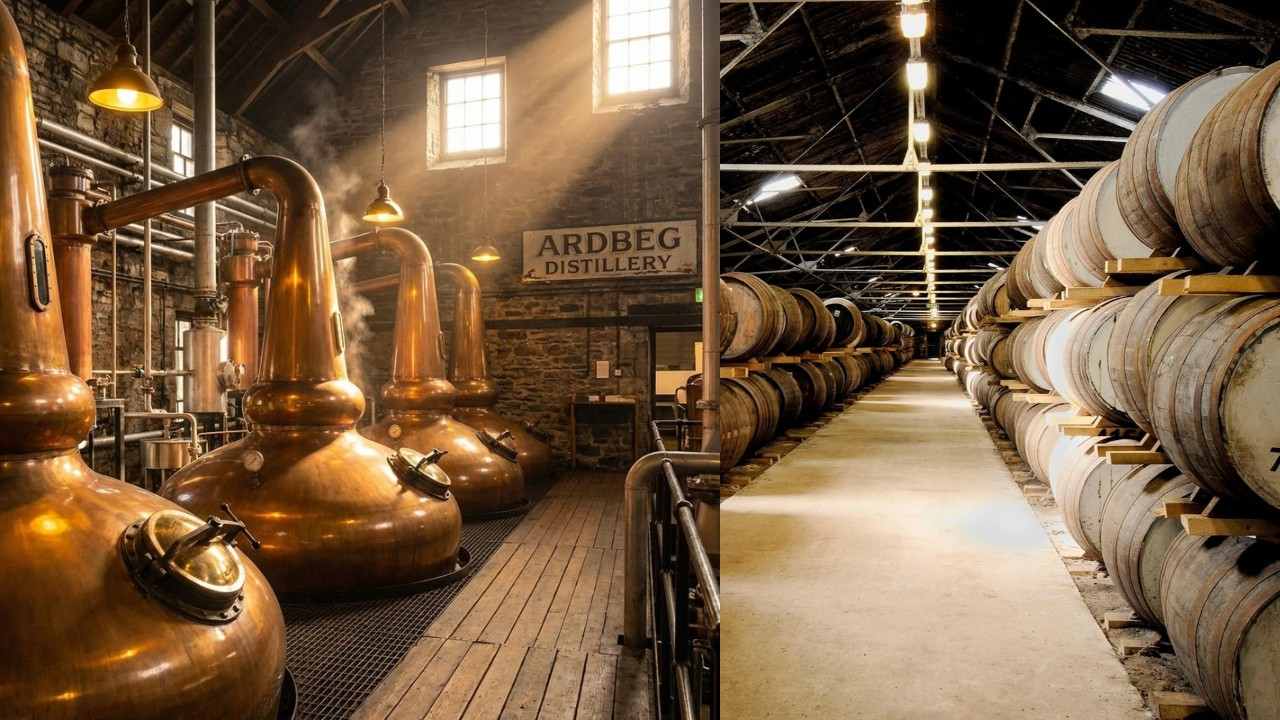
Often people consider every expensive and good whiskey as 'Scotch' but this is completely wrong both legally and in taste. Only that which is completely made in Scotland can be called Scotch whiskey. Any whiskey produced in India, no matter how excellent its quality, cannot be called Scotch.
In fact, in many famous whiskey brands sold in the Indian market, Scotch imported from Scotland is added to it, but this does not make the entire bottle Scotch. Let us read in this report what are the rules for making Scotch, how Indian companies use it and what is the legal and business dispute over it?
Also read: Fall in bank shares, what was the condition of the stock market today? Know the price of gold and silver
The biggest condition of being scotch
Scotch is not the common name of a specific type of liquor but is a Geographical Identification (GI). Just like Darjeeling tea or Banarasi saree. According to Britain's 'Scotch Whiskey Regulations, 2009', certain conditions must be fulfilled for a whiskey to be called Scotch. First, the entire process of manufacturing, distilling and growing it must take place in Scotland.
Second, it must be aged for at least three years in oak barrels made in Scotland itself. Even if a company brings raw liquor from Scotland and keeps it in India for three years, it will not be called Scotch. It is made from water and malted barley. No external flavor can be added to it and it must contain at least 40% alcohol while bottling. Its five traditional strongholds are Speyside, Isla, Highland, Lowland and Campbeltown in Scotland. The taste of Scotch varies depending on the air and water of each region, such as sweet like fruit or slightly smoky.
How do Indian companies use the name 'Scotch'?
This is where most of the confusion arises in the market. There are two types of whiskey sold in India, the first one which comes directly from Scotland which is the real Scotch and the second one is 'Indian-Made Foreign Liqueur' (IMFL), which is made in India.
To make many of their popular brands (like Blenders Pride etc.), Indian companies import Scotch from Scotland in large containers (bulk) and mix it with grain spirits made in India. Since it contains some portion of Scotch, companies promote it. But according to the rules, it will not be considered 'Scotch whiskey' but an Indian blended whiskey.
Legal dispute over the name of Scotch in India too
Not only Britain, Indian laws also prevent misuse of the name 'Scotch'. 'Scotch Whiskey' was officially entered in the GI Register of India in 2011 (which is valid till 2029). This simply means that no company in India can write Scotch on its liquor to mislead people.
In the year 2023, a similar case came up in the Delhi High Court. 'Scotch Whiskey Association' had filed a case against an Indian company (Whiskin Spirits). In the subsequent agreement, the company had to admit that it was wrong to use words like 'Scotch Blended Whiskey' for liquor made in India. This may mislead people.
difference between single malt and scotch
Often people consider 'single malt' to be Scotch whereas both are different things. Single malt means that the whiskey is made from only malted barley at a single distillery. If this process happens in Scotland then it is called 'Scotch Single Malt' and if it happens in India then it is called 'Indian Single Malt'. Today, India's single malt whiskeys like Amrut, Paul John and Rampur are making waves all over the world. These companies sell their whiskey not by calling it Scotch, but on the basis of the excellent quality of 'Indian Single Malt'. The Food Safety Rules of India (FSSAI) also have strict standards for this.
Big market and latest controversy regarding tax
In terms of trade, India is one of the largest buyers of Scotch in the world. In 2025, the equivalent of more than 22 crore bottles of Scotch was exported to India. The special thing is that about 80 percent of the total Scotch coming to India from Britain comes in large quantities. It is used in making whiskey here.
Also read: Factories have increased in India but who is the owner of the real technology?
A new controversy is also heated up regarding the import tax of Scotch in November 2026. Under the trade agreement (FTA) between India and Britain, it was agreed to reduce the heavy 150% custom duty on Scotch to 75% (and to 40% in the next 10 years). But now there is a tussle between the Government of India and the liquor companies on whether this tax exemption will also apply to 'bulk Scotch' coming in containers or not. The government is considering it as a separate category whereas the companies say that the liquor coming in bulk is also genuine Scotch, hence they should also get tax relief.