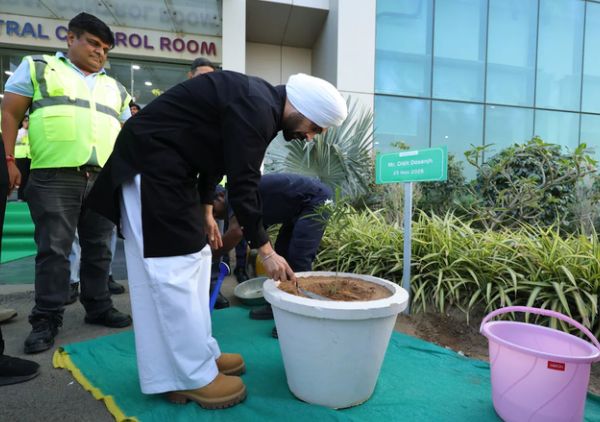
Singer Diljit Dosanjh recently visited the Adani Group’s Khavda Renewable Energy Project in Gujarat and expressed admiration for the scale of India’s green energy transition. The visit took place during the Gujarat leg of his national concert tour, giving the singer an opportunity to explore one of the world’s largest renewable energy and battery storage projects.
“Bohot Vadhiya (this is too good!),” Dosanjh reportedly said while witnessing the sprawling facility in the Kutch region.
Punjabi aa gaye oyeee!
We manifested, and the G.O.A.T. arrived!Global icon @diljitdosanjh visited Adani Green Energy’s Khavda Renewable Energy Plant, the world’s largest, to witness the green magic taking shape in the heart of the Kutch region.
Thank you @diljitdosanjh… pic.twitter.com/ZV4ibvbDIq
— Adani Green Energy Ltd. (@AdaniGreen) November 27, 2026

Diljit Dosanjh Explores Adani's Khavda Renewable Energy Project
Spread across 538 square kilometres, the Khavda project is located in a remote saline landscape, around 70–100 kilometres from the nearest human settlement. During his visit, Dosanjh interacted with site engineers to understand the logistical and engineering challenges involved in developing the massive facility.
The singer viewed the expansive solar panel installations and wind turbines from the site’s viewing tower. He also visited the central control room, where engineers demonstrated how operations across the project are monitored and managed digitally.
Dosanjh praised the Adani Green Warriors working at the site and planted a sapling during his visit. The Khavda team also presented him with traditional Rogan art and an Ajrakh-print scarf, showcasing the cultural heritage of the Kutch region.

Khavda Project: 30 GW Renewable Energy Capacity Planned
The 30-GW Khavda Renewable Energy Project has already achieved more than 11 GW of operational renewable generation capacity. Once completed, it is expected to comprise 26 GW of solar power and 4 GW of wind energy.
The facility also houses a 6.63 GWh Battery Energy Storage System (BESS), described as the world’s largest operational battery storage system at a single location. This represents more than 50 per cent of India’s total operational BESS capacity and is intended to support round-the-clock renewable power and grid stability.
The project is ultimately planned to have 50 GWh of battery storage capacity.
How Khavda Project Supports India’s Green Energy Goals
More than 15,000 people are currently working on the project, which spans an area five times the size of Paris. According to the project details, the facility is expected to generate enough electricity to power more than 17 million homes annually once fully developed.
Executed by Adani Green Energy Limited (AGEL), Khavda is a key part of the Adani Group’s planned investment of around $100 billion over five years in India’s energy transition.
The project is also expected to play a role in India’s target of achieving 500 GW of non-fossil fuel energy capacity by 2030. By 2029, Khavda is projected to become the world’s largest power plant across all energy sources.
FAQs
1. Where did Diljit Dosanjh visit in Gujarat?
Diljit Dosanjh visited the Adani Group’s Khavda Renewable Energy Project in the Kutch region of Gujarat.
2. What is the planned capacity of the Khavda project?
The project is planned to have a total renewable energy generation capacity of 30 GW, comprising 26 GW of solar and 4 GW of wind energy.
3. How much operational capacity has Khavda achieved?
The project has achieved more than 11 GW of operational renewable generation capacity.
4. What is special about Khavda’s battery storage facility?
It houses a 6.63 GWh Battery Energy Storage System, described as the world’s largest operational BESS at a single location.
5. How many homes could the completed Khavda project power?
The project is expected to generate enough electricity to power more than 17 million homes annually.