
Although former Chief Minister and Peoples Democratic Party (PDP) president Mehbooba Mufti has intensified her campaign against what she alleges is ecological damage at Sheshnag Lake, the Jammu and Kashmir Government on Friday released a detailed report, accompanied by Google satellite images, to defend the ongoing work.
The report comes amid growing concerns among environmentalists, experts and nature lovers over possible ecological damage and alleged environmental violations in Jammu and Kashmir’s fragile Himalayan ecosystem.
The clarification follows Chief Minister Omar Abdullah taking cognisance of the viral footage and directing Forest Minister Altaf Ahmad Kaloo to submit a detailed report and ascertain whether any violation or deviation had occurred during the ongoing work near the high-altitude lake.
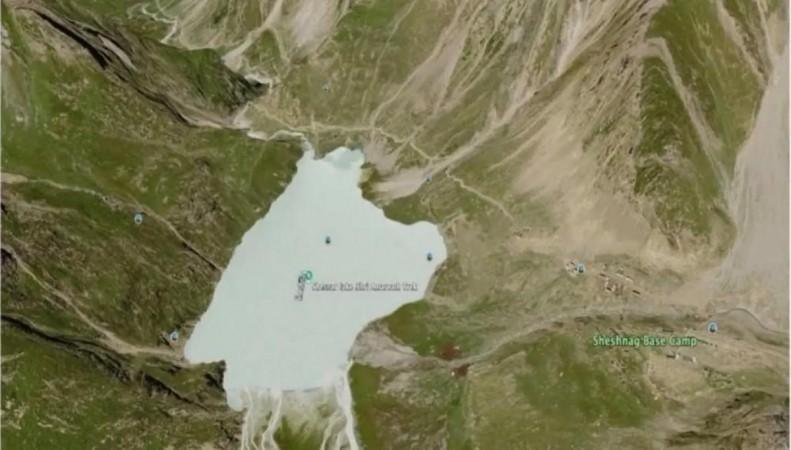
In its report the Forest Department, J&K, stated that the track originating from Chandanwari, passing through Sheshnag and leading towards the Holy Cave, undergoes annual maintenance to ensure its safety and accessibility for pilgrims. It maintained that the exercise is longstanding and has been carried out regularly since 2012, rather than being a new activity initiated in 2026.
The government has also released Google satellite imagery depicting the existing track and its alignment from Chandanwari to the Holy Cave. According to the official clarification, the imagery shows that the track runs parallel to Sheshnag Lake while maintaining a clear distance from its shoreline.
The department further clarified that the Yatra track runs along the right-hand side of the lake and is situated at a considerable distance from the water body. It asserted that the maintenance work is not intended to alter the lake’s character or ecological integrity.
If the UT government is relying on satellite images to claim that no construction is taking place at Sheshnag, why not allow us to visit the site and see for ourselves? The JCBs wreaking havoc there are visible for all to see. To dispel all doubts, let the CM depute a team of political leaders and environmentalists to inspect the site and establish the truth. What is there to hide?
— Mehbooba Mufti (@MehboobaMufti) November 27, 2026
Explaining the legal basis for the maintenance work, the department referred to the Supreme Court’s directions in PIL Court on its own motion versus the Union of India and Others (Suo Motu Writ Petition (Civil) No. 284 of 2012).
The Supreme Court had emphasised that the Amarnath Yatra walking tracks should have a minimum width of 12 feet to facilitate the simultaneous movement of pilgrims, horses and palkis. It had also directed improvements to vulnerable stretches, including protective measures such as retaining walls, railings and other necessary structural support.
However, the court had specifically clarified that its directions should not be interpreted as permitting the construction of a motorable metalled road in place of the existing walking tracks.
The Forest Department stated that, in accordance with these directions, the responsibility for maintaining the Yatra track rests with the Border Roads Organisation (BRO), and the activity shown in the viral footage forms part of its routine annual maintenance operations.
It categorically maintained that no new road construction or fresh alignment is being undertaken.
The controversy erupted after a video, originally circulated on social media by an excavator operator, showed a heavy crawler excavator operating near the blue waters of Sheshnag Lake. The footage subsequently went viral, triggering questions over the use of heavy machinery in the fragile Himalayan ecosystem and concerns about possible damage to the lake and its surrounding landscape.
Environmentalists, political leaders and other concerned citizens questioned the necessity of excavation in the vicinity of the high-altitude water body and sought clarification regarding the nature of the work, environmental safeguards and the permissions obtained.
The Border Roads Organisation subsequently defended its operations, stating that the work was part of post-Amarnath Yatra track maintenance and stabilisation, with a focus on widening vulnerable stretches, improving safety and easing congestion during the annual pilgrimage. The BRO maintained that the work was confined to existing tracks and that measures were being taken to ensure the safe disposal of excavated material, protect natural drainage and minimise disturbance to the surrounding terrain.
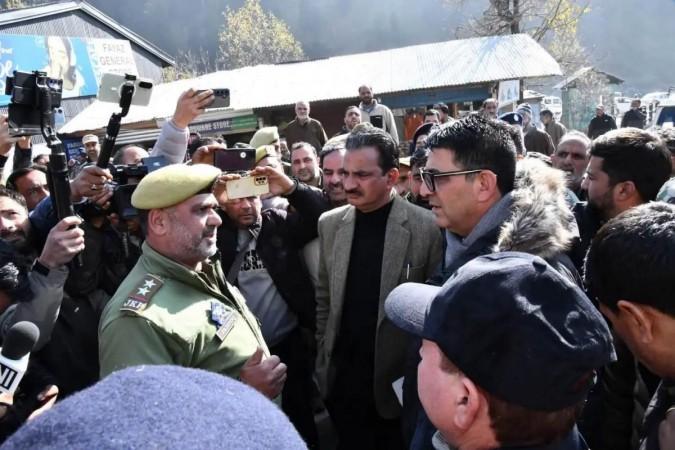
The ecological issue subsequently took a political turn, with Mehbooba Mufti questioning the ongoing work and seeking clarity over its possible environmental impact. She also attempted to visit Sheshnag Lake along with party leaders but was stopped by police at Chandanwari, with security reasons cited for restricting her movement.
Amid the growing controversy, Chief Minister Omar Abdullah directed the Forest Minister to examine the matter and ascertain whether any deviation from the existing alignment or violation had occurred.
Forest Minister Altaf Ahmad Kaloo subsequently said that a departmental team had inspected the site and found no evidence of tampering or damage to the lake. He maintained that no soil or debris had entered the water body and that the work was being carried out by the BRO as part of routine track maintenance.
The latest government clarification, accompanied by satellite imagery and references to the Supreme Court’s 2012 directions, seeks to place the ongoing work in the context of the longstanding maintenance requirements of the Amarnath Yatra route and the safety of pilgrims.
The government has maintained that the matter should be viewed in the light of judicial directions, pilgrimage safety requirements and the longstanding nature of the track maintenance exercise.