Like so many remarkable documentary films, You Can See Everything is born out of an extraordinary and rather strange proposition: Elizabeth Holmes — once hailed as a visionary and the ‘next Steve Jobs’ for promising, through her company Theranos, to radically democratise blood testing, before she was exposed as a fraud — is weeks away from beginning her prison sentence. Along with her husband Billy, she invites two filmmakers of note, Lance Oppenheim and Nathan Fielder, into their home, allowing them unbridled access to their lives and the licence to film everything. Holmes and Billy have just had their second child and to say that it’s a particularly turbulent time in their lives would be an understatement, not to mention it’s the last few days she gets to spend with her loved ones before jail time begins.
What do they hope to gain out of this transaction with the filmmakers? (Holmes approached the studio A24 looking for someone to document her life). Certainly, it’s not because they want to facilitate the creation of a potentially great piece of art that could emerge out of what is an extraordinary situation. Although never quite clearly articulated in the film, the commonsensical logic is that she wants someone to tell ‘her side of the story’. But anyone familiar with Oppenheim and Fielder’s work would know that things are unlikely to be that straightforward: these are not filmmakers who are going to take part in a whitewashing PR job; they are here precisely because they hope to make a potentially great piece of art.
Trying for the ‘truth’
Scenarios such as these often hinge on a delicate quid-pro-quo between the two parties, and it is the duty of the artist to resist the easy comforts of access-filmmaking, to be able to exercise their creative freedom, and to pursue nothing but the truth — without, of course, being cavalier about the damage it could cause their subjects or misrepresenting them (a loaded term, to be sure). What the audience sees during the course of this nearly three-hour-long film is a tightrope walk that manages to tick all those boxes, and then some. It’s something of a triumph on the part of the filmmakers, taking the medium to uncharted territory, to investigate truth in ways that only cinema can. That they have also turned a documentary into a cinematic event and taken the US box office by storm is no mean feat.
One of the most radical things the film does is to put Fielder, also an actor and a comedian, right at the centre of it (while Oppenheim stays behind the camera). He’s as important a character in the film as Holmes. He actively takes part in the “scenes”, steering them, asking questions — probing but humane — and hoping that his subject opens up. And in Holmes he meets a worthy adversary: a cipher whose stock responses are lines like ‘I don’t know’ and ‘This is what I believe in’; someone who appears to lie with extraordinary ease and who, if the media is to be believed, is something of a monster.
Frustrated, although not visibly, Fielder resorts to exercises that might crack open something: like showing her a comedy routine, through which he hopes to illustrate where she’s failing to communicate; or together watching the hit TV series on her life, The Dropout, which, viewers are told, has hugely contributed to her ‘villainous public image’.
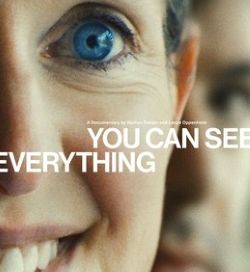
Where the film’s probing is at its most sublime is when the camera looks unblinkingly at her face, in tight, lingering close-ups. Holmes’ face is a gift for cinema — big, blue eyes; arched eyebrows; thin, subtly asymmetrical lips — but it’s also about the deliberate stylistic choices Oppenheim and Fielder make: bathing her face in natural light that lends it an ethereal glow, so that she looks like a cherub, even as she appears to be lying through her teeth, smiling like she isn’t human.
It’s unsettling and a little… freaky. Does that humanise her or make her seem like more of the monster she’s made out to be? Either way, the close-ups (one of cinema’s superpowers) are hypnotic; they are the film’s money shots, a kind of spectacle that tells us everything about her but also nothing, leaving room for the kind of ambiguity that’s often essential for great art.
When fiction meets non-fiction
It’s not as though the film isn’t interested in hard facts, and that it only has aspirations to be arty. In its camerawork as much as its sound design, the film is immersive from the get-go, drawing the audience into the domestic space, where viewers are going to spend much of the film. And it’s more messy than pretty, its disorder speaking as much to the circumstances as to Elizabeth’s complex relationship with Billy, a key player with secrets viewers will find out only later. Sometimes, You Can See Everything has the energy of an addictive true-crime show, and it uses some of its tools, but never once does it feel like the viewers are being manipulated by the storytelling.
Instead, the audience gets the feeling that they are as lost as Fielder, trying to make sense of this mystery. Often, it feels like a gothic chamber piece set in a modern apartment — with an eerie, atonal horror-film-like score — as though Fielder is a guest trapped in a house with a weird couple as hosts, with their cultish belief in a seemingly impossible technology.
Fielder and the rest filmed Holmes and co. for some thirty-odd days before she went to prison, a point that is reached halfway into the film, making the audience wonder what the rest of it is going to be about. This is when the film introduces its masterstroke, taking its formal playfulness to a whole other level. Fielder approaches Amanda Seyfried, who played Holmes in the miniseries, and she becomes an active participant thereon. Seyfried develops sympathy towards Holmes, and she and Fielder begin to dig in, teaming up like detectives, out on the great American open road, trying to uncover a mystery. Their prime suspect? Billy.
Also read: IFFI 2026: Nepali film ‘Elephants in the Fog’ uses jungle metaphor to tell a story of alienation
What happens over the course of the last hour of the film is even more fascinating than what precedes it. Fielder no longer has access to Holmes, and whatever little opportunity there is to meet her in prison and film it, is made difficult by Billy. But the possibilities of non-fiction cinema are limitless, and when it hits a roadblock, You Can See Everything resorts to one of the most hackneyed devices of the documentary and turns it into something of a meditation on the nature of truth, subjectivity and perception. Fielder reconstructs scenes of his meeting with Holmes in prison with Seyfried (who also expresses a desire to play her again), thus giving the film’s interplay of non-fiction and fiction a dramatic denouement.
Holmes believes that Seyfried’s portrayal of her in that TV show ruined her life; and it’s only appropriate that she plays Holmes in the scenes when she says those very lines. And Fielder? He plays himself, all over again, trying to figure out if he’s remembering correctly. ‘I’m just trying to be accurate,’ he says. It’s the kind of self-reflexive, boundary-pushing endeavour that allows You Can See Everything to turn the camera on itself, as it tries to peel the layers off this complex thing called truth.