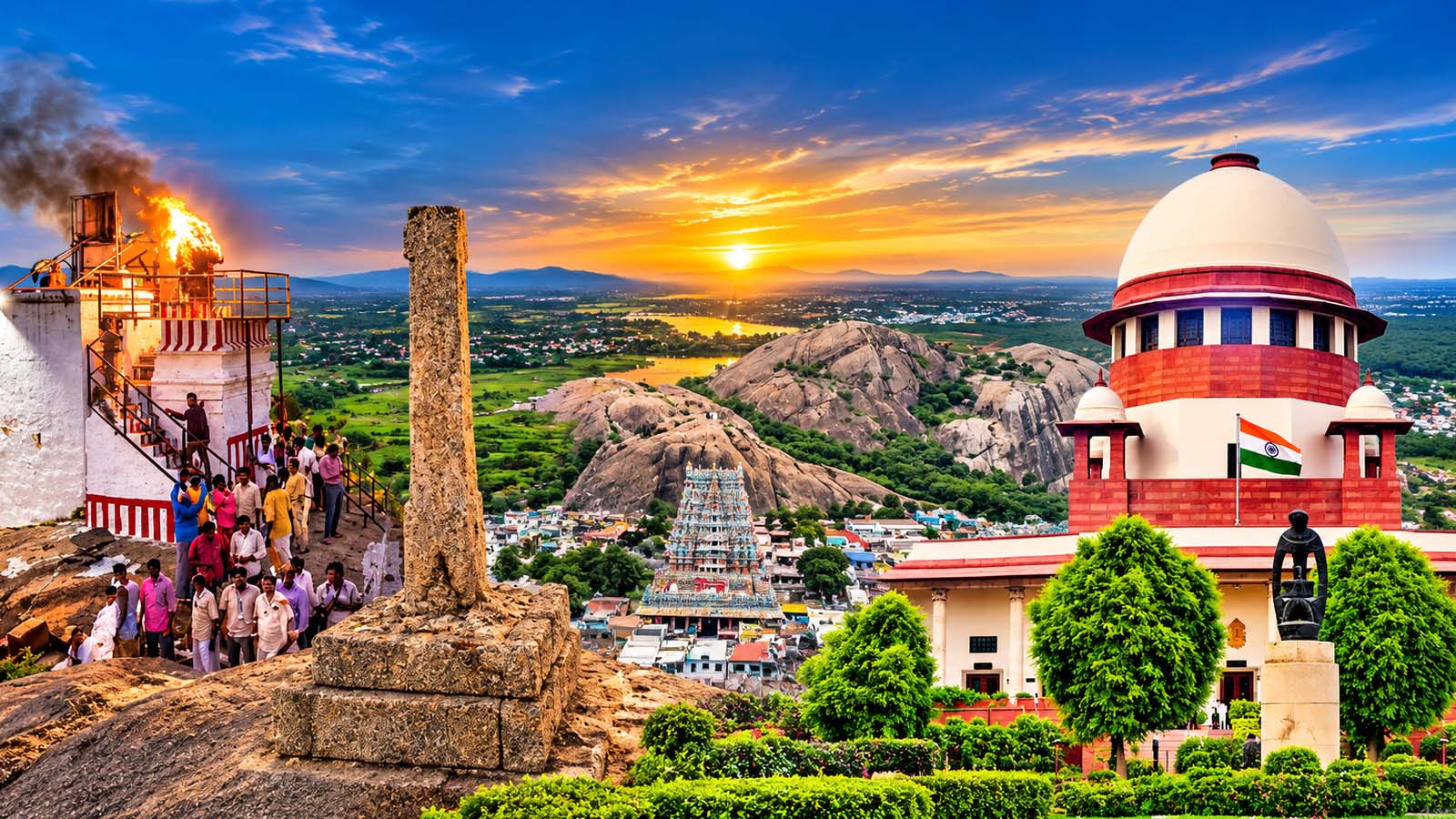
The Supreme Court on Friday (November 27) issued a series of directions in the Thiruparankundram Deepathoon dispute, ordering that the ceremonial Karthigai Deepam lamp be lit at the disputed stone pillar on Saturday, November 28.
Read the full Supreme Court report on Thiruparankundram
A Bench of Justices Aravind Kumar and Vipul Pancholi took serious exception to the failure of Tamil Nadu authorities and the temple administration to implement its November 20 order, which had permitted the lighting of the lamp at the Deepathoon as a one-time measure.
The earlier order had allowed a small team authorised by the temple administration to light the lamp and placed the Madurai District Collector in charge of supervising the arrangements. However, on November 24, the lamp was lit at the customary Uchipillaiyar Mandapam and not at the disputed Deepathoon.
The temple’s Board of Trustees had subsequently passed a resolution stating that the lamp could not be lit at the Deepathoon, citing established temple traditions. The District Collector relied on this resolution while explaining why the November 20 direction had not been implemented.
Following contempt petitions alleging wilful disobedience of its earlier order, the Supreme Court on Friday issued fresh directions, suspended the temple’s Board of Trustees, appointed two retired Madras High Court judges as receivers and issued show-cause notices to senior government officials.
The Bench also made several significant observations on the authority of judicial orders, the responsibilities of government officials and the constitutional obligation to uphold the rule of law.
Here are 10 key points the Supreme Court made and directed in its November 27 order.
1. The lamp must be lit at the Deepathoon on November 28
The Supreme Court directed that the ceremonial lamp be lit at the Deepathoon on Saturday, November 28. It said the flame from the lamp lit at the Uchipillaiyar Mandapam should be used, provided it was still burning. Alternatively, arrangements could be made to light the lamp through other means.
This matters because the November 20 order permitted lighting only as a one-time measure. The November 27 direction now fixes November 28 as the date for implementing that order.
2. Every devotee can participate in lighting the lamp
The November 20 order had permitted only a small team authorised by the temple administration to light the lamp. The Supreme Court has now expanded this permission, allowing every devotee to participate in lighting lamps at the Deepathoon. However, this permission comes with an important geographical restriction.
3. A 50-metre buffer must be maintained around the Dargah
The Court has specifically directed that the lighting of lamps must be lit at least 50 metres away from the Dargah. This is an important safeguard given the disputed pillar’s proximity to the Muslim place of worship and concerns about possible interference with its religious activities.
The direction also needs to be read alongside the Court’s assurance that its earlier safeguards for protecting the Dargah would continue.
4. CRPF security for both temple and dargah
The Supreme Court directed the Central Reserve Police Force (CRPF) to provide security to both the temple and the Dargah. Importantly, the force has also been tasked with ensuring that Muslim devotees are not obstructed from accessing the Dargah or offering prayers there.
The direction is significant because the dispute has raised concerns about maintaining communal peace while implementing the Court’s order. The Court has made it clear that the lighting ceremony cannot come at the cost of the Dargah’s religious activities.
5. Temple Board of Trustees suspended
The Supreme Court suspended the existing Board of Trustees of the Arulmigu Subramaniaswamy Temple. The decision followed the trustees’ resolution stating that the lamp could not be lit at the Deepathoon in view of the temple’s established traditions. The Court took serious exception to the resolution, observing that it disclosed prima facie wilful and flagrant disobedience of its November 20 order.
Also read: Karthigai Deepam row: Priests’ contradictory statements add twist to controversy
It also described the resolution as an attempt to overreach the Court’s directions through a strained interpretation of the order. The Court further observed that the trustees had never appeared before it to contest the earlier order.
6. Two retired Madras High Court judges appointed as receivers
The Supreme Court appointed former Madras High Court judges Justice S Vaidyanathan and Justice V Parthiban as receivers to take charge of the temple’s administration. Their responsibility includes ensuring the implementation of the Supreme Court’s directions.
The appointment follows the suspension of the existing Board of Trustees and is intended to ensure that the November 28 lighting ceremony takes place in accordance with the Court’s directions.
7. Supreme Court vacates its earlier stay on the Madras High Court’s findings
This is an important legal development in the case. In its November 20 order, the Supreme Court had stayed the Madras High Court’s findings concerning the nature of the Deepathoon and the land on which it stands.
Also read: Thirupparankundram hill is shared heritage, says archaeologist C Santhalingam
On November 27, the Supreme Court vacated that stay, citing the non-compliance with its earlier directions. However, it clarified that the safeguards imposed in its previous order to protect the Dargah would continue to operate.
8. Contempt notices issued to senior Tamil Nadu officials and temple authorities
The Supreme Court issued show-cause notices to several senior government officials and temple functionaries, asking them to explain why contempt proceedings should not be initiated against them. Those who received notices include Tamil Nadu Chief Secretary M Sai Kumar, DGP Mahesh Agarwala, HR&CE Secretary V Rajaram, HR&CE Commissioner T G Vinay, Madurai District Collector Nishant Krishna and Madurai Superintendent of Police L Devanathan.
Also read: Thirupparankundram: Why an unlit lamp does not prove contempt
The notices also extend to other HR&CE officials and members of the temple administration, including the suspended trustees.
9. Chief Secretary directed to submit a comprehensive affidavit
The Supreme Court directed the Tamil Nadu Chief Secretary to submit a detailed affidavit explaining the sequence of events surrounding the failure to implement the November 20 order. The affidavit must include communications exchanged between officials, including emails, telephone calls and messages concerning the proposed lighting ceremony.
The Court wants to understand how decisions were taken and how the administration dealt with its earlier directions. The Bench expressed concern over the possibility of executive authorities acting under external influence. It said the sequence of events needed to be unearthed.
10. Officials directed to appear personally before the Supreme Court on December 15
The Supreme Court directed the officials and temple authorities who received contempt notices to remain personally present before it on December 15. The Chief Secretary has also been specifically directed to appear in person. The next hearing will therefore be significant, as the Court will consider the explanations furnished by the officials and examine whether the failure to implement its November 20 order amounts to contempt.
The constitutional message behind the order
Beyond the immediate dispute, the Supreme Court’s November 27 order contains strong observations on the binding nature of judicial directions. The Bench invoked Article 144 of the Constitution, which requires all civil and judicial authorities in India to act in aid of the Supreme Court. It observed that an order of the Supreme Court is not an invitation to negotiate and binds the State, its officers and statutory or religious institutions functioning under state law until the Court itself modifies it.
The Bench also expressed concern over what it described as administrative chaos, at least in Madurai district. “Time has come to deal with such situations with an iron hand, otherwise, it will lead to Constitutional chaos,” the Court observed.