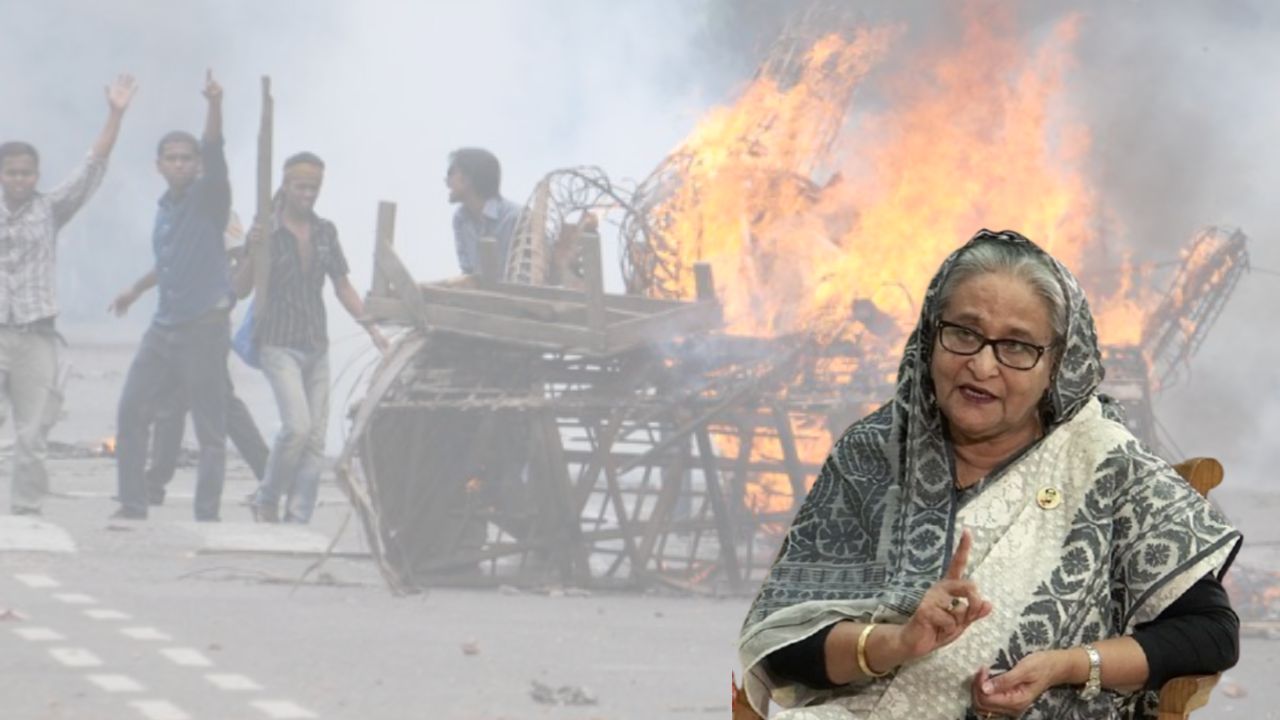
Former Prime Minister of Bangladesh Sheikh Hasina is going to return to her country on 16 December 2026. She has been living in India since losing power and leaving the country following the student movement in August 2024. Her spokesperson Syed Mozammel Ali said on November 24 that Hasina wants to return home on the occasion of Bangladesh's Victory Day. For this, he has demanded from the government of current Prime Minister Tariq Rahman to provide flights of national aviation company Biman Bangladesh Airlines.
However, even before the possible return of Sheikh Hasina, tension has increased in her native district Gopalganj. After the rejection of passport demand and arrest of Awami League leaders and workers, incidents of violence, vandalism and arson have taken place in the area. In view of the situation, the government has deployed a large number of security forces. The Awami League's proposed 48-hour nationwide lockdown from November 29 has deepened the political crisis in Bangladesh.
Why did violence erupt in Gopalganj?
Gopalganj district of Bangladesh is considered to be the strongest political stronghold of Sheikh Hasina and her family. Awami League has had influence here for a long time. Sheikh Hasina's legal team had applied for a new passport to return to Bangladesh on 9 November 2026. However, the government of Prime Minister Tariq Rahman did not accept this demand. This decision of the government increased the anger among the supporters of Awami League. In protest against this, party supporters started protesting in Gopalganj on 15 November. The protesters had sticks and weapons in their hands. Within no time the protests turned violent and vandalism and arson started in the area.
Incidents of violence continued in Gopalganj even after 15 November. On November 17, police arrested several local Awami League leaders and workers in Tungipara, Sheikh Hasina's native village. After this action the anger of the supporters increased further. The angry mob targeted Tungipara police station. The protesters attacked the police station, set it on fire and freed their arrested comrades.
How is the security system in Gopalganj?
In view of the incidents of violence and arson, the Bangladesh government has tightened security arrangements in Gopalganj. 113 contingents of Border Guard Bangladesh (BGB) have been deployed across the country, out of which 56 platoons have been deployed in Gopalganj alone. Apart from this, about 2,000 policemen and Special Response Battalion (SRB) personnel have also been deployed in the area. Security forces are keeping an eye on sensitive areas with the help of drones and body-worn cameras.
At present there is tension in Gopalganj and many other parts of Bangladesh. After the deployment of security forces in large numbers, direct clashes in the area have been controlled to some extent, but the lives of common people have been affected. Life has not returned to normal in many areas.
What is the relation of Sheikh Hasina's family with Gopalganj?
Tungipara village of Gopalganj district is very special for Sheikh Hasina's family. Many generations of his family have lived in this village. Sheikh Mujibur Rahman, the founder of Bangladesh and father of Sheikh Hasina, was born in Tungipara on 17 March 1920. Sheikh Hasina was also born in this village on 28 September 1947. Sheikh Mujibur Rahman was assassinated in Dhaka on 15 August 1975. After this he was buried in his native village Tungipara. His mausoleum has been built here.
Gopalganj has also played an important role in Sheikh Hasina's politics. He won the election from Gopalganj-3 parliamentary seat eight consecutive times between 1986 and 2024. During this period he continued to strengthen his political influence. Due to the strong hold of Sheikh Hasina and her family in this area, Awami League has always got huge support from here.