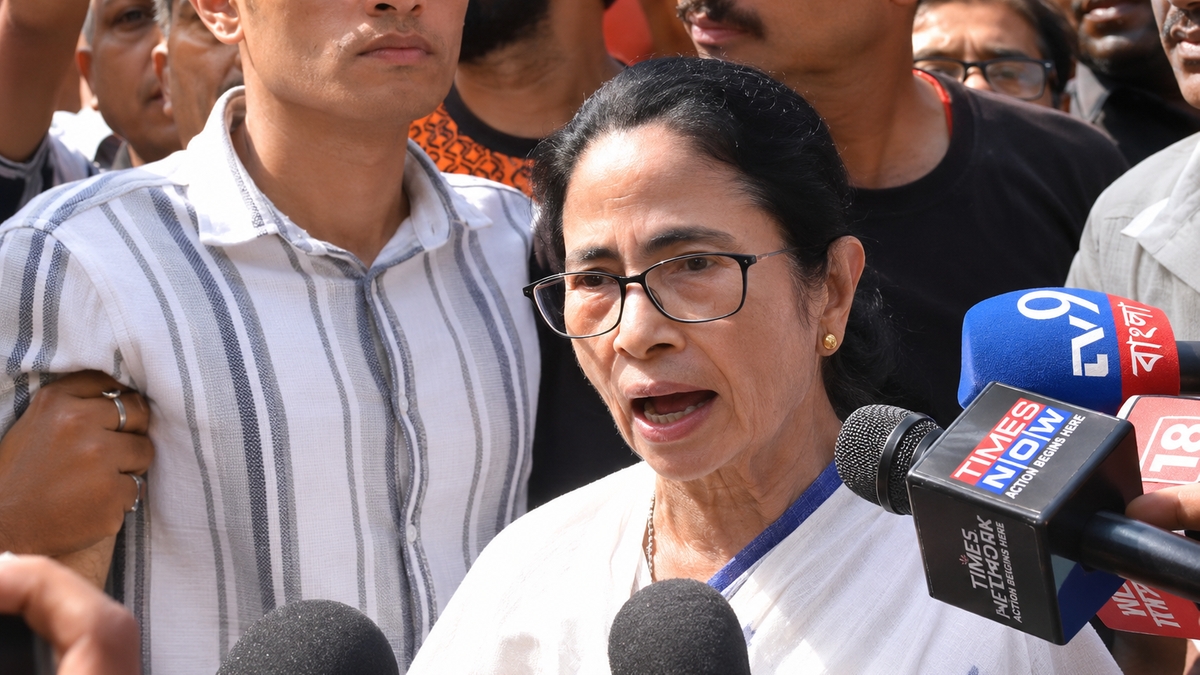
West Bengal Former Chief Minister Mamata Banerjee has called the Centre’s proposed Delimitation Bill a “bad bill”, questioning its 2051 timeline and asking, “Nobody can say up to 2051 whether they will even survive till that time.” Her remarks come ahead of Parliament’s special sitting on November 30, where the proposed delimitation and women’s reservation measures are expected to face a crucial political and constitutional test.
Kolkata: Former West Bengal Chief Minister and TMC chief Mamata Banerjee has criticized the Centre’s proposed Delimitation Bill, calling it a “bad bill” and questioning why decisions should be tied to a timeline extending to 2051. Her remarks come ahead of Parliament’s scheduled special sitting from November 30, as political parties reassess their positions and the government works to secure the numbers needed for the proposed constitutional changes.
“Nobody can say up to 2051 whether they will even survive until that time,” she said, challenging the long-term timeline being discussed in connection with the proposed legislation.
The Trinamool Congress (TMC) leader also defended her party’s record on women’s representation, claiming that her side had fought strongly for Nari Shakti. She referred to an incident in Parliament during her tenure as a Lok Sabha MP and urged people to look at footage of what she described as an assault on her and her colleagues inside the House.
“The Women’s Reservation Bill was already passed,” Banerjee said, arguing that the issue of women’s representation had already received parliamentary approval.
Her comments come amid renewed political debate over the Centre’s plan to link the implementation of women’s reservation with an expansion and readjustment of legislative seats.
Parliament session puts Delimitation Bill back in focus
The Lok Sabha is scheduled to reconvene on Monday, November 30, while the Rajya Sabha is expected to meet from December 2. The sittings are scheduled to continue until December 3.
The government has not publicly specified the complete legislative agenda for the sittings. However, the proposed delimitation and women’s reservation measures are at the center of political discussions ahead of the session.
The revised legislative framework includes a proposed 50% increase in the number of seats in the Lok Sabha and state and Union Territory assemblies, alongside provisions intended to facilitate the implementation of women’s reservation. The revised proposal also provides for the constitution of a Delimitation Commission.
The government faces the challenge of securing the constitutionally required majority in both Houses. The political arithmetic has become more complicated because some regional parties have indicated support for the revised proposal, even as several Opposition parties remain opposed to the Centre’s approach.
Floor arithmetic: Why the two-thirds figure matters
A constitutional amendment under Article 368 requires two separate conditions in each House of Parliament: support from a majority of the House’s total membership and votes in favor from at least two-thirds of members present and voting.
The distinction is important because the two-thirds threshold can change depending on attendance and the number of members who actually vote.
Recent reports put the number of Lok Sabha members eligible to vote at 538, excluding the Speaker, if the current suspension and vacancy position remains unchanged. If all 538 members vote, the two-thirds requirement would be 359 votes. The separate requirement of a majority of the House’s total membership would also have to be met.
The revised proposal has received support signals from parties including the DMK and the NCP (Sharadchandra Pawar), potentially improving the government’s position. However, these indications do not amount to a confirmed final vote count. Attendance, abstentions, party whips and the positions taken by other parties could influence the outcome.
Why the Delimitation Bill is politically contentious
Delimitation determines the boundaries of electoral constituencies and the allocation of seats among states. Any major change can affect the political representation of states in Parliament, making the exercise particularly sensitive for states that have raised concerns about population-based redistribution.
The Centre’s revised proposal seeks to address some of these concerns through a uniform 50% increase in seats. However, Opposition parties have questioned the decision to link women’s reservation with delimitation rather than implementing the quota within the existing strength of legislatures.
Banerjee’s criticism adds to the political contest over the proposed framework. Her reference to 2051 places the long-term implications of the legislation at the center of the debate, while her remarks on Nari Shakti seek to challenge the political narrative around which party has done more for women’s representation.
The immediate test will be whether the government can secure the required numbers when Parliament takes up the proposed measures. The final outcome will depend not only on declared party positions but also on the constitutional voting requirements and the attendance of members.