The ministry has included related funding in its budget request for fiscal 2027, and the test would serve applicants for the Specified Skilled Worker residence status, which requires foreign workers to prove their Japanese ability, government officials said Wednesday, Jiji Press reported.
For Type 1 of the status, the government currently offers two tests run by bodies including the Japan Foundation: the Japanese-Language Proficiency Test (JLPT) and the Japan Foundation Test for Basic Japanese (JFT-Basic).
The JLPT is held in principle in July and December on paper bubble sheets, while the JFT-Basic is computer-based and held monthly in principle.
Applications for the JLPT have risen since 2023 as the Covid-19 pandemic subsided. About 533,000 people applied to sit December’s test in Japan, a record that far exceeds the previous high of about 447,000, Kyodo News reported, citing government sources.
Applications for the December test closed in September after all slots were filled, and more foreigners are also believed to be taking the JLPT to qualify for residence statuses other than Specified Skilled Worker, Jiji said.
|
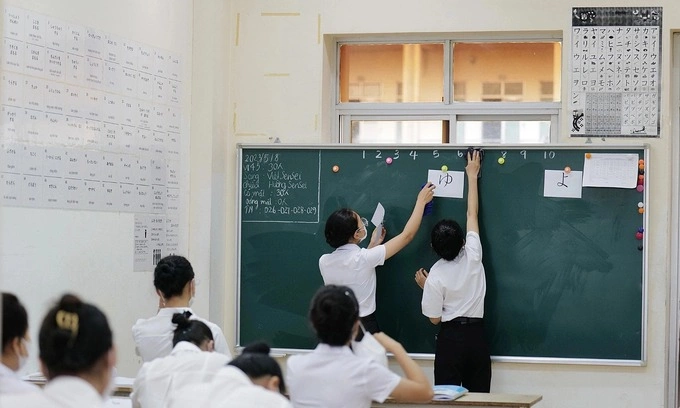
Trainees attend a Japanese-language class in Hanoi before leaving to work in Japan, May 2023. Photo by Read/Ngoc Thanh |
Under revised ministerial ordinances based on Japan’s immigration law, foreign workers newly entering the country with Type 2 Specified Skilled Worker status will need Japanese ability at or above the B1 level of the Common European Framework of Reference for Languages, an international standard, from April 2027. B1 broadly means being able to communicate on familiar topics.
The requirement covers applications for certificates of eligibility filed from April 1, 2027, according to the Immigration Services Agency, which said the timing for applications to change or extend status inside Japan is still under consideration. The same B1 standard will apply to Type 1 workers in bus and taxi driving and railway transport, replacing the current JLPT N3 requirement.
Because the JFT-Basic has no level that measures B1, demand for the JLPT is expected to climb further.
The Foreign Ministry has concluded that a new test at B1 or above is needed, Jiji said. The leading option is to add a new level to the JFT-Basic, and the ministry will also consider a computer-based version of the JLPT.
The Regulatory Reform Implementation Plan, approved by the Cabinet in July, noted that opportunities to take tests at the B1 level are limited and called on the ministry and other agencies to expand them.
Vietnamese are the largest nationality under the program. Nearly 177,000 held Specified Skilled Worker status at the end of June, about 40% of the 444,256 total, according to preliminary Immigration Services Agency figures.