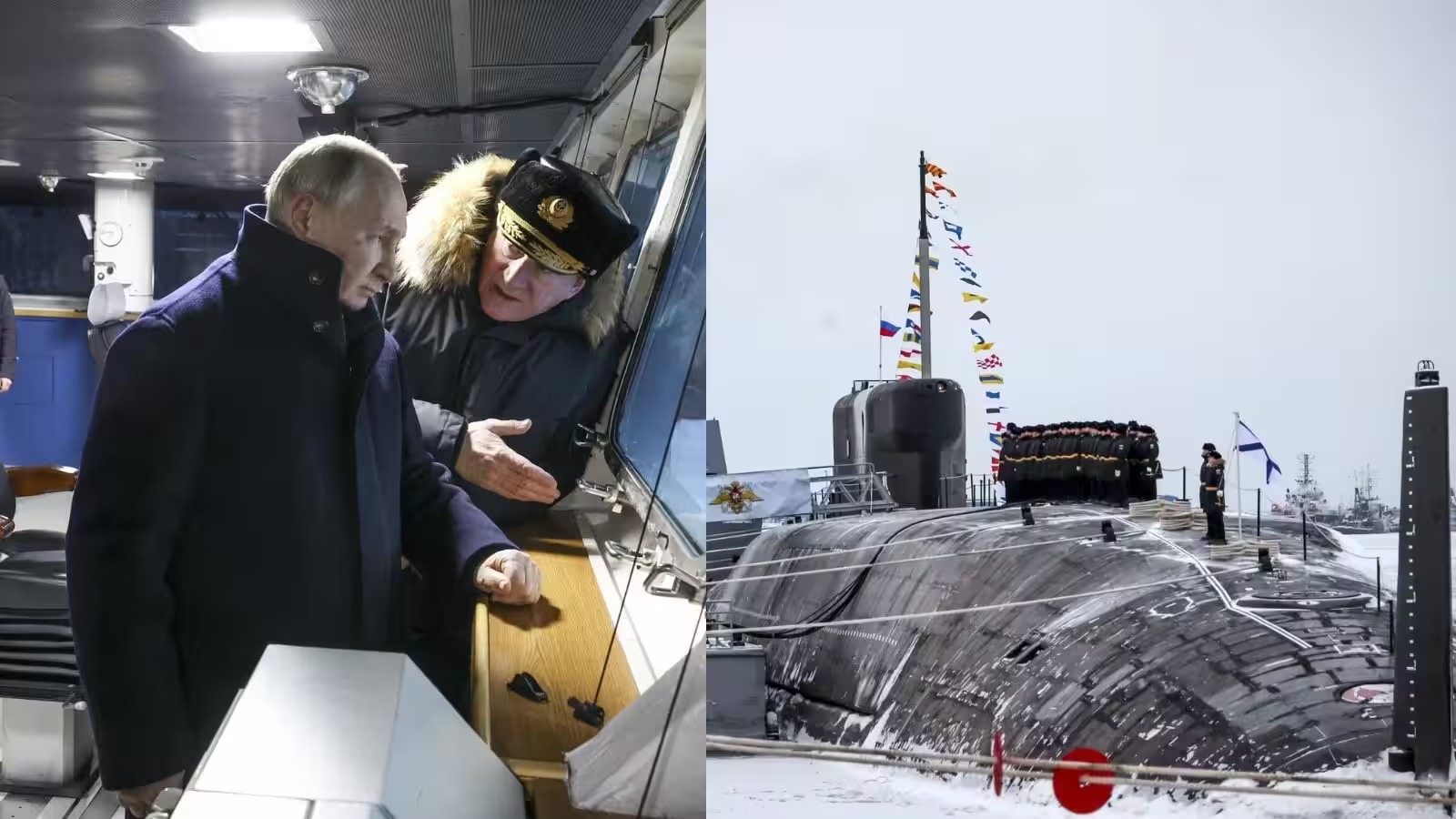
Giving a new edge to its naval power, Russia has formally inducted the Yasen-M (Project 885M) class new nuclear-powered attack submarine 'Perm' into the navy. President Vladimir Putin himself was present at the flag hoisting ceremony held in Severodvinsk, northern Russia, on 27 November 2026. Moscow claims that it is the first nuclear submarine to be equipped with Zircon (3M22 Zircon) hypersonic cruise missiles. Defense analysts are considering the combination of missiles with hypersonic speed and the ability to attack stealthily from the depths of the sea as a major strategic step. Putin's message at the commissioning and ceremony of the 'Perm' submarine During the ceremony held at the Sevmash Shipyard in Severodvinsk, President Putin said that very few countries in the world are capable of building such powerful nuclear submarines that have global reach and strategic importance. He stressed that these submarines can conduct operations in any part of the world's oceans and can carry a variety of cruise missiles. According to Putin, Russia will complete its naval modernization plan on schedule and by the year 2030, five more new nuclear submarines will be added to the fleet, which will include three Yasen-M class submarines. The submarine was laid down at the Sevmash Shipyard in 2016 and was launched in March 2025. After sea trials began in August 2025, it was handed over to the Navy in November 2026 after completing a long investigation and trial process. It is the second Russian submarine to be named after the city of Perm; Prior to this, the Be-292 Perm of Project 671RTMK was in service from 2002 to 2005. Zircon Hypersonic Missile and Submarine Firepower The biggest discussion about this deployment is about the 3M22 Zircon hypersonic cruise missile. Hypersonic means a speed more than five times the speed of sound. According to various defense reports and Russian claims, the Zircon missile's operational range is said to be more than 1,000 kilometers (about 620 miles), while estimates vary as to its maximum speed. Russian claims place top speed at Mach 8 to Mach 9 or higher, while independent analysts consistently report the speed decreasing during flight and slowing as it approaches the target. Yasen-M class submarines are multi-role attack submarines, which can engage enemy ships and submarines as well as launch precision strikes against sea and land targets from vertical launch tubes. These submarines, with a displacement of approximately 14,000 tonnes, are counted among the most heavily armed submarines in the world. However, independent sources have not confirmed how many Zircon missiles are deployed on the Perm at the time of commissioning or what its actual range would be in combat conditions. Deploying the Pacific Fleet and Changing Maritime Equation According to reports, Perm (hull number K-572) is to be inducted into the Pacific Fleet of Russia. The Pacific Fleet remains active in the North Pacific and Sea of Okhotsk areas, where it also monitors strategic developments in the Western Pacific and around Japan. The addition of a long-range strike submarine is expected to strengthen Russia's maritime presence and deterrence capability in the Pacific region. This development has come to light at a time when Kremlin's rhetoric regarding maritime security and tension in waterways is also intensifying. Kremlin spokesman Dmitry Peskov said in recent days that Russia is surrounded by an extremely hostile environment and that its nuclear triad is a reliable guarantee of its security. Naval modernization is receiving special attention amid reports of attacks on cargo ship Sparta-II in the Gulf of Finland and corvette ship Mercury off the Libyan coast in the third week of November 2026. Replacement of Cold War-era submarines and the way forward The entry of new Yasen-M ships and Zircon missiles into Russia's naval strategy is part of a long-term process of replacing older Cold War-era submarine classes, such as the Oscar and Akula classes. Nuclear-powered submarines can remain underwater for long periods of time without surfacing, thereby maintaining a 'second-strike' capability in the event of a potential attack. This development is also interesting from a technical and strategic point of view for India, as the future hypersonic version of BrahMos (BrahMos-II), a joint venture between India and Russia, has often been discussed in the context of Zircon-like capabilities and technology. For the time being, the commencement of formal patrolling of the Perm submarine in the Pacific and the actual deployment of the Zircon missile will remain under the watch of international defense circles.