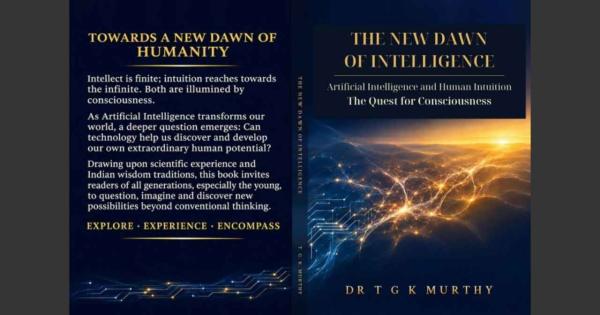
Artificial intelligence is growing at a phenomenal pace, with technological applications expanding across various fields, while simultaneously creating extraordinary concerns, fear and professional uncertainty about the future. Against this backdrop, former ISRO Distinguished Scientist Dr. TGK Murthy explores artificial intelligence, human intuition and the quest for consciousness in his new book, The New Dawn of Intelligence: Artificial Intelligence, Human Intuition and the Quest for Consciousness.
Rather than concentrating solely on what machines may achieve in the future, the book raises a fundamental question: Are human beings developing their own intelligence, intuition and judgment sufficiently to keep pace with technological advancement?
Drawing upon his extensive experience in space science, scientific discoveries and the philosophical teachings of Advaita Vedanta, Dr. Murthy explores the relationship between human creativity, artificial intelligence and the deeper understanding of consciousness.
Four Decades of Scientific Experience
Dr. Murthy served ISRO for 42 years, rising to the position of Distinguished Scientist and Program Director for Atmospheric Sciences. A Fellow of the Indian Academy of Sciences, he has received ten national awards for his contributions to India's space research programs.
His scientific career provides the foundation for several discussions in the book, particularly those concerning intuitive thinking, problem-solving and decision-making under uncertainty.
Among the experiences described are the development of a variable-angle spectrophotometer following an unexpected geometric insight at the Indian Institute of Science, weather assessments associated with the Chandrayaan-1 launch, and an innovative optical design developed for the Technology Experiment Satellite.
Through these examples, the author illustrates how intuition can contribute to scientific discoveries when supported by systematic analysis, experimentation and verification.
Exploring the Relationship Between AI and Human Intelligence
Organized into 18 chapters across six parts, the book examines scientific discovery, neuroscience, artificial intelligence, human consciousness and Indian philosophical thought.
Dr. Murthy presents intuition as an important component of human intelligence, explaining how knowledge, clearly defined problems, creative connections and verification contribute to innovation.
The book also discusses significant developments in artificial intelligence, including AI-assisted scientific discoveries, while examining the limitations of machine-generated information and the risks of excessive technological dependence.
One of its central messages is that artificial intelligence should complement human reasoning rather than replace independent thinking, creativity and critical judgment.
For students and young researchers, the author emphasizes the importance of attempting problems independently before relying on AI-generated solutions.
Science Meets Indian Philosophy
A distinctive aspect of The New Dawn of Intelligence is its exploration of the relationship between modern science and Indian spiritual philosophy.
Drawing on Advaita Vedanta and the teachings of Swami Vivekananda, Sri Aurobindo and Ramana Maharshi, the author distinguishes scientific intuition from philosophical inquiry into consciousness and the nature of the Self.
Importantly, the book does not present modern neuroscience or quantum physics as scientific proof of Advaita Vedanta. Instead, it examines these disciplines within their respective intellectual frameworks.
Traditional stories and philosophical illustrations, including accounts associated with Tenali Raman, Nasruddin and Zen teachings, are used to explain complex ideas in an accessible manner.
The book also includes ten concluding principles and a glossary to help readers understand its scientific and philosophical concepts.
Contributions to Science and Spiritual Literature
Apart from his distinguished scientific career, Dr. Murthy has made notable contributions to literature exploring the relationship between science and spirituality.
His earlier publications include Swami Vivekananda: An Intuitive Scientistpublished by Ramakrishna Math, Chennai, and Swami Vivekananda: Holistic Scientistpublished by Ramakrishna Seva Samithi, Bapatla.
According to the author's details, the two books have collectively sold approximately 50,000 copies, with the former undergoing multiple reprints.
Dr. Murthy has also contributed around 30 articles to publications including Bhavan's Journal, Prabuddha Bharata, Vedanta Kesari, Samvit and The Mountain Path.
His latest book carries a Message of Benediction from Swami Gautamananda, President of the Ramakrishna Math and Ramakrishna Mission, and a foreword by Swami Nityayogananda of Belur Math.
A Message for the Age of Artificial Intelligence
Through The New Dawn of IntelligenceDr. Murthy seeks to encourage a balanced understanding of technological progress and human intellectual development.
The book argues that scientific advancement cannot depend entirely on increasingly powerful machines. Human reasoning, intuitive insight, ethical judgment and self-awareness must also continue to evolve.
Addressing themes relevant to students, educators, scientists, engineers, administrators and readers interested in Indian philosophy, the publication offers an interdisciplinary perspective on the future relationship between human beings and artificial intelligence.
At a time when AI is rapidly redefining the boundaries of knowledge and discovery, Dr. Murthy's work highlights the continuing importance of nurturing the distinctly human capacities for creativity, reflection and independent thought.