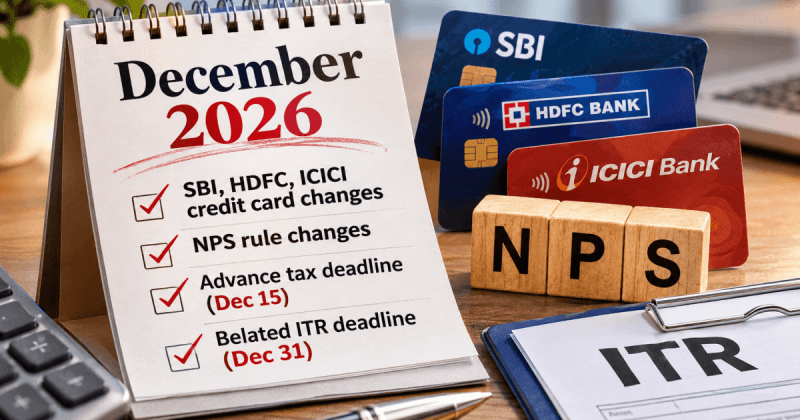
December 2026 will bring several important financial changes that could impact bank customers, credit cardholders, pension subscribers and taxpayers. State Bank of India (SBI), HDFC Bank and ICICI Bank are revising certain credit card charges, reward points and complimentary benefits. Meanwhile, changes to the National Pension System (NPS) framework will also come into effect from December 1.
Apart from banking and credit card changes, taxpayers have two important deadlines to remember in December. December 15 is the last date for paying the third instalment of advance tax, while December 31 is the deadline for filing belated income tax returns (ITR) for FY 2025-26.
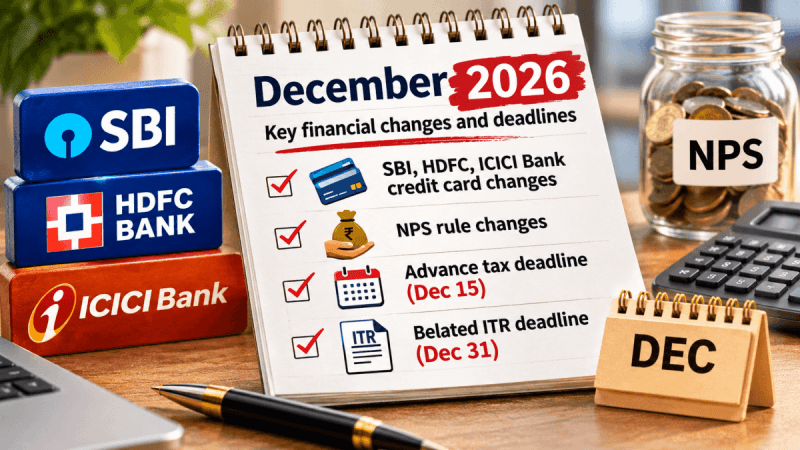
Here’s a look at the key financial changes and deadlines coming in December 2026.
1. SBI credit card charges to change from December 1
SBI Card customers will face revised charges on certain high-value transportation and fuel transactions from December 1, 2026.
Under the revised fee structure, a 1% fee will apply to transportation transactions exceeding Rs 30,000.
Similarly, if the combined value of fuel transactions made using an SBI credit card exceeds Rs 50,000 in a billing cycle, a 1% fee will be charged on the total fuel expenditure.
The changes will particularly impact customers who frequently use their SBI credit cards for high-value transportation and fuel payments.
2. HDFC Bank credit card changes from December 21
HDFC Bank is revising the reward structure and spending requirements for its BizBlack Metal credit cardholders from December 21, 2026.
Under the revised rules, cardholders will need to meet a minimum eligible retail spending requirement of Rs 50,000 per statement cycle to unlock accelerated reward points.
The bank has also reduced the quarterly spending milestone for vouchers from Rs 5 lakh to Rs 4 lakh.
Key changes include:
- 5X reward points on eligible business spends.
- Quarterly milestone vouchers on eligible spending of Rs 4 lakh.
- Reward points on income tax and GST payments.
Cardholders should check the revised conditions to understand how the changes will affect their spending and reward benefits.
3. ICICI Bank revises cash transaction charges from December 1
ICICI Bank savings account customers will continue to receive three free cash deposit transactions and three free cash withdrawal transactions every month.
However, charges will increase if customers cross the monthly complimentary transaction value limit of Rs 1 lakh each for deposits and withdrawals.
Under the revised structure, the applicable charge will increase from Rs 3.50 to Rs 4 per Rs 1,000 transaction, or Rs 150, whichever is higher.
Customers who frequently deposit or withdraw large amounts of cash should take note of the revised charges.
4. ICICI Bank credit card changes: Replacement fees and complimentary benefits
ICICI Bank is also making several changes to credit card charges and complimentary benefits during December.
Credit card replacement fee from December 11
The credit card replacement fee will increase from Rs 200 plus GST to Rs 300 plus GST from December 11, 2026. The bank will also introduce a replacement fee for Priority Pass credit cards from the same date.
INOX benefits discontinued from December 15
ICICI Bank will discontinue complimentary INOX benefits linked to select debit and credit cards from December 15, 2026.
The bank will also discontinue certain complimentary insurance benefits linked to select credit cards from the same date.
Customers holding affected cards should check the revised terms and conditions to understand which benefits will no longer be available.
5. NPS rule changes from December 1, 2026
The National Pension System (NPS) framework will see changes from December 1, 2026, following amendments by the Pension Fund Regulatory and Development Authority (PFRDA).
The changes relate to the classification and presentation of schemes under the Multiple Scheme Framework (MSF).
Under the revised framework, the regulator has clarified how MSF schemes, also known as pension fund schemes, should be named and displayed on websites and platforms used by subscribers to open NPS accounts.
The changes aim to bring greater clarity and consistency to the way these schemes are presented to investors.
6. December 15: Third advance tax instalment deadline
Income taxpayers who are required to pay advance tax have an important deadline on December 15, 2026.
This is the due date for paying the third instalment of advance tax for the financial year 2026-27. Eligible taxpayers must have paid at least 75% of their total estimated annual tax liability by this date.
Advance tax applies to taxpayers whose estimated tax liability for the financial year, after adjusting for TDS and other applicable credits, is Rs 10,000 or more.
Missing the applicable advance tax instalment deadline can result in interest under the Income Tax Act.
7. December 31: Last date to file belated ITR for FY 2025-26
Taxpayers who missed the original income tax return filing deadline for FY 2025-26 still have time to file a belated ITR.
December 31, 2026, is the last date to file a belated income tax return for the assessment year 2026-27, subject to applicable provisions.
However, filing a belated return can attract a late-filing fee under Section 234F of the Income Tax Act.
The late-filing fee is Rs 5,000, but it is restricted to Rs 1,000 for taxpayers whose total income does not exceed Rs 5 lakh.
With several banking changes, revised credit card charges and important tax deadlines coming into effect, customers and taxpayers should review the applicable rules and plan their finances accordingly.