
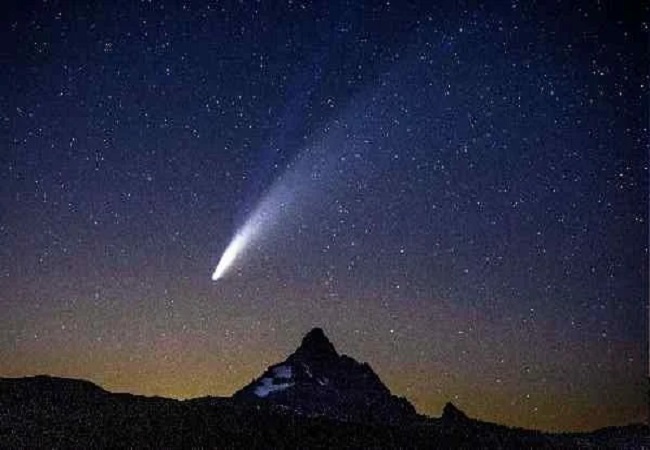

Rare Interstellar, C/2025 R3 Comet : Some amazing events happening in the sky are so extraordinary that we get a chance to see them only once in a lifetime. Now such a special and rare sight is going to be seen by all of us when a rare astronomical interstellar comet will be seen shining in the sky. This incident is not only special for astronomy lovers but this incident is also no less than magic for the common people. An extremely rare astronomical event is going to happen this year, in which an interstellar comet named C/2025 R3 (Pan-STARRS) is passing through our solar system. It was first discovered at Haleakalā by Pan-STARRS on 7 September 2025.
Read :- Multi-storey DMR hospital has come up on government land worth Rs. 259 crore, complaint reached CM Yogi, yet the administration is a mute spectator.
According to New York Times news, scientists say that this comet revolves around the Sun approximately once in 1,70,000 years. This means that it must have been last seen when the prehistoric period was going on on Earth. Therefore, its appearance at present is considered very special and rare.
According to experts, the best time to see this comet is between April 10 and April 20 because during this time it will gradually become brighter. It will be closest to the Sun (perihelion) on April 19 and will be brightest and closest to Earth on April 27, but will not be visible in the Northern Hemisphere at that time.
According to Nick James (an astrophysicist/astronomer, but he is also a professional astronomer as well as a space industry engineer), one has to get up in the morning about 1-2 hours before sunrise to see it. With this, look for clear sky in the east direction and go to a dark and open place away from the city lights. Currently this comet is present in the Pegasus constellation and is passing through the ‘Great Square of Pegasus’.
Identify comets like this
Read :- Canteen employee of Chinnaswamy Stadium was selling IPL tickets in black, Bengaluru Police arrested
To identify this comet, one will have to pay attention to its faint glow because as it comes closer to the Sun, its small tail will also become visible. To see it clearly, you can use a device like 10×50 binoculars, although it can also be seen with the naked eye.
Report: Sushil Kumar Sah
Comments are closed.