
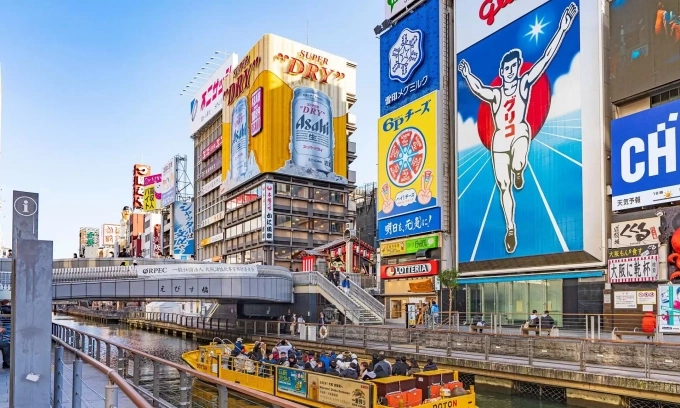

When people talk about Dotonbori District, it is hard not to refer to the Glico’s running man that stands above the Ebisubashi Bridge since it is one of Osaka’s most photographed landmarks.
According to the Japan National Tourism Organization, it is even considered Dotonbori’s unofficial mascot.
First unveiled in 1935, Glico’s running man has remained at the same spot ever since, even as other billboards around it were redesigned, relocated or removed over the decades.
The Glico’s running man sign as it appeared between 1950 and 1960. Photo by Koday Shafer |
The billboard was installed by a company called Ezaki Glico to promote its caramel products. The brand’s story dates back to the 1920s, when founder Riichi Ezaki created Glico candy using glycogen extracted from oysters as a nutritious snack for children.
He linked the product to the idea that one piece could fuel a 300-meter run, an image later expressed by a runner breaking the finish line with arms raised. The distance was chosen to match the caramel’s calorie content, according to Asahi Shimbun newspaper.
Over a century the Glico’s running man has never been replaced. It has undergone upgrades in technology, but not changes to its position along the Dotonbori canal on one of Osaka’s busiest streets.
The billboard has gone through six updates, mostly focused on improvements in materials and illumination, while the runner motif has been preserved across generations.
Early versions relied on neon lighting, but the current version, introduced in 2014, replaced the neon system with an LED screen capable of displaying backgrounds that change with the seasons, events or customized contents, according to Japan Today.
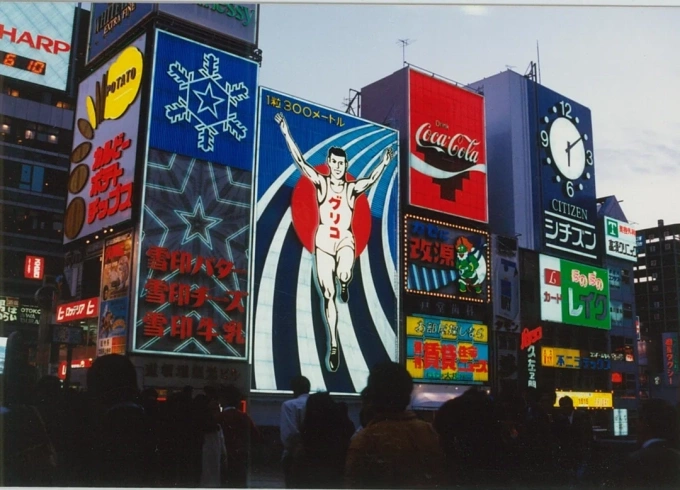 |
The Glico’s running man’s appearance between 1980 and 1990. Photo by Koday Shafer |
In 1943 the billboard was dismantled due to wartime metal shortages. After World War II, when many signs never returned, the Glico’s running man was reinstalled.
The billboard now gets global attention through social media platforms such as TikTok and Instagram. Visitors flock to the spot to recreate the runner’s pose with arms raised and one leg bent.
Reaching the spot is straightforward thanks to its central location in Minami District. The most convenient transport hub is Namba Station, which connects multiple subway and urban rail lines.
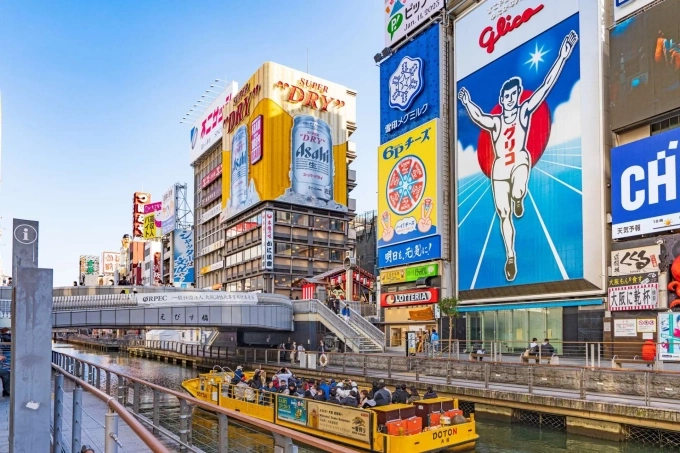 |
The Glico’s running man sign after a makeover with LED lights in 2014. Photo courtesy of gltjp |
From Shin-Osaka Station, a stop on the Shinkansen line, travelers can take the Midosuji Line toward Nakamozu and get off at Namba after about 15 minutes.
From Osaka or Umeda stations, also on the Midosuji Line, the journey takes about 10 minutes.
Those staying in the Shinsaibashi area can walk south along the Shinsaibashi-suji shopping street for 10 minutes to reach Ebisubashi Bridge.
At Namba Station, Exit 14 is the most convenient.
From there, walk north along the Dotonbori Canal, and Ebisubashi Bridge comes into view within three to five minutes, with the billboard on the left side of the bridge.
One can use transport cards such as ICOCA or Suica, or opt for day passes.
As Namba Station has numerous exits, using Google Maps with keywords like “Glico Sign” or “Ebisubashi Bridge” can help with navigation.
The billboard’s LED lights switch on about 30 minutes after sunset and remain illuminated until midnight, making the evening hours the most popular time for visits and photography.

Comments are closed.